Department of Gastroenterology, Southwest Hospital, Third Military Medical University, Chongqing, China.
Med Sci Monit. 2012 Jan;18(1):RA12-15. doi: 10.12659/msm.882192.
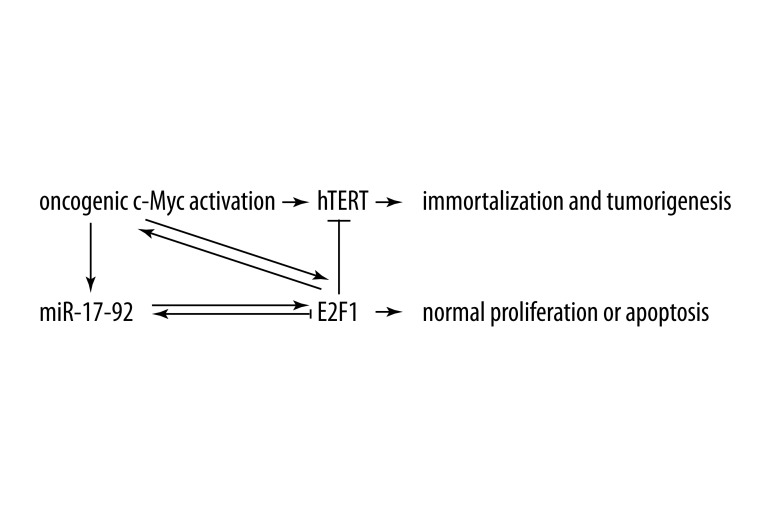
Previous studies have revealed that the link between c-Myc and E2F1 pathway plays a pivotal role in regulating cell growth and death. Human telomerase reverse transcriptase (hTERT), activation of which is required for cell immortalization and transformation, has been confirmed to be a direct transcriptional target of c-Myc. It is of note that E2F1, which is also a direct transcriptional target of c-Myc, can bind the hTERT promoter and repress its expression. Thus, although oncogene c-Myc can be activated in normal cells, for the subsequent induction of E2F1, it may still be insufficient to trigger the expression of hTERT. This negative feedback regulation, if it exists, may be another mechanism for normal cells to control the transmission of c-Myc-mediated oncogenic signals. In this article, we reviewed current knowledge about the crosstalk among c-Myc, E2F1 and hTERT, with an emphasis on the hypothesis that E2F1 negatively regulates c-Myc-induced hTERT transcription. Additionally, we postulated that the miR-17-92 cluster-mediated regulation of c-Myc and E2F1 expression may be of particular importance for the repression of hTERT transcription.
先前的研究表明,c-Myc 和 E2F1 通路之间的联系在调节细胞生长和死亡方面起着关键作用。人类端粒酶逆转录酶(hTERT)的激活对于细胞永生化和转化是必需的,已经被证实是 c-Myc 的直接转录靶标。值得注意的是,E2F1 也是 c-Myc 的直接转录靶标,它可以结合 hTERT 启动子并抑制其表达。因此,尽管正常细胞中可以激活癌基因 c-Myc,但对于随后诱导 E2F1,可能仍然不足以触发 hTERT 的表达。这种负反馈调节,如果存在的话,可能是正常细胞控制 c-Myc 介导的致癌信号传递的另一种机制。在本文中,我们综述了 c-Myc、E2F1 和 hTERT 之间相互作用的最新知识,重点介绍了 E2F1 负调节 c-Myc 诱导的 hTERT 转录的假说。此外,我们推测 miR-17-92 簇对 c-Myc 和 E2F1 表达的调节可能对 hTERT 转录的抑制特别重要。