Institute of Human Genetics, University Medical Center, Mainz, Germany.
Epigenetics. 2012 Jan 1;7(1):47-54. doi: 10.4161/epi.7.1.18814.
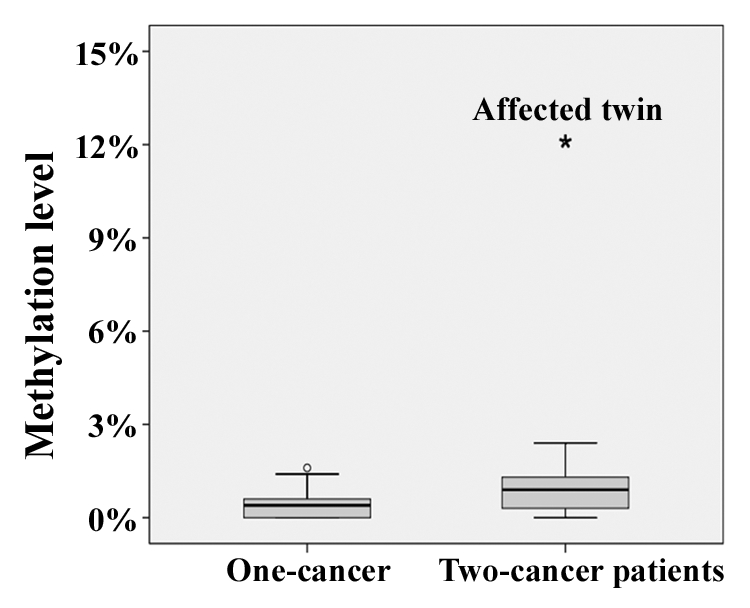
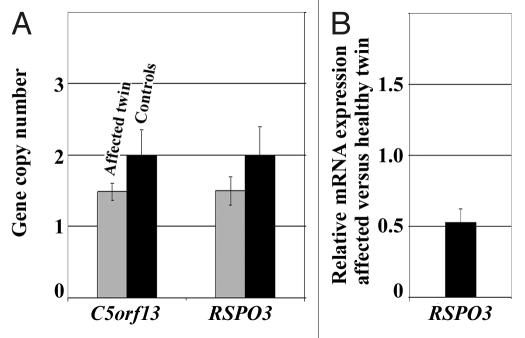
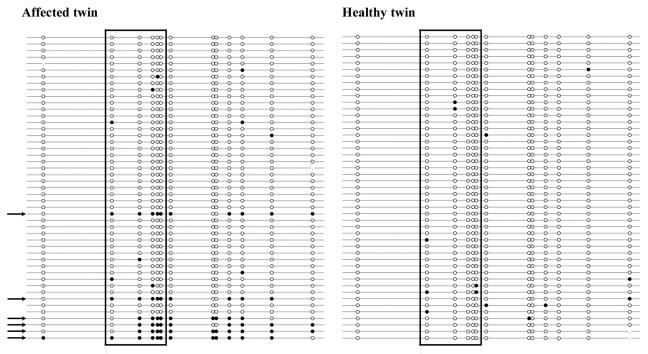
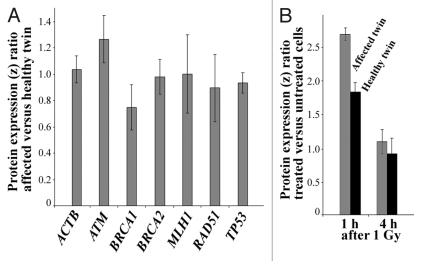
We describe monozygotic twins discordant for childhood leukemia and secondary thyroid carcinoma. We used bisulfite pyrosequencing to compare the constitutive promoter methylation of BRCA1 and several other tumor suppressor genes in primary fibroblasts. The affected twin displayed an increased BRCA1 methylation (12%), compared with her sister (3%). Subsequent bisulfite plasmid sequencing demonstrated that 13% (6 of 47) BRCA1 alleles were fully methylated in the affected twin, whereas her sister displayed only single CpG errors without functional implications. This between-twin methylation difference was also found in irradiated fibroblasts and untreated saliva cells. The BRCA1 epimutation may have originated by an early somatic event in the affected twin: approximately 25% of her body cells derived from different embryonic cell lineages carry one epigenetically inactivated BRCA1 allele. This epimutation was associated with reduced basal protein levels and a higher induction of BRCA1 after DNA damage. In addition, we performed a genome-wide microarray analysis of both sisters and found several copy number variations, i.e., heterozygous deletion and reduced expression of the RSPO3 gene in the affected twin. This monozygotic twin pair represents an impressive example of epigenetic somatic mosaicism, suggesting a role for constitutive epimutations, maybe along with de novo genetic alterations in recurrent tumor development.
我们描述了一对同卵双胞胎,她们在儿童期患有白血病,后来又患有甲状腺癌。我们使用亚硫酸氢盐焦磷酸测序来比较原发性成纤维细胞中 BRCA1 和其他几个肿瘤抑制基因的组成型启动子甲基化。患病的双胞胎显示 BRCA1 甲基化增加(12%),而她的妹妹则为 3%。随后的亚硫酸氢盐质粒测序表明,患病双胞胎的 13%(47 个中的 6 个)BRCA1 等位基因完全甲基化,而她的妹妹只有单个 CpG 错误,没有功能影响。这种双胞胎之间的甲基化差异也存在于辐照的成纤维细胞和未经处理的唾液细胞中。BRCA1 表观遗传突变可能是由患病双胞胎的早期体细胞事件引起的:她大约 25%的体细胞来自不同的胚胎细胞谱系,携带一个表观遗传失活的 BRCA1 等位基因。这种表观遗传突变与基础蛋白水平降低和 DNA 损伤后 BRCA1 的更高诱导有关。此外,我们对这对双胞胎姐妹进行了全基因组微阵列分析,发现患病双胞胎存在一些拷贝数变异,即 RSPO3 基因的杂合性缺失和表达减少。这对同卵双胞胎代表了一个令人印象深刻的表观遗传体细胞嵌合体的例子,提示组成型表观遗传突变可能与新的遗传改变一起在复发性肿瘤发展中起作用。