Department of Neurology, University of California at San Francisco, San Francisco, California 94143, USA.
Nature. 2010 Apr 29;464(7293):1351-6. doi: 10.1038/nature08990.
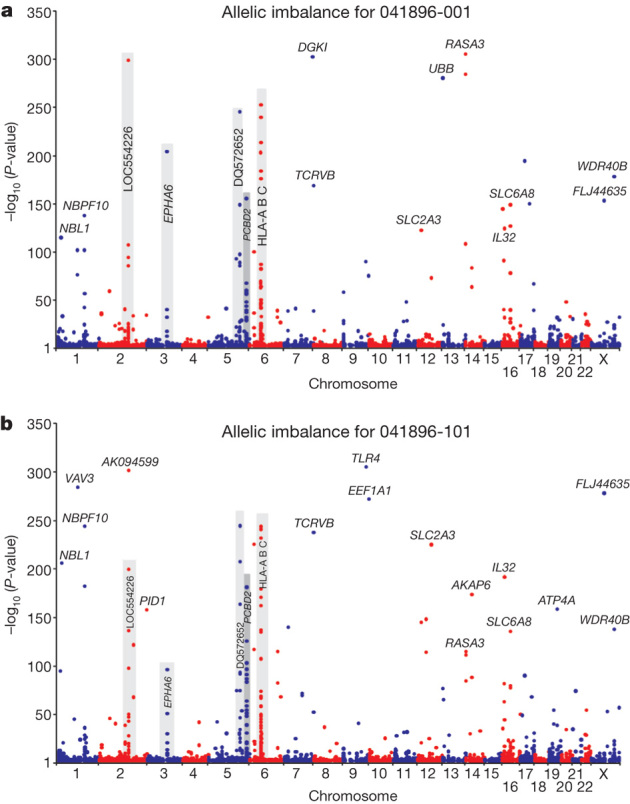
Monozygotic or 'identical' twins have been widely studied to dissect the relative contributions of genetics and environment in human diseases. In multiple sclerosis (MS), an autoimmune demyelinating disease and common cause of neurodegeneration and disability in young adults, disease discordance in monozygotic twins has been interpreted to indicate environmental importance in its pathogenesis. However, genetic and epigenetic differences between monozygotic twins have been described, challenging the accepted experimental model in disambiguating the effects of nature and nurture. Here we report the genome sequences of one MS-discordant monozygotic twin pair, and messenger RNA transcriptome and epigenome sequences of CD4(+) lymphocytes from three MS-discordant, monozygotic twin pairs. No reproducible differences were detected between co-twins among approximately 3.6 million single nucleotide polymorphisms (SNPs) or approximately 0.2 million insertion-deletion polymorphisms. Nor were any reproducible differences observed between siblings of the three twin pairs in HLA haplotypes, confirmed MS-susceptibility SNPs, copy number variations, mRNA and genomic SNP and insertion-deletion genotypes, or the expression of approximately 19,000 genes in CD4(+) T cells. Only 2 to 176 differences in the methylation of approximately 2 million CpG dinucleotides were detected between siblings of the three twin pairs, in contrast to approximately 800 methylation differences between T cells of unrelated individuals and several thousand differences between tissues or between normal and cancerous tissues. In the first systematic effort to estimate sequence variation among monozygotic co-twins, we did not find evidence for genetic, epigenetic or transcriptome differences that explained disease discordance. These are the first, to our knowledge, female, twin and autoimmune disease individual genome sequences reported.
同卵双胞胎(即“同卵双生”)被广泛用于剖析遗传学和环境因素在人类疾病中的相对作用。在多发性硬化症(MS)这种自身免疫性脱髓鞘疾病中,同卵双胞胎发病不一致被认为提示环境因素在其发病机制中的重要性。然而,同卵双胞胎之间的遗传和表观遗传差异已经被描述出来,这对用于区分先天和后天因素影响的公认实验模型提出了挑战。在此,我们报告了一对 MS 发病不一致的同卵双胞胎的基因组序列,以及三对 MS 发病不一致的同卵双胞胎 CD4+淋巴细胞的信使 RNA 转录组和表观基因组序列。在大约 360 万个单核苷酸多态性(SNP)或大约 200 万个插入缺失多态性中,未检测到同卵双胞胎之间可重复的差异。在三个双胞胎组的兄弟姐妹中,HLA 单倍型、经证实的 MS 易感 SNP、拷贝数变异、mRNA 和基因组 SNP 及插入缺失基因型,或 CD4+T 细胞中大约 19000 个基因的表达,也均未观察到可重复的差异。在三个双胞胎组的兄弟姐妹之间,大约 200 万个 CpG 二核苷酸中仅检测到 2 到 176 个甲基化差异,而在无关个体的 T 细胞之间有大约 800 个甲基化差异,在组织之间或正常组织与癌组织之间有几千个差异。这是首次系统估计同卵双胞胎之间序列变异的研究,我们没有发现可解释疾病不一致的遗传、表观遗传或转录组差异的证据。这些是我们所知的首次报告的女性、双胞胎和自身免疫性疾病个体的基因组序列。