Department of Pharmacology, University of California, Irvine, CA, United States.
Eur Neuropsychopharmacol. 2012 Aug;22(8):607-13. doi: 10.1016/j.euroneuro.2011.12.001. Epub 2011 Dec 29.
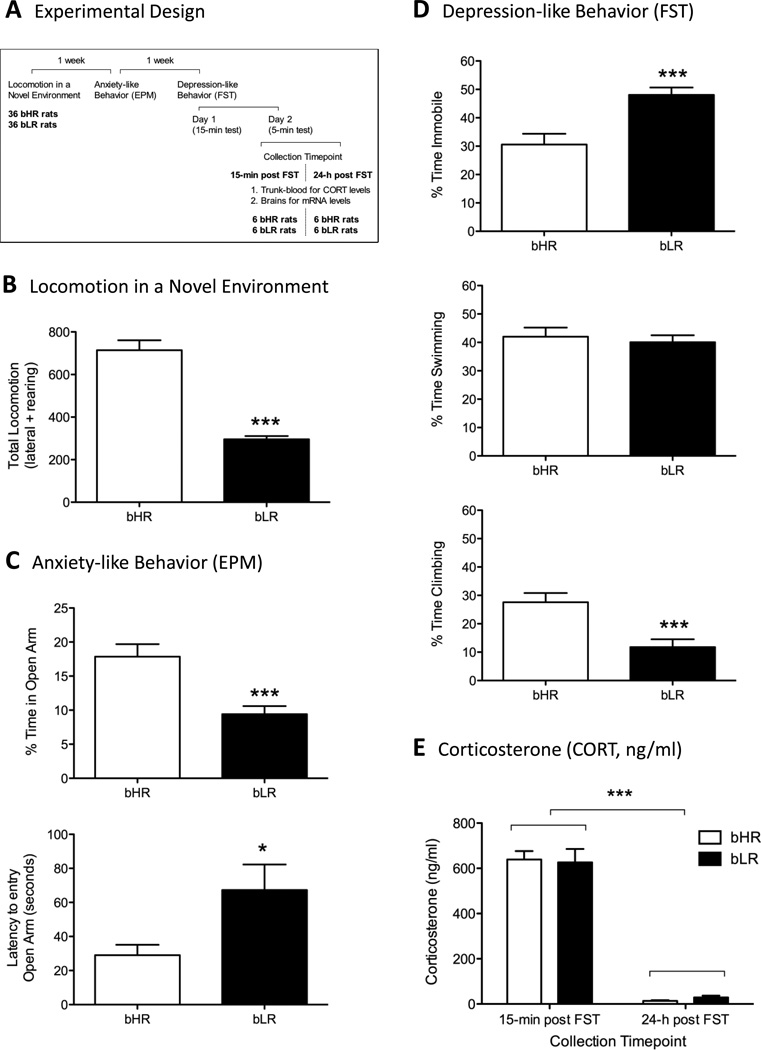
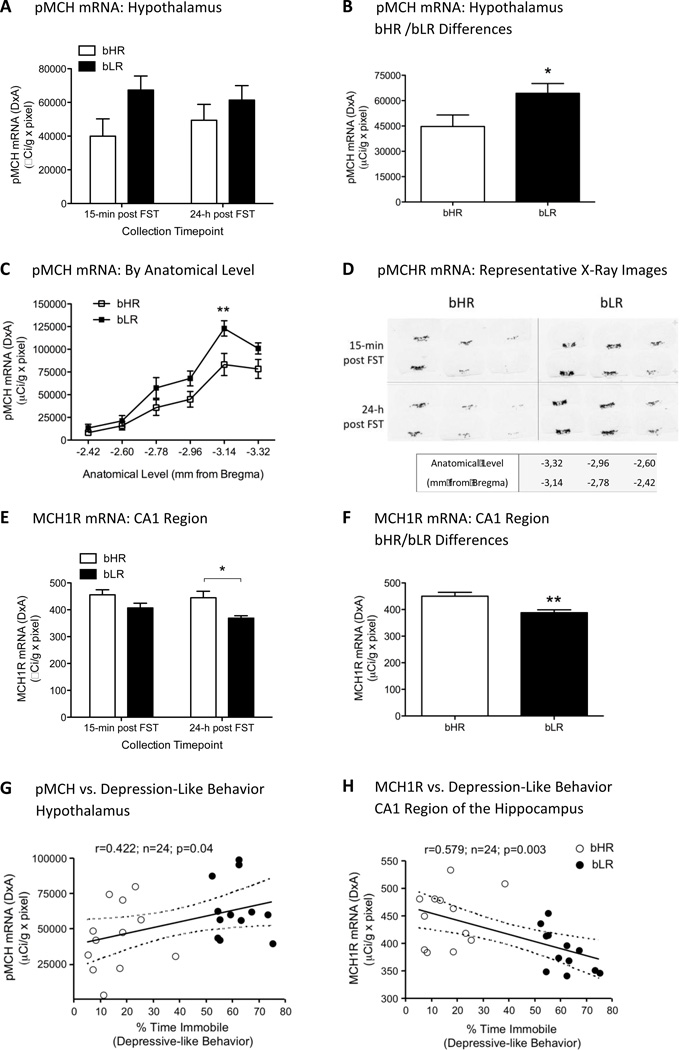
Selective breeding for divergence in locomotion in a novel environment (bHR, bred High-Responder; bLR, bred Low-Responder) correlates with stress-reactivity, spontaneous anxiety-like behaviors and predicts vulnerability in a rodent model of depression. Identifying genetic factors that may account for such vulnerability are key determinants not only for the illness outcome but also for the development of better-tailored treatment options. Melanin-concentrating hormone (MCH) is a neuropeptide that exhibits some of the hallmarks of a regulator of affective states. The aim of this study was to ascertain the role of the MCH system in depression-like behaviors in bHR vs. bLR rats. bLR rats showed a 44% increase in hypothalamic pMCH mRNA and a 14% decrease in hippocampal CA1 MCH1R mRNA when compared to bHR rats. Interestingly, the amount of time that rats spent immobile in the FST (depressive-like behavior) correlated positively with the amount of hypothalamic pMCH mRNA and negatively with that of hippocampal CA1 MCH1R. The results indicate that the bLR-bHR is a useful rat model to investigate individual basal genetic differences that participate in the monitoring of emotional responsiveness (i.e., depression- and anxiety-like behaviors). They also point to the MCH system (i.e., chronically higher pMCH expression and consequently receptor down-regulation) as a candidate biomarker for the severity of depressive-like behavior. The data indicate that MCH1R participates in the modulation of depression-like behavior through a process that involves the CA1 region of the hippocampus, supporting the possible use of MCH1R antagonists in the treatment of depression.
在新环境中对运动方式的差异进行选择性繁殖(bHR,高度反应 bred;bLR,低度反应 bred)与应激反应、自发性焦虑样行为相关,并可预测抑郁的啮齿动物模型中的易感性。确定可能导致这种易感性的遗传因素不仅是疾病结果的关键决定因素,也是开发更量身定制的治疗选择的关键决定因素。黑色素浓缩激素(MCH)是一种神经肽,表现出一些调节情感状态的特征。本研究的目的是确定 MCH 系统在 bHR 与 bLR 大鼠的抑郁样行为中的作用。与 bHR 大鼠相比,bLR 大鼠的下丘脑 pMCH mRNA 增加了 44%,海马 CA1 MCH1R mRNA 减少了 14%。有趣的是,大鼠在 FST 中不动的时间(抑郁样行为)与下丘脑 pMCH mRNA 的量呈正相关,与海马 CA1 MCH1R 的量呈负相关。结果表明,bLR-bHR 是一种有用的大鼠模型,可以研究参与情绪反应监测(即抑郁和焦虑样行为)的个体基础遗传差异。它们还指向 MCH 系统(即慢性更高的 pMCH 表达,进而导致受体下调)作为抑郁样行为严重程度的候选生物标志物。数据表明,MCH1R 通过涉及海马 CA1 区域的过程参与了抑郁样行为的调节,支持 MCH1R 拮抗剂在治疗抑郁症中的可能应用。