Rheumatology Unit, Royal Adelaide Hospital, Adelaide, Australia.
PLoS One. 2011;6(12):e29662. doi: 10.1371/journal.pone.0029662. Epub 2011 Dec 22.
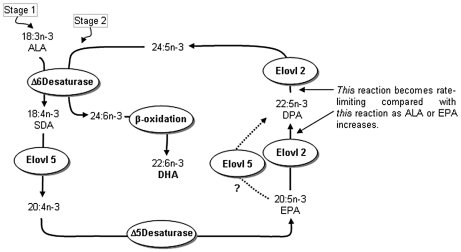
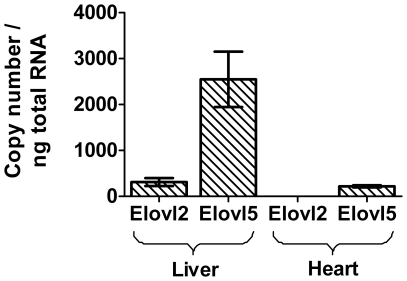
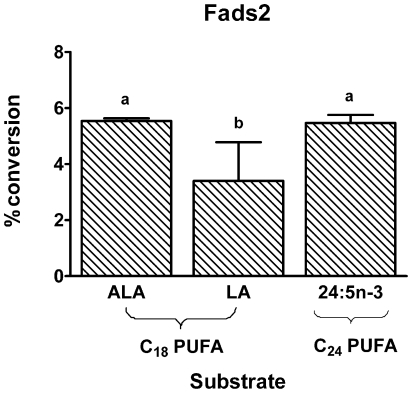
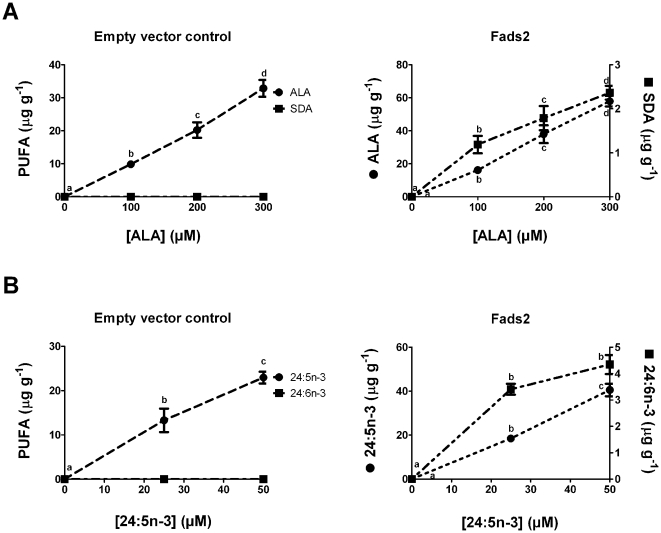
Δ6-Desaturase (Fads2) is widely regarded as rate-limiting in the conversion of dietary α-linolenic acid (18:3n-3; ALA) to the long-chain omega-3 polyunsaturated fatty acid docosahexaenoic acid (22:6n-3; DHA). However, increasing dietary ALA or the direct Fads2 product, stearidonic acid (18:4n-3; SDA), increases tissue levels of eicosapentaenoic acid (20:5n-3; EPA) and docosapentaenoic acid (22:5n-3; DPA), but not DHA. These observations suggest that one or more control points must exist beyond ALA metabolism by Fads2. One possible control point is a second reaction involving Fads2 itself, since this enzyme catalyses desaturation of 24:5n-3 to 24:6n-3, as well as ALA to SDA. However, metabolism of EPA and DPA both require elongation reactions. This study examined the activities of two elongase enzymes as well as the second reaction of Fads2 in order to concentrate on the metabolism of EPA to DHA.
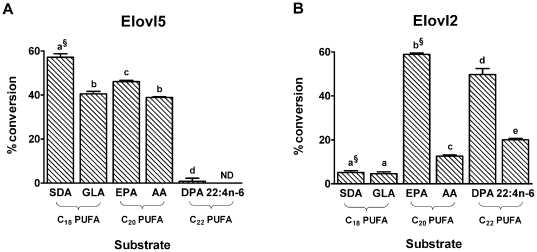
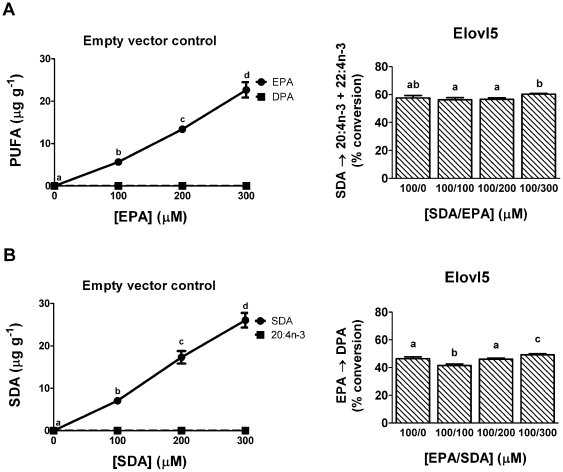
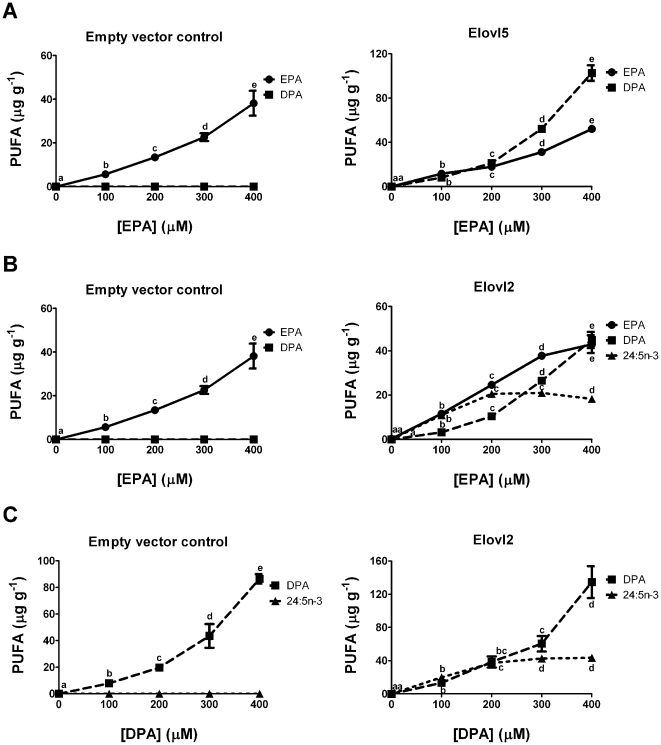
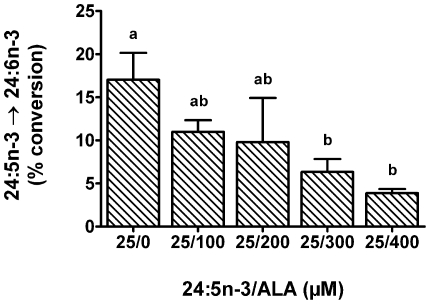
METHODOLOGY/PRINCIPAL FINDINGS: The substrate selectivities, competitive substrate interactions and dose response curves of the rat elongases, Elovl2 and Elovl5 were determined after expression of the enzymes in yeast. The competitive substrate interactions for rat Fads2 were also examined. Rat Elovl2 was active with C(20) and C(22) polyunsaturated fatty acids and this single enzyme catalysed the sequential elongation reactions of EPA→DPA→24:5n-3. The second reaction DPA→24:5n-3 appeared to be saturated at substrate concentrations not saturating for the first reaction EPA→DPA. ALA dose-dependently inhibited Fads2 conversion of 24:5n-3 to 24:6n-3.
The competition between ALA and 24:5n-3 for Fads2 may explain the decrease in DHA levels observed after certain intakes of dietary ALA have been exceeded. In addition, the apparent saturation of the second Elovl2 reaction, DPA→24:5n-3, provides further explanations for the accumulation of DPA when ALA, SDA or EPA is provided in the diet. This study suggests that Elovl2 will be critical in understanding if DHA synthesis can be increased by dietary means.
Δ6-脱饱和酶(Fads2)被广泛认为是将膳食中的α-亚麻酸(18:3n-3;ALA)转化为长链ω-3 多不饱和脂肪酸二十二碳六烯酸(22:6n-3;DHA)的限速酶。然而,增加膳食中的 ALA 或直接的 Fads2 产物,硬脂酸(18:4n-3;SDA),会增加组织中二十碳五烯酸(20:5n-3;EPA)和二十二碳五烯酸(22:5n-3;DPA)的水平,但不会增加 DHA。这些观察结果表明,在 Fads2 代谢 ALA 之后,必须存在一个或多个控制点。一个可能的控制点是涉及 Fads2 本身的第二个反应,因为该酶催化 24:5n-3 向 24:6n-3 以及 ALA 向 SDA 的去饱和反应。然而,EPA 和 DPA 的代谢都需要延伸反应。本研究检测了两种延伸酶的活性以及 Fads2 的第二个反应,以集中研究 EPA 向 DHA 的代谢。
方法/主要发现:在酵母中表达这些酶后,测定了大鼠延伸酶 Elovl2 和 Elovl5 的底物选择性、竞争性底物相互作用和剂量反应曲线。还研究了大鼠 Fads2 的竞争性底物相互作用。大鼠 Elovl2 对 C(20)和 C(22)多不饱和脂肪酸具有活性,这种单一酶催化 EPA→DPA→24:5n-3 的顺序延伸反应。第二个反应 DPA→24:5n-3 似乎在第一个反应 EPA→DPA 的底物浓度未达到饱和时就达到饱和。ALA 剂量依赖性地抑制 Fads2 将 24:5n-3 转化为 24:6n-3。
ALA 和 24:5n-3 对 Fads2 的竞争可能解释了某些膳食 ALA 摄入量超过后 DHA 水平下降的原因。此外,当饮食中提供 ALA、SDA 或 EPA 时,第二 Elovl2 反应 DPA→24:5n-3 的明显饱和,进一步解释了 DPA 的积累。本研究表明,Elovl2 将是理解通过饮食方式增加 DHA 合成的关键。