Department of Psychiatry, RCSI University of Medicine and Health Sciences, Dublin, Ireland.
School of Pharmacy and Pharmaceutical Sciences, Cardiff University, Cardiff, UK.
Transl Psychiatry. 2022 Oct 28;12(1):454. doi: 10.1038/s41398-022-02217-0.
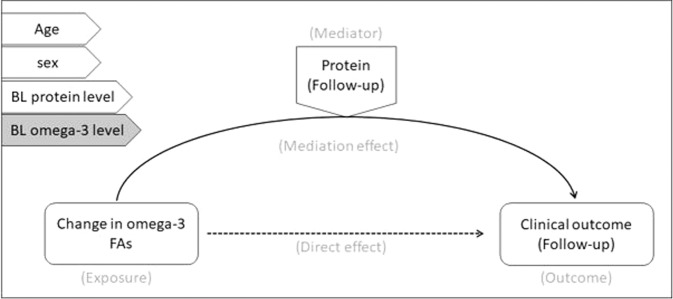
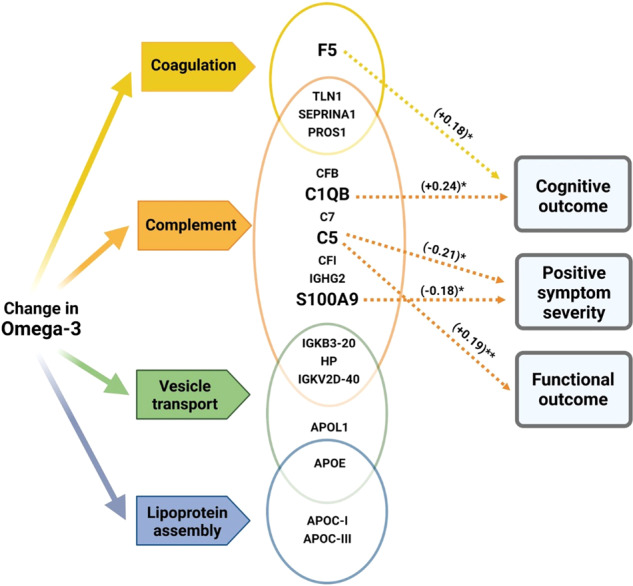
Preliminary evidence indicates beneficial effects of omega-3 polyunsaturated fatty acids (PUFAs) in early psychosis. The present study investigates the molecular mechanism of omega-3 PUFA-associated therapeutic effects in clinical high-risk (CHR) participants. Plasma samples of 126 CHR psychosis participants at baseline and 6-months follow-up were included. Plasma protein levels were quantified using mass spectrometry and erythrocyte omega-3 PUFA levels were quantified using gas chromatography. We examined the relationship between change in polyunsaturated PUFAs (between baseline and 6-month follow-up) and follow-up plasma proteins. Using mediation analysis, we investigated whether plasma proteins mediated the relationship between change in omega-3 PUFAs and clinical outcomes. A 6-months change in omega-3 PUFAs was associated with 24 plasma proteins at follow-up. Pathway analysis revealed the complement and coagulation pathway as the main biological pathway to be associated with change in omega-3 PUFAs. Moreover, complement and coagulation pathway proteins significantly mediated the relationship between change in omega-3 PUFAs and clinical outcome at follow-up. The inflammatory protein complement C5 and protein S100A9 negatively mediated the relationship between change in omega-3 PUFAs and positive symptom severity, while C5 positively mediated the relationship between change in omega-3 and functional outcome. The relationship between change in omega-3 PUFAs and cognition was positively mediated through coagulation factor V and complement protein C1QB. Our findings provide evidence for a longitudinal association of omega-3 PUFAs with complement and coagulation protein changes in the blood. Further, the results suggest that an increase in omega-3 PUFAs decreases symptom severity and improves cognition in the CHR state through modulating effects of complement and coagulation proteins.
初步证据表明ω-3 多不饱和脂肪酸(PUFAs)对早期精神病有有益影响。本研究调查了ω-3 PUFAs 相关治疗效果在临床高风险(CHR)参与者中的分子机制。纳入了 126 名 CHR 精神病患者的基线和 6 个月随访的血浆样本。使用质谱法定量测定血浆蛋白水平,使用气相色谱法定量测定红细胞 ω-3 PUFAs 水平。我们研究了多不饱和 PUFAs(在基线和 6 个月随访之间的变化)与随访血浆蛋白之间的关系。通过中介分析,我们调查了血浆蛋白是否介导了 ω-3 PUFAs 的变化与临床结果之间的关系。ω-3 PUFAs 的 6 个月变化与随访时的 24 种血浆蛋白有关。途径分析显示补体和凝血途径是与 ω-3 PUFAs 变化相关的主要生物学途径。此外,补体和凝血途径蛋白显著介导了 ω-3 PUFAs 变化与随访时临床结果之间的关系。炎症蛋白补体 C5 和蛋白 S100A9 负向介导了 ω-3 PUFAs 变化与阳性症状严重程度之间的关系,而 C5 正向介导了 ω-3 PUFAs 变化与功能结果之间的关系。ω-3 PUFAs 变化与认知之间的关系通过凝血因子 V 和补体蛋白 C1QB 呈正相关。我们的研究结果为 ω-3 PUFAs 与血液中补体和凝血蛋白变化的纵向关联提供了证据。此外,研究结果表明,ω-3 PUFAs 的增加通过调节补体和凝血蛋白的作用,降低 CHR 状态下的症状严重程度并改善认知。