Department of Microbiology and Immunology, Center for Biomedical Research, University of Texas Health Science Center, Tyler, Texas, USA.
PLoS One. 2011;6(12):e29706. doi: 10.1371/journal.pone.0029706. Epub 2011 Dec 28.
Insulin-producing cell clusters (IPCCs) have recently been generated in vitro from adipose tissue-derived stem cells (ASCs) to circumvent islet shortage. However, it is unknown how long they can survive upon transplantation, whether they are eventually rejected by recipients, and how their long-term survival can be induced to permanently cure type 1 diabetes. IPCC graft survival is critical for their clinical application and this issue must be systematically addressed prior to their in-depth clinical trials.
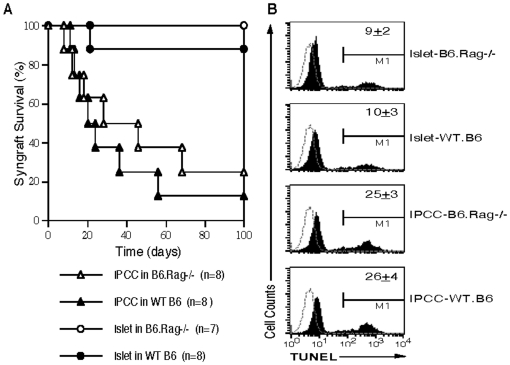
METHODOLOGY/PRINCIPAL FINDINGS: Here we found that IPCC grafts that differentiated from murine ASCs in vitro, unlike their freshly isolated islet counterparts, did not survive long-term in syngeneic mice, suggesting that ASC-derived IPCCs have intrinsic survival disadvantage over freshly isolated islets. Indeed, β cells retrieved from IPCC syngrafts underwent faster apoptosis than their islet counterparts. However, blocking both Fas and TNF receptor death pathways inhibited their apoptosis and restored their long-term survival in syngeneic recipients. Furthermore, blocking CD40-CD154 costimulation and Fas/TNF signaling induced long-term IPCC allograft survival in overwhelming majority of recipients. Importantly, Fas-deficient IPCC allografts exhibited certain immune privilege and enjoyed long-term survival in diabetic NOD mice in the presence of CD28/CD40 joint blockade while their islet counterparts failed to do so.
CONCLUSIONS/SIGNIFICANCE: Long-term survival of ASC-derived IPCC syngeneic grafts requires blocking Fas and TNF death pathways, whereas blocking both death pathways and CD28/CD40 costimulation is needed for long-term IPCC allograft survival in diabetic NOD mice. Our studies have important clinical implications for treating type 1 diabetes via ASC-derived IPCC transplantation.
最近已经从脂肪组织来源的干细胞(ASCs)体外生成了产生胰岛素的细胞簇(IPCCs),以避免胰岛短缺。然而,尚不清楚它们在移植后能存活多久,它们是否最终会被受者排斥,以及如何诱导它们的长期存活以永久性治愈 1 型糖尿病。IPCC 移植物的存活对于其临床应用至关重要,在对其进行深入的临床试验之前,必须系统地解决这个问题。
方法/主要发现:在这里,我们发现与新鲜分离的胰岛相比,体外分化自鼠 ASCs 的 IPCC 移植物不能在同基因小鼠中长期存活,这表明 ASC 衍生的 IPCCs 与新鲜分离的胰岛相比具有内在的生存劣势。事实上,从 IPCC 同种异体移植物中回收的β细胞比其胰岛对应物更快地凋亡。然而,阻断 Fas 和 TNF 受体死亡途径可抑制其凋亡,并恢复其在同基因受者中的长期存活。此外,阻断 CD40-CD154 共刺激和 Fas/TNF 信号诱导了绝大多数受者中 IPCC 同种异体移植物的长期存活。重要的是,Fas 缺陷型 IPCC 同种异体移植物在存在 CD28/CD40 联合阻断的情况下,在糖尿病 NOD 小鼠中表现出一定的免疫特权并长期存活,而其胰岛对应物则不能。
结论/意义:ASCs 衍生的 IPCC 同基因移植物的长期存活需要阻断 Fas 和 TNF 死亡途径,而阻断 Fas 和 TNF 死亡途径以及 CD28/CD40 共刺激对于糖尿病 NOD 小鼠中 IPCC 同种异体移植物的长期存活是必需的。我们的研究对于通过 ASC 衍生的 IPCC 移植治疗 1 型糖尿病具有重要的临床意义。