The Russell H. Morgan Department of Radiology and Radiological Science, The Johns Hopkins University School of Medicine, Maryland 21287-0807, USA.
Synapse. 2012 Jun;66(6):471-82. doi: 10.1002/syn.21515. Epub 2012 Feb 28.
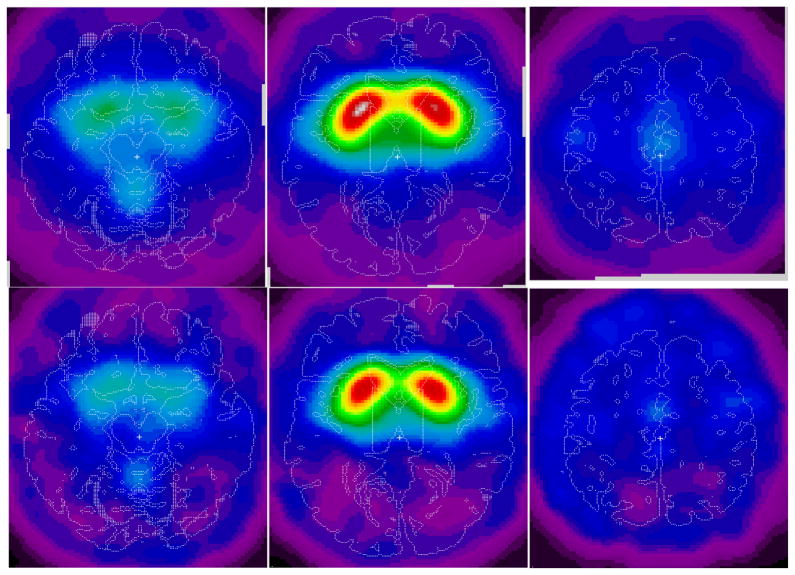
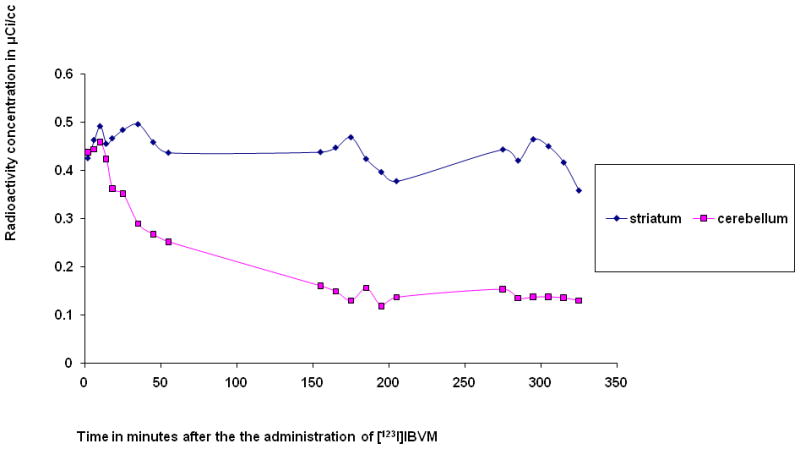
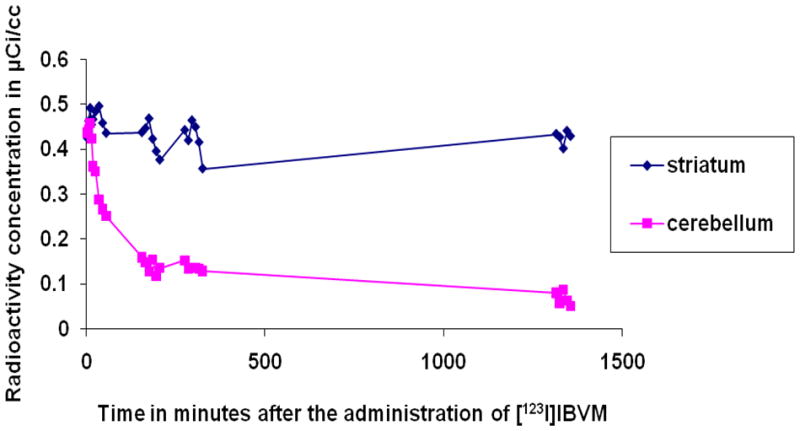
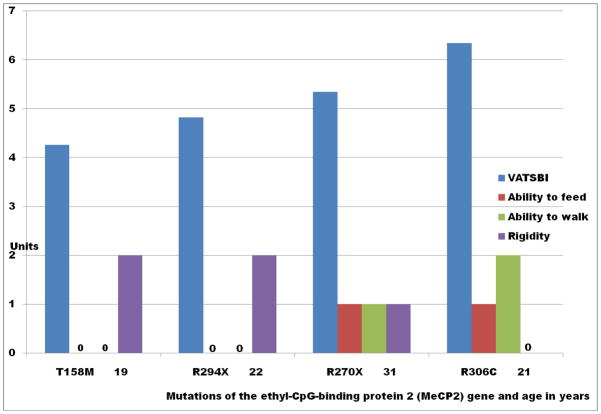
Rett syndrome (RTT) is a neurodevelopmental disability characterized by mutations in the X-linked methyl-CpG-binding protein 2 located at the Xq28 region. The severity is modified in part by X chromosomal inactivation resulting in wide clinical variability. We hypothesized that the ability to perform the activities of daily living (ADL) is correlated with the density of vesicular acetylcholine transporters in the striata of women with RTT. The density of the vesicular acetylcholine transporters in the living human brain can be estimated by single-photon emission-computed tomography (SPECT) after the administration of (-)-5-[¹²³I]iodobenzovesamicol ([¹²³I]IBVM). Twenty-four hours following the intravenous injection of ∼333 MBq (9 mCi) [¹²³ I]IBVM, four women with RTT and nine healthy adult volunteer control participants underwent SPECT brain scans for 60 min. The Vesicular Acetylcholine Transporter Binding Site Index (Kuhl et al., 1994), a measurement of the density of vesicular acetylcholine transporters, was estimated in the striatum and the reference structure, the cerebellum. The women with RTT were assessed for certain ADL. Although the striatal Vesicular Acetylcholine Transporter Binding Site Index was not significantly lower in RTT (5.2 ± 0.9) than in healthy adults (5.7 ± 1.6), RTT striatal Vesicular Acetylcholine Transporter Binding Site Indices and ADL scores were linearly associated (ADL = 0.89*(Vesicular Acetylcholine Transporter Binding Site Index) + 4.5; R² = 0.93; P < 0.01), suggesting a correlation between the ability to perform ADL and the density of vesicular acetylcholine transporters in the striata of women with RTT. [¹²³I]IBVM is a promising tool to characterize the pathophysiological mechanisms of RTT and other neurodevelopmental disabilities.
雷特综合征(RTT)是一种神经发育障碍,其特征是位于 Xq28 区域的 X 连锁甲基-CpG 结合蛋白 2 发生突变。其严重程度部分受到 X 染色体失活的影响,导致临床表现存在广泛的变异性。我们假设,女性 RTT 患者执行日常生活活动(ADL)的能力与纹状体中囊泡乙酰胆碱转运体的密度相关。通过静脉注射约 333MBq(9mCi)[¹²³I]IBVM 后,可使用单光子发射计算机断层扫描(SPECT)估计活体人脑中的囊泡乙酰胆碱转运体的密度。[¹²³I]IBVM 静脉注射后 24 小时,4 名 RTT 女性和 9 名健康成年志愿者对照参与者接受 SPECT 脑扫描 60 分钟。囊泡乙酰胆碱转运体结合部位指数(Kuhl 等人,1994 年)是测量囊泡乙酰胆碱转运体密度的一种方法,该指数可在纹状体和参考结构(小脑)中进行估计。对 RTT 女性进行了某些 ADL 评估。尽管 RTT 中的纹状体囊泡乙酰胆碱转运体结合部位指数(5.2±0.9)与健康成年人(5.7±1.6)相比无明显降低,但 RTT 纹状体囊泡乙酰胆碱转运体结合部位指数与 ADL 评分呈线性相关(ADL=0.89×(囊泡乙酰胆碱转运体结合部位指数)+4.5;R²=0.93;P<0.01),提示 RTT 女性纹状体中囊泡乙酰胆碱转运体的密度与执行 ADL 的能力之间存在相关性。[¹²³I]IBVM 是一种有前途的工具,可用于描述 RTT 和其他神经发育障碍的病理生理机制。