Xibing Gu, Xiaojuan Yang, Zhonghua Lu, Juanhua Wang
Wuxi Hospital for Infectious Diseases, Wuxi, China.
Hepat Mon. 2011 Oct;11(10):810-5. doi: 10.5812/kowsar.1735-143x.760.
It is difficult to predict what type of chronic hepatitis B (CHB) progresses to chronic severe hepatitis B.
This study aimed to observe changes in the HBV-specific and -nonspecific cellmediated immune responses after CHB deteriorates into severe hepatic disease and explore the significance of such changes.
This study aimed to observe changes in the HBV-specific and -nonspecific cell-mediated immune responses after CHB deteriorates into severe hepatic disease and explore the significance of such changes.
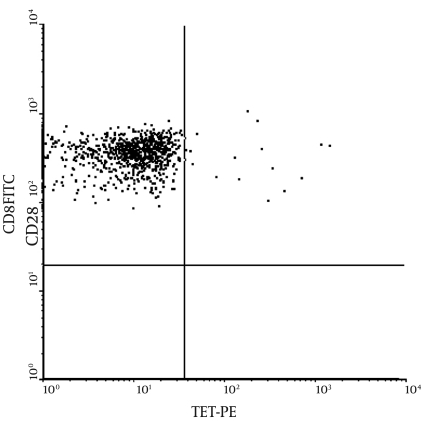
In 49 of 255 CHB patients (19.22%), the disease developed into chronic severe hepatitis (early stage) an average of 10.06 ± 1.73 days after admission. CD4+ and NK cells levels in Group A were lower after progression into severe hepatitis than on the second day of admission (baseline) (P < 0.01). CD8+ cells and nonspecific CTL levels in Group A were higher after progression than at baseline (P < 0.01), and latter was higher than in Group B at baseline (P < 0.01); the levels of CD8+ cells and nonspecific CTLs in Group A after progression were significantly higher than those of Group B 10 days after admission (P < 0.01). There were no significant differences in HBV-specific CTL levels in Group A before and after progression to severe hepatitis (P > 0.05).
Our results suggest that the immunological pathogenesis of chronic severe hepatitis B is related to significant rises in CD8+ and nonspecific CTL levels and that such increases predict that the disease will deteriorate into severe hepatitis.
很难预测哪种类型的慢性乙型肝炎(CHB)会进展为慢性重型乙型肝炎。
本研究旨在观察CHB恶化为严重肝脏疾病后HBV特异性和非特异性细胞介导免疫反应的变化,并探讨这些变化的意义。
本研究旨在观察CHB恶化为严重肝脏疾病后HBV特异性和非特异性细胞介导免疫反应的变化,并探讨这些变化的意义。
255例CHB患者中有49例(19.22%)在入院后平均10.06±1.73天发展为慢性重型肝炎(早期)。A组进展为重型肝炎后的CD4+和NK细胞水平低于入院第二天(基线)(P<0.01)。A组进展后的CD8+细胞和非特异性CTL水平高于基线(P<0.01),且后者在基线时高于B组(P<0.01);A组进展后10天的CD8+细胞和非特异性CTL水平显著高于B组(P<0.01)。A组进展为重型肝炎前后的HBV特异性CTL水平无显著差异(P>0.05)。
我们的结果表明,慢性重型乙型肝炎的免疫发病机制与CD8+和非特异性CTL水平的显著升高有关,且这种升高预示着疾病将恶化为重型肝炎。