Medical Research Council International Nutrition Group, London School of Hygiene & Tropical Medicine, London, United Kingdom.
Blood. 2012 Feb 23;119(8):1922-8. doi: 10.1182/blood-2011-11-391219. Epub 2012 Jan 6.
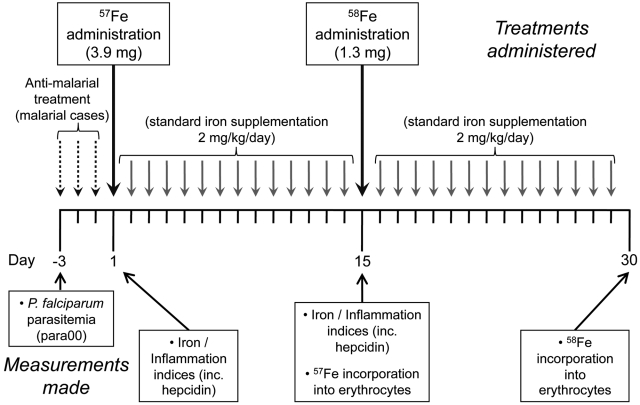
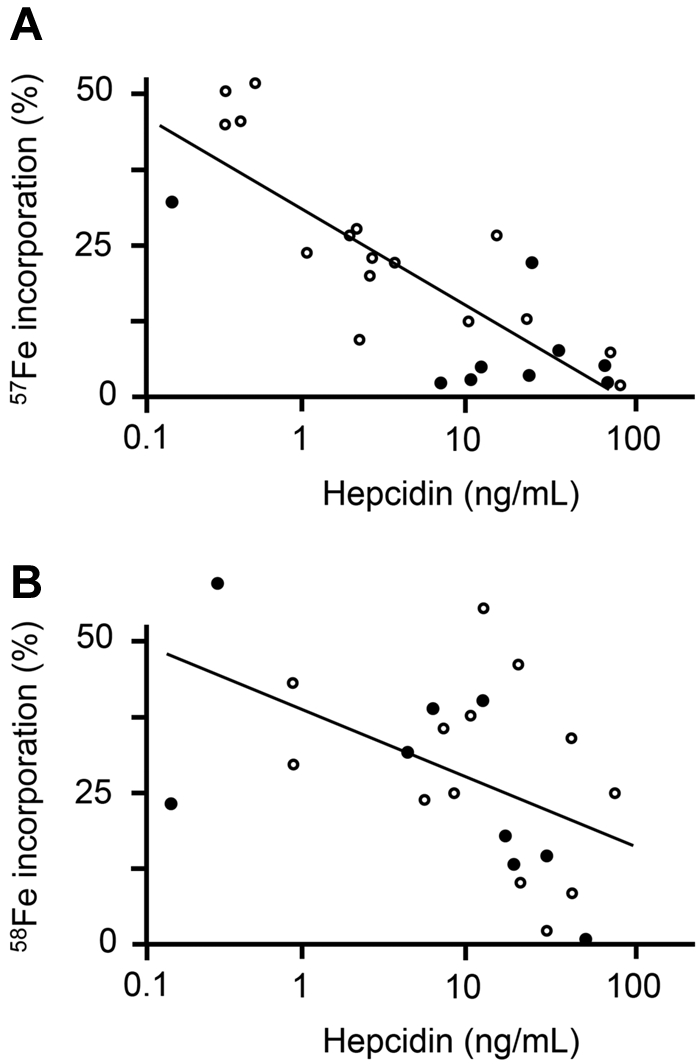
Iron supplementation strategies in the developing world remain controversial because of fears of exacerbating prevalent infectious diseases. Understanding the conditions in which iron will be absorbed and incorporated into erythrocytes is therefore important. We studied Gambian children with either postmalarial or nonmalarial anemia, who were given oral iron supplements daily for 30 days. Supplements administered on days 1 and 15 contained the stable iron isotopes (57)Fe and (58)Fe, respectively, and erythrocyte incorporation was measured in blood samples drawn 14 days later. We investigated how the iron-regulatory hormone hepcidin and other inflammatory/iron-related indices, all measured on the day of isotope administration, correlated with erythrocyte iron incorporation. In univariate analyses, hepcidin, ferritin, C-reactive protein, and soluble transferrin receptor (sTfR) strongly predicted incorporation of (57)Fe given on day 1, while hepcidin, ferritin, and sTfR/log ferritin correlated with (58)Fe incorporation. In a final multivariate model, the most consistent predictor of erythrocyte isotope incorporation was hepcidin. We conclude that under conditions of competing signals (anemia, iron deficiency, and infection), hepcidin powerfully controls use of dietary iron. We suggest that low-cost point-of-care hepcidin assays would aid iron supplementation programs in the developing world.
在发展中国家,铁补充策略仍然存在争议,因为担心会加剧普遍存在的传染病。因此,了解铁将被吸收并纳入红细胞的条件非常重要。我们研究了患有疟后或非疟性贫血的冈比亚儿童,他们每天口服铁补充剂 30 天。第 1 天和第 15 天给予的补充剂分别含有稳定的铁同位素 (57)Fe 和 (58)Fe,14 天后从血液样本中测量红细胞的掺入情况。我们研究了铁调节激素铁调素以及其他炎症/铁相关指标在给予同位素的当天如何与红细胞铁的掺入相关。在单变量分析中,铁调素、铁蛋白、C 反应蛋白和可溶性转铁蛋白受体 (sTfR) 强烈预测第 1 天给予的 (57)Fe 的掺入,而铁调素、铁蛋白和 sTfR/铁蛋白比值与 (58)Fe 的掺入相关。在最终的多变量模型中,红细胞同位素掺入的最一致预测因子是铁调素。我们得出的结论是,在存在竞争信号(贫血、缺铁和感染)的情况下,铁调素有力地控制了膳食铁的利用。我们建议在发展中国家,低成本的即时护理铁调素检测将有助于铁补充计划。