Departments of Clinical Laboratory Sciences, College of Applied Medical Sciences, King Saud University, Riyadh, Saudi Arabia.
Rehabilitation Research Chair, Department of Rehabilitation Sciences, College of Applied Medical Sciences, King Saud University, Riyadh, Saudi Arabia.
Eur J Med Res. 2023 Dec 15;28(1):595. doi: 10.1186/s40001-023-01579-5.
MicroRNAs (miRNAs) can control several biological processes. Thus, the existence of these molecules plays a significant role in regulating human iron metabolism or homeostasis.
The study aimed to determine the role of circulating microRNAs and hepcidin in controlling iron homeostasis and evaluating possible anemia among school children.
The study was based on a biochemical and cross-sectional survey study that included three hundred fifty school children aged 12-18 years old. RT-PCR and immunoassay analysis were accomplished to estimate iron concentration, Hgb, serum ferritin (SF), soluble transferrin receptor (sTfR), total body iron stores (TIBs), total oxidative stress (TOS), total antioxidant capacity (TAC), α-1-acid glycoprotein (AGP), high sensitive C-reactive protein (hs-CRP), and miRNAs; miR-146a, miR-129b, and miR-122 in 350 school adolescents.
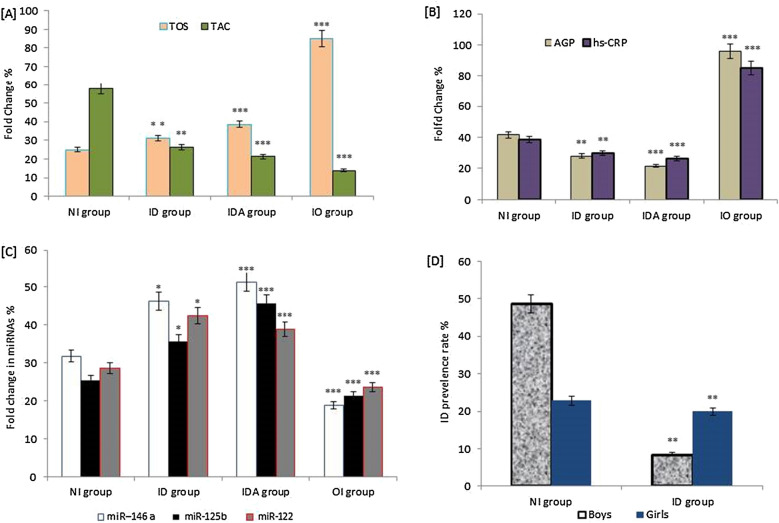
Iron disorders were cross-sectionally predicted in 28.54% of the study population; they were classified into 14.26% with ID, 5.7% with IDA, and 8.6% with iron overload. The overall proportion of iron depletion was significantly higher in girls (20.0%) than in boys (8.6%). MicroRNAs; miR-146a, miR-125b, and miR-122 were significantly upregulated with lower hepcidin expression in adolescence with ID and IDA compared to iron-overloaded subjects, whereas downregulation of these miRNAs was linked with higher hepcidin. Also, a significant correlation was recorded between miRNAs, hepcidin levels, AGP, hs-CRP, TAC, and other iron-related indicators.
Molecular microRNAs such as miR-146a, miR-125b, and miR-122 were shown to provide an additional means of controlling or regulating cellular iron uptake or metabolism either via the oxidative stress pathway or regulation of hepcidin expression via activating genes encoding Hfe and Hjv activators, which promote iron regulation. Thus, circulating miRNAs as molecular markers and serum hepcidin could provide an additional means of controlling or regulating cellular iron and be associated as valuable markers in diagnosing and treating cases with different iron deficiencies.
MicroRNAs(miRNAs)可以控制多种生物过程。因此,这些分子的存在在调节人类铁代谢或体内平衡方面起着重要作用。
本研究旨在确定循环 microRNAs 和铁调素在控制铁平衡中的作用,并评估学龄儿童中可能存在的贫血。
该研究基于生化和横断面调查研究,包括 350 名 12-18 岁的学龄儿童。通过 RT-PCR 和免疫分析来估计铁浓度、Hgb、血清铁蛋白(SF)、可溶性转铁蛋白受体(sTfR)、全身铁储存量(TIBs)、总氧化应激(TOS)、总抗氧化能力(TAC)、α-1-酸性糖蛋白(AGP)、高敏 C 反应蛋白(hs-CRP)和 microRNAs;miR-146a、miR-129b 和 miR-122 在 350 名青少年中。
铁代谢紊乱在研究人群中的横断面预测率为 28.54%;它们分为 14.26%的 ID、5.7%的 IDA 和 8.6%的铁过载。缺铁性贫血在女孩中的总体比例(20.0%)明显高于男孩(8.6%)。在 ID 和 IDA 青少年中,miR-146a、miR-125b 和 miR-122 的表达水平明显升高,而铁调素表达水平降低,与铁过载患者相比,这些 miRNA 的下调与铁调素升高有关。此外,miRNAs、铁调素水平、AGP、hs-CRP、TAC 和其他与铁相关的指标之间存在显著相关性。
分子 microRNAs,如 miR-146a、miR-125b 和 miR-122,通过氧化应激途径或通过激活编码 Hfe 和 Hjv 激活物的基因来调节铁调素的表达,从而提供了一种控制或调节细胞铁摄取或代谢的额外手段。因此,循环 microRNAs 作为分子标志物和血清铁调素可以提供一种控制或调节细胞铁的额外手段,并作为诊断和治疗不同缺铁症的有价值的标志物。