Ances Beau M, Benzinger Tammie L, Christensen Jon J, Thomas Jewell, Venkat Rohit, Teshome Mengesha, Aldea Patricia, Fagan Anne M, Holtzman David M, Morris John C, Clifford David B
Department of Neurology, Washington University in St. Louis, Campus Box 8111, 660 S Euclid Ave, St Louis, MO 63110, USA.
Arch Neurol. 2012 Jan;69(1):72-7. doi: 10.1001/archneurol.2011.761.
To evaluate whether the amyloid-binding agent carbon 11-labeled Pittsburgh Compound B ((11)C-PiB) could differentiate Alzheimer disease (AD) from human immunodeficiency virus (HIV)-associated neurocognitive disorder (HAND) in middle-aged HIV-positive participants.
(11)C-PiB scanning, clinical assessment, and cerebrospinal fluid (CSF) analysis were performed. Both χ(2) and t tests assessed differences in clinical and demographic variables between HIV-positive participants and community-living individuals observed at the Knight Alzheimer's Disease Research Center (ADRC). Analysis of variance assessed for regional differences in amyloid-β protein 1-42 (Aβ42) using (11)C-PiB.
An ADRC and HIV clinic.
Sixteen HIV-positive participants (11 cognitively normal and 5 with HAND) and 19 ADRC participants (8 cognitively normal and 11 with symptomatic AD).
Mean and regional (11)C-PiB binding potentials.
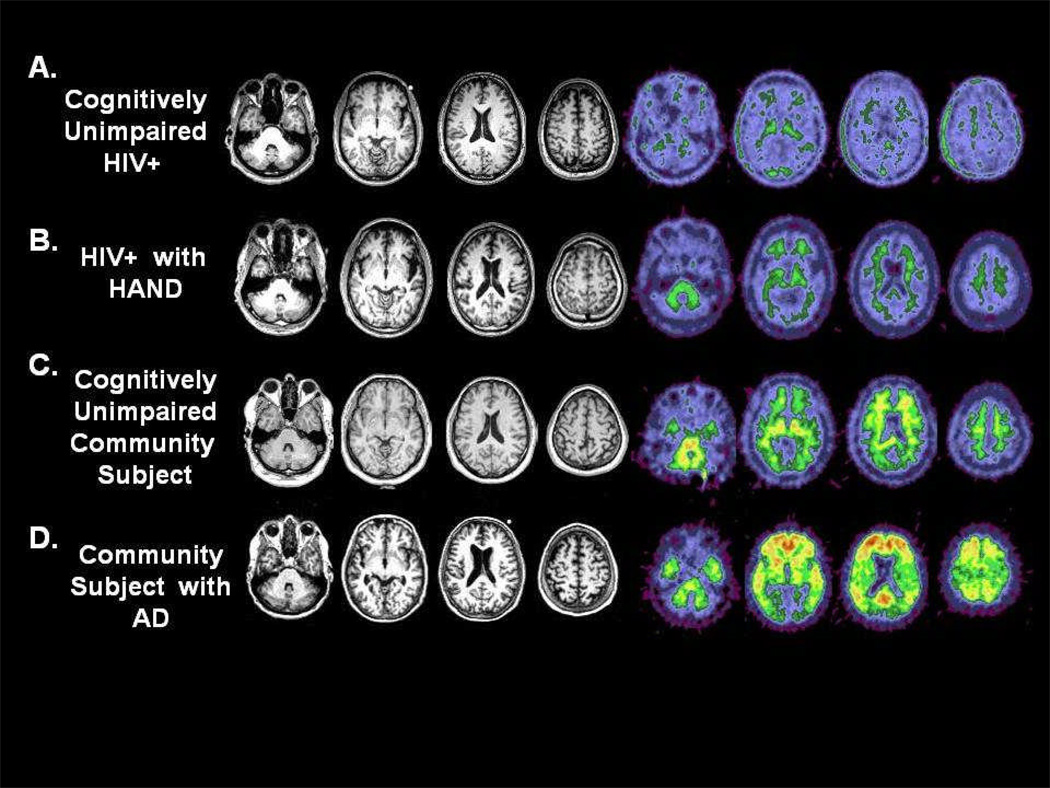
Participants with symptomatic AD were older (P < .001), had lower CSF Aβ42 levels (P < .001), and had higher CSF tau levels (P < .001) than other groups. Regardless of degree of impairment, HIV-positive participants did not have increased (11)C-PiB levels. Mean and regional binding potentials were elevated for symptomatic AD participants (P < .001).
Middle-aged HIV-positive participants, even with HAND, do not exhibit increased (11)C-PiB levels, whereas symptomatic AD individuals have increased fibrillar Aβ42 deposition in cortical and subcortical regions. Observed dissimilarities between HAND and AD may reflect differences in Aβ42 metabolism. (11)C-PiB may provide a diagnostic biomarker for distinguishing symptomatic AD from HAND in middle-aged HIV-positive participants. Future cross-sectional and longitudinal studies are required to assess the utility of (11)C-PiB in older individuals with HAND.
评估淀粉样蛋白结合剂碳11标记的匹兹堡化合物B((11)C-PiB)能否在中年HIV阳性参与者中区分阿尔茨海默病(AD)与人类免疫缺陷病毒(HIV)相关神经认知障碍(HAND)。
进行了(11)C-PiB扫描、临床评估和脑脊液(CSF)分析。卡方检验和t检验评估了HIV阳性参与者与在奈特阿尔茨海默病研究中心(ADRC)观察到的社区居住个体之间临床和人口统计学变量的差异。方差分析使用(11)C-PiB评估淀粉样β蛋白1-42(Aβ42)的区域差异。
一个ADRC和HIV诊所。
16名HIV阳性参与者(11名认知正常,5名患有HAND)和19名ADRC参与者(8名认知正常,11名有症状性AD)。
平均和区域(11)C-PiB结合电位。
有症状性AD的参与者比其他组年龄更大(P <.001),脑脊液Aβ42水平更低(P <.001),脑脊液tau水平更高(P <.001)。无论损伤程度如何,HIV阳性参与者的(11)C-PiB水平均未升高。有症状性AD的参与者的平均和区域结合电位升高(P <.001)。
中年HIV阳性参与者,即使患有HAND,也不会表现出(11)C-PiB水平升高,而有症状性AD的个体在皮质和皮质下区域有增加的纤维状Aβ42沉积。观察到的HAND和AD之间的差异可能反映了Aβ42代谢的差异。(11)C-PiB可能为区分中年HIV阳性参与者的有症状性AD与HAND提供一种诊断生物标志物。未来需要进行横断面和纵向研究,以评估(11)C-PiB在老年HAND患者中的效用。