Department of Psychology, Saint Bonaventure University, New York, USA.
Food Nutr Res. 2012;56. doi: 10.3402/fnr.v56i0.10202. Epub 2012 Jan 5.
Studies show inconsistent results with regards to whether eating slower can enhance satiety and reduce intake in a meal. Some methodological differences are apparent and could potentially explain why results are not consistent across studies.
To determine whether eating slower can enhance satiety and reduce intake when rate of eating is manipulated and not manipulated in a kitchen setting using a sample of participants who exhibit high dietary restraint (HDR).
Two samples of college students who exhibit HDR, which is a group likely to use behavioral strategies to manage intake, were selected in a prescreening session. Participants were told how fast or slow to eat (Variation 1) or allowed to eat at their own pace (Variation 2). Self-reported satiety during the meal and amount consumed was recorded. The types of foods, macronutrient intakes, weights of foods, order of food intakes, and the dimensions of foods were held constant between groups to control for group differences in the sensory and hedonic qualities of the meals.
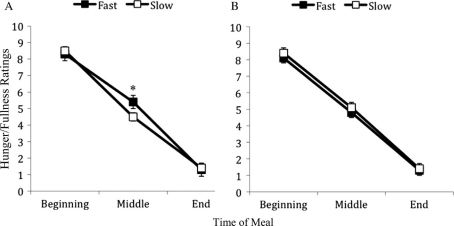
Eating slower enhanced mid-meal satiety ratings, but only when instructions were given to eat fast or slow (Variation 1). In both variations, eating slower did not reduce amount consumed in the meal, although each variation had sufficient power to detect differences.
Eating slower is not likely to be an effective strategy to control intake in a meal among those exhibiting HDR.
研究表明,进食速度较慢是否能增强饱腹感并减少进食量的结果并不一致。一些方法学上的差异是显而易见的,这可能解释了为什么研究结果不一致。
在厨房环境中,通过操纵和不操纵进食速度,确定进食速度较慢是否可以增强饱腹感并减少高饮食克制(HDR)人群的进食量。
在预筛选阶段,选择了两组表现出 HDR 的大学生样本,这是一组可能使用行为策略来控制摄入量的人群。参与者被告知要吃快或慢(变体 1),或者可以自行决定进食速度(变体 2)。记录了用餐期间的自我报告饱腹感和摄入量。为了控制组间餐食感官和愉悦品质的差异,两组之间保持了食物类型、宏量营养素摄入量、食物重量、食物摄入顺序和食物维度的恒定。
当给予快速或慢速进食的指示时(变体 1),进食速度较慢会增强中餐饮食的饱腹感评分。但在两种变体中,进食速度较慢都不会减少餐食的摄入量,尽管每种变体都有足够的能力检测到差异。
对于表现出 HDR 的人群来说,进食速度较慢不太可能成为控制餐食摄入量的有效策略。