Department of Pathology, Johns Hopkins University, Baltimore, Maryland 21287, USA.
Transfusion. 2012 Jun;52(6):1221-7. doi: 10.1111/j.1537-2995.2011.03476.x. Epub 2012 Jan 10.
Concentrating and washing apheresis platelets (APs) substantially reduce the number of allergic transfusion reactions likely due to removal of plasma. However, these processes may damage platelets (PLTs). This study evaluated whether concentrating or washing APs decrease the corrected count increment (CCI).
This retrospective study evaluated individuals who initially received unmanipulated APs and subsequently received concentrated and/or washed APs at a large university hospital between 1998 and 2009. Concentrated units were prepared by reducing the plasma volume of APs by a goal of more than 67%. Washed units were prepared by washing the APs with 1 L of normal saline. The CCI (PLTs [×10(6)] × m(2)/L) for all transfusions was calculated. Hypothesis testing was performed with t tests for continuous variables and chi-square tests for dichotomous variables.
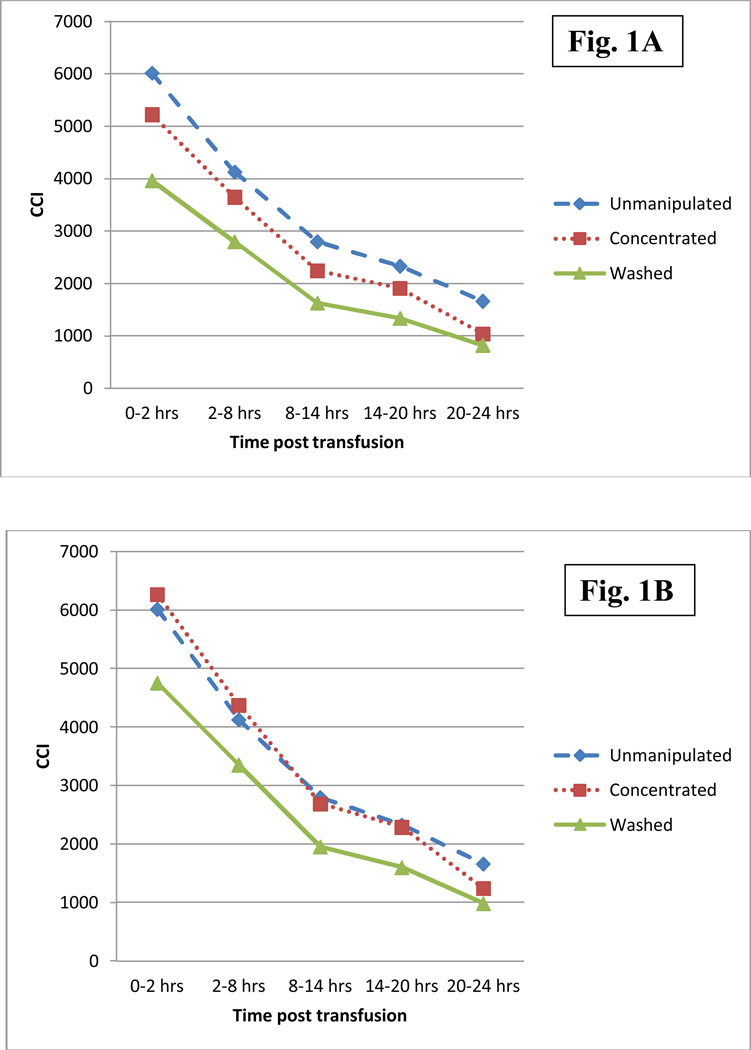
We evaluated 121 individuals: 46 patients who received unmanipulated, concentrated, and then washed APs; 59 patients who received unmanipulated and then concentrated APs; and 16 patients who received unmanipulated and then washed APs. Patient demographics were similar among the three groups. The mean CCI for unmanipulated AP transfusions at 0 to 2 hours posttransfusion was significantly higher than concentrated and washed PLT transfusions (p<0.001). When accounting for PLT loss due to manipulation, concentrating APs did not impact the CCI. However, the CCI remained significantly lower for washed products at all time points after transfusion (40.7% mean reduction at 20-24 hr, p<0.001).
Washing APs significantly reduces PLT count recovery and survival, as demonstrated by a significantly reduced CCI.
浓缩和洗涤单采血小板(APs)可大大减少因去除血浆而引起的过敏输血反应的数量。然而,这些过程可能会损伤血小板(PLTs)。本研究评估了浓缩或洗涤 APs 是否会降低校正后的血小板计数增加(CCI)。
本回顾性研究评估了 1998 年至 2009 年期间在一家大型大学医院中,最初接受未处理的 APs 后,随后接受浓缩和/或洗涤 APs 的个体。浓缩单位通过将 APs 的血浆体积减少到目标值的 67%以上来制备。洗涤单位通过用 1 L 生理盐水洗涤 APs 来制备。所有输血的 CCI(血小板[×10(6)]×m(2)/L)都进行了计算。连续变量采用 t 检验,二分类变量采用卡方检验进行假设检验。
我们评估了 121 名患者:46 名患者接受了未处理的、浓缩的和随后洗涤的 APs;59 名患者接受了未处理的浓缩的 APs;16 名患者接受了未处理的洗涤的 APs。三组患者的人口统计学特征相似。未处理的 AP 输血后 0 至 2 小时的平均 CCI 明显高于浓缩和洗涤的 PLT 输血(p<0.001)。当考虑到由于操作导致的 PLT 损失时,浓缩 APs 并不影响 CCI。然而,在输血后所有时间点,洗涤产品的 CCI 仍然明显降低(20-24 小时时平均降低 40.7%,p<0.001)。
洗涤 APs 显著降低了 PLT 计数的恢复和存活率,这表现为 CCI 显著降低。