Institute for Health Metrics and Evaluation, Seattle, Washington, USA.
BMC Health Serv Res. 2012 Jan 11;12:13. doi: 10.1186/1472-6963-12-13.
HIV voluntary counselling and testing was a key HIV prevention strategy brought to scale by India's National AIDS Control Organization. Condom uptake is an essential metric of intervention impact given the expansion of the epidemic into an increasingly diverse population. With only 20% of first-time counselling and testing clients at the largest HIV treatment hospital in south India reporting previous condom use, the question of intervention impact on condom use deserves investigation. In this study, we track intervention impact across various demographic groups and identify the added value of more thorough counselling.
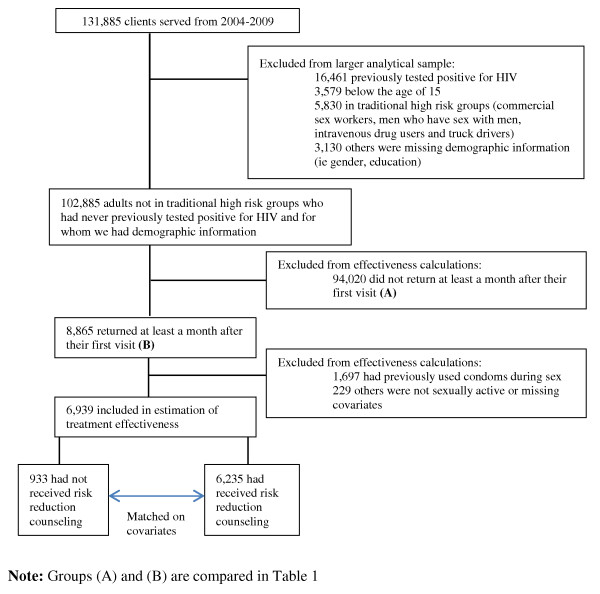
Data were collected from 8,865 individuals who attended counselling multiple times at the Tamil Nadu Government Hospital of Thoracic Medicine over the years 2004-2009. Counsellors recorded client demographic characteristics, HIV risk behaviours reported, and counselling services provided after each counselling session. Matching and regression methods were used to determine the probability of condom uptake by serostatus, gender, and receipt of personalized risk reduction counselling while controlling for other characteristics.
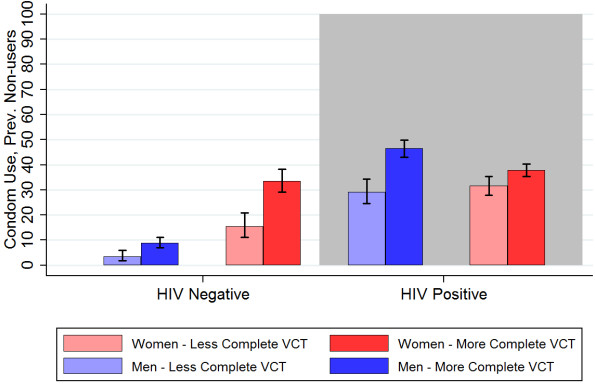
HIV counselling and testing was associated with condom uptake among 29.2% of HIV positive women (CI 24.5-34.4%), 31.7% of HIV positive men (CI 27.8-35.4%), 15.5% of HIV negative women (CI 11.2-20.8%), and only 3.6% of HIV negative men (CI 1.9-5.9%) who had previously never used condoms. Personalized risk reduction counselling increased impact in some groups; for example an additional 18% of HIV negative women (CI 11.3-24.4%) and 17% of HIV positive men (CI 10.9-23.4%) started using condoms. The number of sexual partners was not associated with the impact of counselling completeness.
Because the components of testing and counselling impact the condom use habits of men and women differently, understanding the dynamics of condom use negotiation between partners is essential to optimizing impact on Indian couples. Clients' predicted condom uptake ranged between 4% and 47% depending on factors like gender, serostatus, and services provided. Personalized risk reduction counselling is associated with increased chance of condom use, with larger gains in HIV negative women and HIV positive men. HIV negative men are least likely to start using condoms and least impacted by additional counselling.
艾滋病毒自愿咨询和检测是印度国家艾滋病控制组织推广的一项关键艾滋病毒预防战略。由于疫情已经蔓延到越来越多样化的人群,因此, condom 的使用情况是干预措施影响的一个重要指标。在印度南部最大的艾滋病毒治疗医院,只有 20%的首次咨询和检测客户报告之前使用 condom,因此,干预措施对 condom 使用的影响值得调查。在这项研究中,我们跟踪了不同人群的干预效果,并确定了更彻底咨询的附加价值。
数据来自 2004 年至 2009 年间在泰米尔纳德邦政府胸科医院多次接受咨询的 8865 个人。咨询师记录了客户的人口统计学特征、报告的艾滋病毒风险行为以及每次咨询后的咨询服务。在控制其他特征的情况下,使用匹配和回归方法来确定血清阳性、性别和接受个性化风险降低咨询的个体 condom 使用率的概率。
艾滋病毒咨询和检测与 29.2%的 HIV 阳性女性(CI 24.5-34.4%)、31.7%的 HIV 阳性男性(CI 27.8-35.4%)、15.5%的 HIV 阴性女性(CI 11.2-20.8%)和 3.6%的 HIV 阴性男性(CI 1.9-5.9%)之前从未使用 condom 的人 condom 的使用有关。个性化的风险降低咨询在某些群体中增加了效果;例如,另外 18%的 HIV 阴性女性(CI 11.3-24.4%)和 17%的 HIV 阳性男性(CI 10.9-23.4%)开始使用 condom。性伴侣的数量与咨询完整性的影响无关。
由于测试和咨询的组成部分对男性和女性 condom 使用习惯的影响不同,因此了解伴侣之间 condom 使用谈判的动态对于优化印度夫妇的效果至关重要。根据性别、血清状态和提供的服务等因素,客户预测的 condom 使用率在 4%到 47%之间。个性化的风险降低咨询与 condom 使用几率的增加有关,对 HIV 阴性女性和 HIV 阳性男性的影响更大。HIV 阴性男性开始使用 condom 的可能性最低,而且受额外咨询的影响最小。