Department of Pathology, University of Pittsburgh, Pittsburgh, PA 15261, USA.
Mol Cancer. 2012 Jan 11;11:3. doi: 10.1186/1476-4598-11-3.
Carcinoma cells must circumvent the normally suppressive signals to disseminate. While often considered 'stop' signals for adherent cells, CXCR3-binding chemokines have recently been correlated positively with cancer progression though the molecular basis remains unclear.
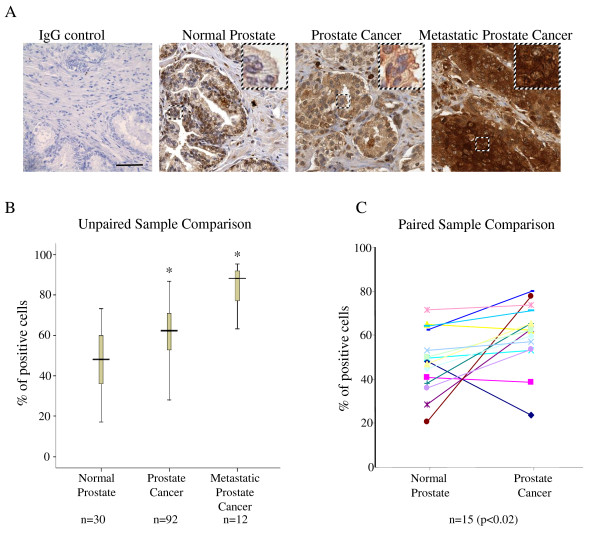
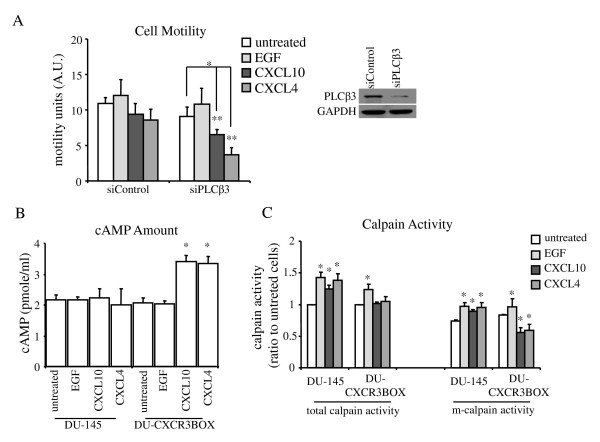
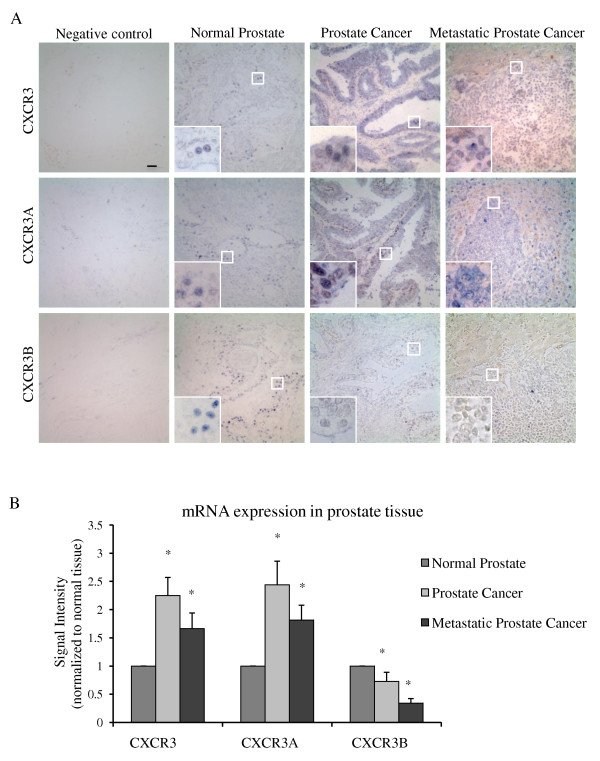
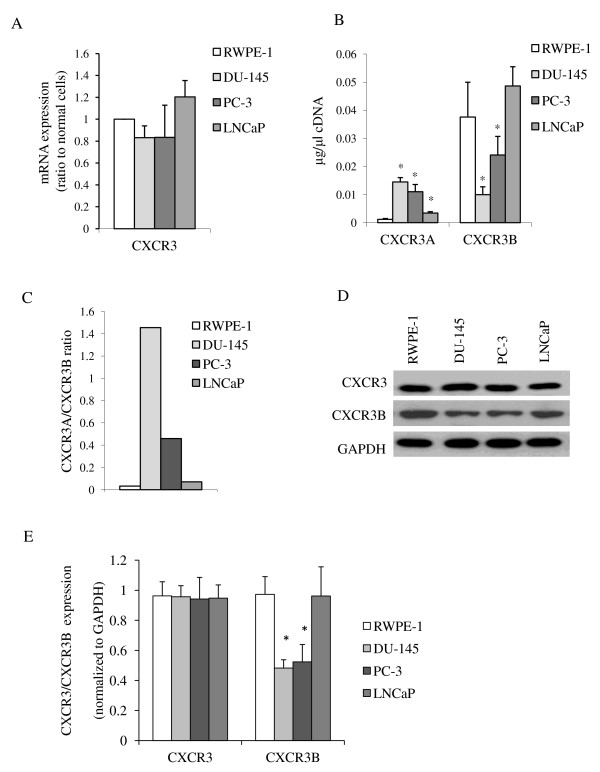
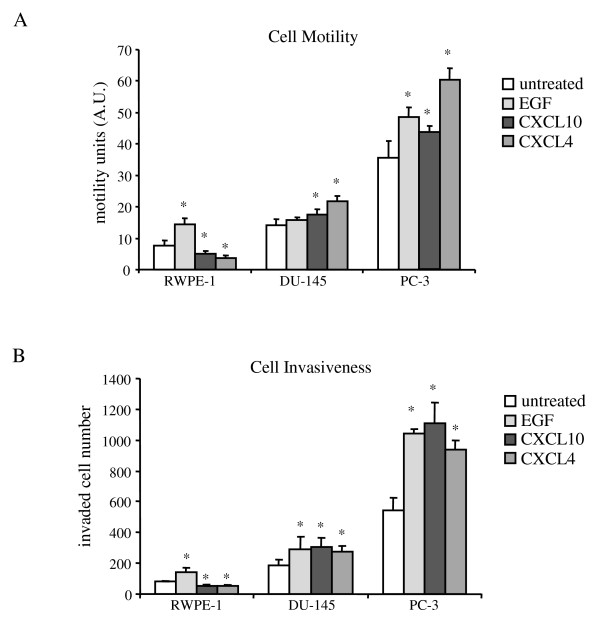
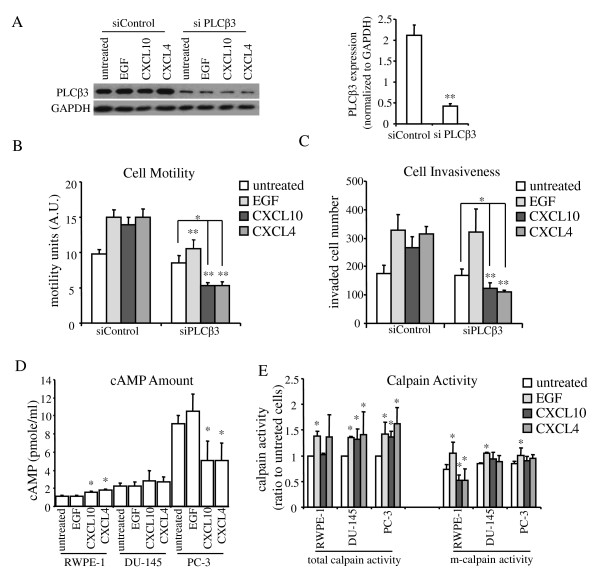
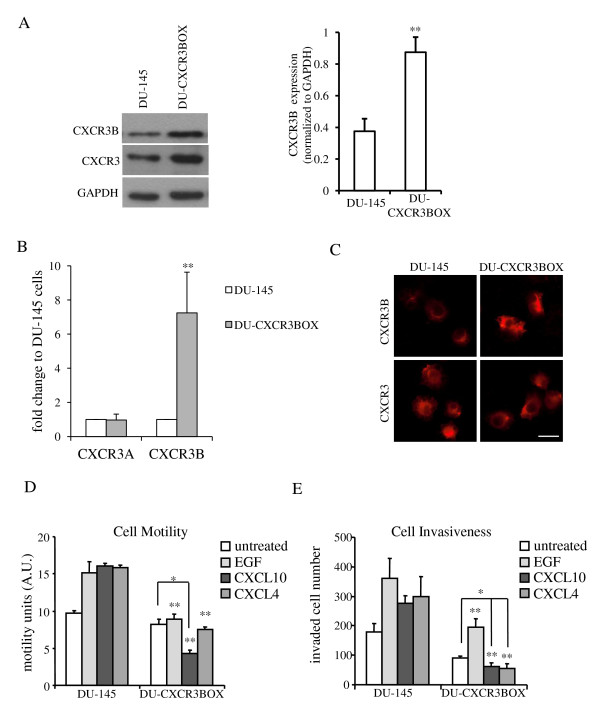
Here, we examined the expression and function of two CXCR3 variants in human prostate cancer biopsies and cell lines. Globally, both CXCR3 mRNA and protein were elevated in localized and metastatic human cancer biopsies compared to normal. Additionally, CXCR3A mRNA level was upregulated while CXCR3B mRNA was downregulated in these prostate cancer specimens. In contrast to normal prostate epithelial cells (RWPE-1), CXCR3A was up to half the receptor in the invasive and metastatic DU-145 and PC-3 prostate cancer cells, but not in the localized LNCaP cells. Instead of inhibiting cell migration as in RWPE-1 cells, the CXCR3 ligands CXCL4/PF4 and CXCL10/IP10 promoted cell motility and invasiveness in both DU-145 and PC-3 cells via PLCβ3 and μ-calpain activation. CXCR3-mediated diminution of cell motility in RWPE-1 cells is likely a result of cAMP upregulation and m-calpain inhibition via CXCR3B signal transduction. Interestingly, overexpression of CXCR3B in DU-145 cells decreased cell movement and invasion.
These data suggest that the aberrant expression of CXCR3A and down-regulation of CXCR3B may switch a progression "stop" to a "go" signal to promote prostate tumor metastasis via stimulating cell migration and invasion.
癌细胞必须规避通常的抑制信号才能扩散。虽然趋化因子受体 3(CXCR3)结合的趋化因子通常被认为是黏附细胞的“停止”信号,但最近它们与癌症进展呈正相关,尽管其分子基础仍不清楚。
在这里,我们检测了两种人前列腺癌活检和细胞系中 CXCR3 变体的表达和功能。与正常组织相比,局部和转移性人癌活检中 CXCR3 mRNA 和蛋白均升高。此外,这些前列腺癌标本中 CXCR3A mRNA 水平上调,而 CXCR3B mRNA 水平下调。与正常前列腺上皮细胞(RWPE-1)相比,侵袭性和转移性 DU-145 和 PC-3 前列腺癌细胞中 CXCR3A 受体约为一半,但在局部 LNCaP 细胞中则不然。与 RWPE-1 细胞中的抑制细胞迁移相反,CXCR3 配体 CXCL4/PF4 和 CXCL10/IP10 通过 PLCβ3 和 μ-钙蛋白酶激活促进 DU-145 和 PC-3 细胞的运动性和侵袭性。CXCR3 介导的 RWPE-1 细胞中细胞迁移减少可能是由于 cAMP 上调和 m-钙蛋白酶通过 CXCR3B 信号转导抑制所致。有趣的是,DU-145 细胞中 CXCR3B 的过表达可降低细胞运动和侵袭。
这些数据表明,CXCR3A 的异常表达和 CXCR3B 的下调可能会通过刺激细胞迁移和侵袭,将进展的“停止”信号转变为“前进”信号,从而促进前列腺肿瘤转移。