Division of Medicine, Akershus University Hospital, 1478 Lørenskog, Norway.
Clin Sci (Lond). 2012 Jun;122(12):599-606. doi: 10.1042/CS20110557.
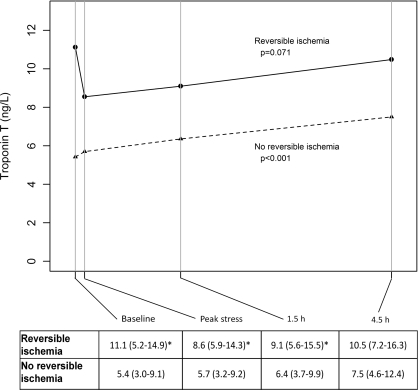
Whether reversible ischaemia in patients referred for exercise stress testing and MPI (myocardial perfusion imaging) is associated with changes in circulating cTn (cardiac troponin) levels is controversial. We measured cTnT with a sensitive assay before, immediately after peak exercise and 1.5 and 4.5 h after exercise stress testing in 198 patients referred for MPI. In total, 19 patients were classified as having reversible myocardial ischaemia. cTnT levels were significantly higher in patients with reversible myocardial ischaemia on MPI at baseline, at peak exercise and after 1.5 h, but not at 4.5 h post-exercise. In patients with reversible ischaemia on MPI, cTnT levels did not change significantly after exercise stress testing [11.1 (5.2-14.9) ng/l at baseline compared with 10.5 (7.2-16.3) ng/l at 4.5 h post-exercise, P=0.27; values are medians (interquartile range)]. Conversely, cTnT levels increased significantly during testing in patients without reversible myocardial ischaemia [5.4 (3.0-9.0) ng/l at baseline compared with 7.5 (4.6-12.4) ng/l, P<0.001]. In conclusion, baseline cTnT levels are higher in patients with MPI evidence of reversible myocardial ischaemia than those without reversible ischaemia. However, although cTnT levels increase during exercise stress testing in patients without evidence of reversible ischaemia, this response appears to be blunted in patients with evidence of reversible ischaemia. Mechanisms other than reversible myocardial ischaemia may play a role for acute exercise-induced increases in circulating cTnT levels.
在因运动应激试验和 MPI(心肌灌注成像)而转诊的患者中,可逆性缺血是否与循环 cTn(心肌肌钙蛋白)水平的变化相关存在争议。我们在 198 名因 MPI 而转诊的患者中,使用敏感检测法在基线、峰值运动后即刻以及运动应激试验后 1.5 小时和 4.5 小时测量 cTnT。共有 19 名患者被归类为 MPI 上存在可逆性心肌缺血。在基线、峰值运动后即刻以及 1.5 小时时,MPI 上存在可逆性心肌缺血的患者 cTnT 水平显著更高,但在运动应激试验后 4.5 小时时没有。在 MPI 上存在可逆性缺血的患者中,cTnT 水平在运动应激试验后没有显著变化[基线时为 11.1(5.2-14.9)ng/L,而运动后 4.5 小时时为 10.5(7.2-16.3)ng/L,P=0.27;中位数(四分位间距)]。相反,在没有可逆性心肌缺血的患者中,cTnT 水平在检测期间显著增加[基线时为 5.4(3.0-9.0)ng/L,而运动后 4.5 小时时为 7.5(4.6-12.4)ng/L,P<0.001]。总之,在 MPI 上存在可逆性心肌缺血的患者中,cTnT 水平高于没有可逆性缺血的患者。然而,尽管在没有可逆性缺血证据的患者中,cTnT 水平在运动应激试验期间增加,但这种反应在有可逆性缺血证据的患者中似乎减弱。除了可逆性心肌缺血以外,其他机制可能在急性运动引起的循环 cTnT 水平升高中发挥作用。