Department of Microbiology, Immunology, and Biochemistry, University of Tennessee Health Science Center, Memphis, Tennessee, United States of America.
PLoS Pathog. 2011 Dec;7(12):e1002452. doi: 10.1371/journal.ppat.1002452. Epub 2011 Dec 29.
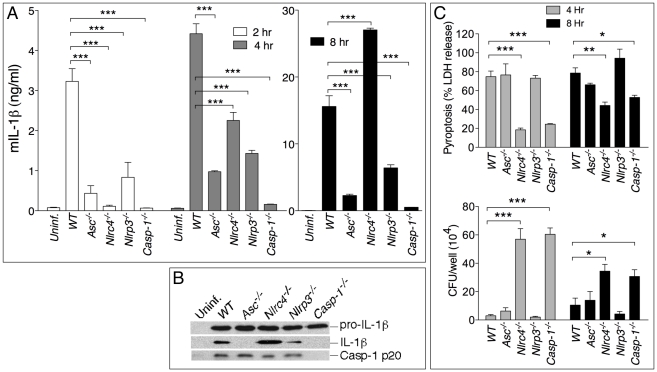
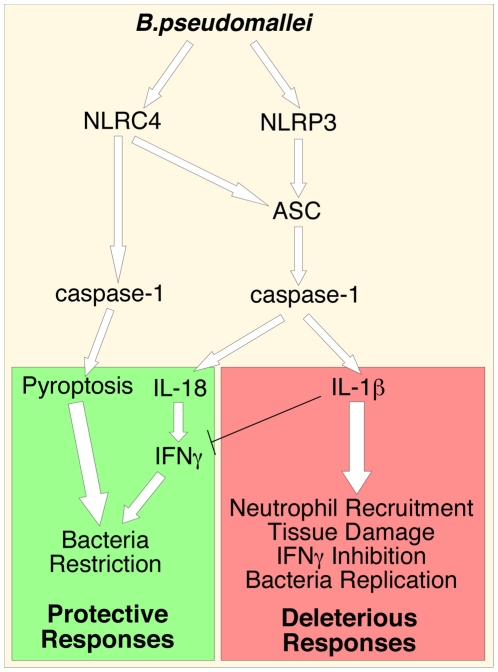
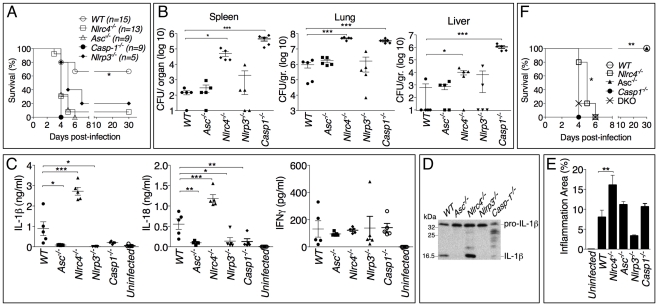
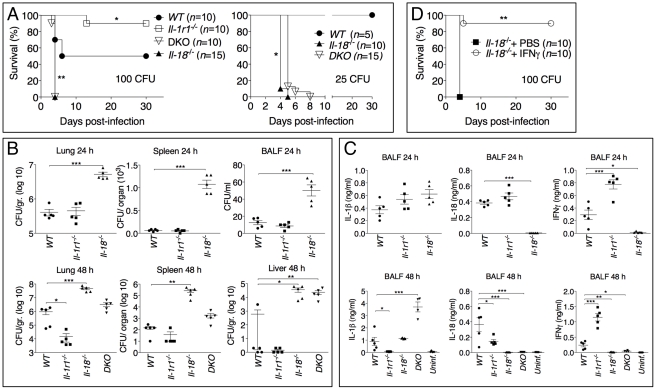
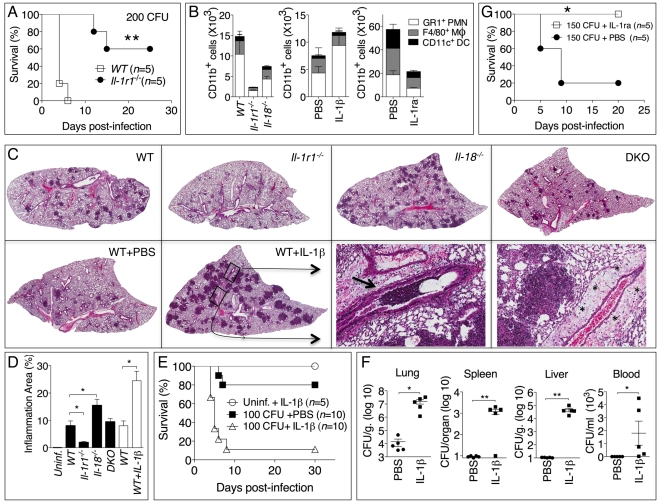
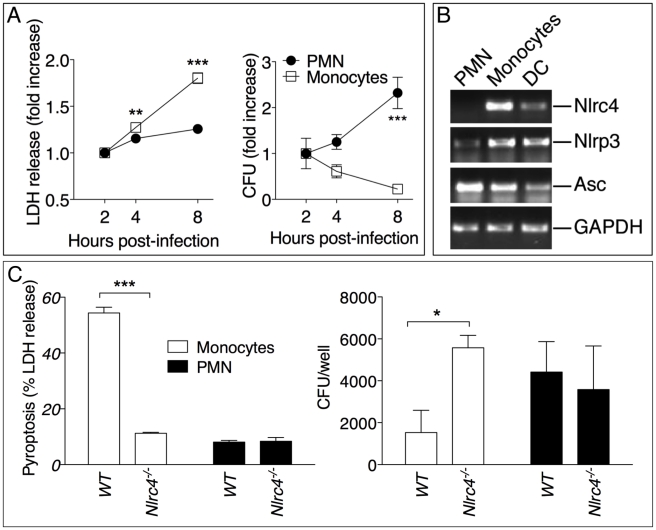
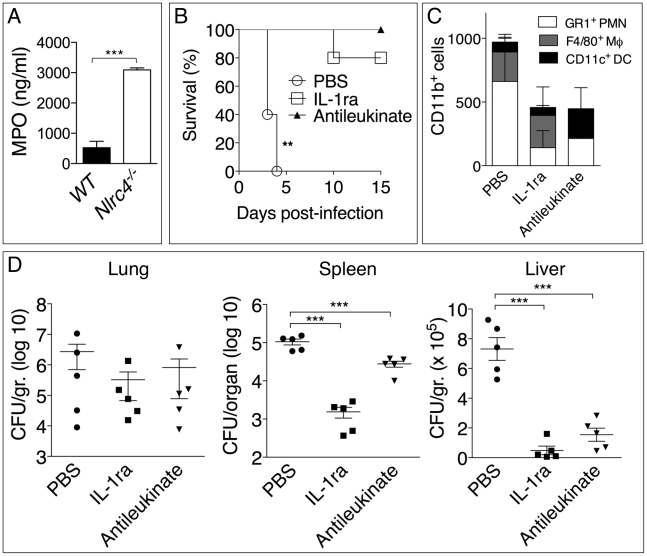
Burkholderia pseudomallei is a Gram-negative bacterium that infects macrophages and other cell types and causes melioidosis. The interaction of B. pseudomallei with the inflammasome and the role of pyroptosis, IL-1β, and IL-18 during melioidosis have not been investigated in detail. Here we show that the Nod-like receptors (NLR) NLRP3 and NLRC4 differentially regulate pyroptosis and production of IL-1β and IL-18 and are critical for inflammasome-mediated resistance to melioidosis. In vitro production of IL-1β by macrophages or dendritic cells infected with B. pseudomallei was dependent on NLRC4 and NLRP3 while pyroptosis required only NLRC4. Mice deficient in the inflammasome components ASC, caspase-1, NLRC4, and NLRP3, were dramatically more susceptible to lung infection with B. pseudomallei than WT mice. The heightened susceptibility of Nlrp3⁻/⁻ mice was due to decreased production of IL-18 and IL-1β. In contrast, Nlrc4⁻/⁻ mice produced IL-1β and IL-18 in higher amount than WT mice and their high susceptibility was due to decreased pyroptosis and consequently higher bacterial burdens. Analyses of IL-18-deficient mice revealed that IL-18 is essential for survival primarily because of its ability to induce IFNγ production. In contrast, studies using IL-1RI-deficient mice or WT mice treated with either IL-1β or IL-1 receptor agonist revealed that IL-1β has deleterious effects during melioidosis. The detrimental role of IL-1β appeared to be due, in part, to excessive recruitment of neutrophils to the lung. Because neutrophils do not express NLRC4 and therefore fail to undergo pyroptosis, they may be permissive to B. pseudomallei intracellular growth. Administration of neutrophil-recruitment inhibitors IL-1ra or the CXCR2 neutrophil chemokine receptor antagonist antileukinate protected Nlrc4⁻/⁻ mice from lethal doses of B. pseudomallei and decreased systemic dissemination of bacteria. Thus, the NLRP3 and NLRC4 inflammasomes have non-redundant protective roles in melioidosis: NLRC4 regulates pyroptosis while NLRP3 regulates production of protective IL-18 and deleterious IL-1β.
类鼻疽伯克霍尔德菌是一种革兰氏阴性细菌,可感染巨噬细胞和其他细胞类型,并导致类鼻疽病。类鼻疽伯克霍尔德菌与炎症小体的相互作用以及细胞焦亡、IL-1β 和 IL-18 在类鼻疽病中的作用尚未被详细研究。在这里,我们表明,核苷酸结合寡聚化结构域样受体 (NLR) NLRP3 和 NLRC4 差异调节细胞焦亡和 IL-1β 和 IL-18 的产生,并且对炎症小体介导的类鼻疽病抗性至关重要。体外感染类鼻疽伯克霍尔德菌的巨噬细胞或树突状细胞产生的 IL-1β 依赖于 NLRC4 和 NLRP3,而细胞焦亡仅需要 NLRC4。ASC、caspase-1、NLRC4 和 NLRP3 炎症小体成分缺失的小鼠对肺部类鼻疽伯克霍尔德菌感染的敏感性明显高于 WT 小鼠。Nlrp3⁻/⁻ 小鼠的易感性增加是由于 IL-18 和 IL-1β 的产生减少所致。相比之下,Nlrc4⁻/⁻ 小鼠产生的 IL-1β 和 IL-18 高于 WT 小鼠,其高易感性是由于细胞焦亡减少,进而细菌负荷增加所致。对 IL-18 缺陷小鼠的分析表明,IL-18 是生存所必需的,主要是因为它能够诱导 IFNγ 的产生。相比之下,使用 IL-1RI 缺陷小鼠或用 IL-1β 或 IL-1 受体激动剂处理的 WT 小鼠的研究表明,IL-1β 在类鼻疽病中具有有害作用。IL-1β 的有害作用似乎部分归因于过度招募中性粒细胞到肺部。由于中性粒细胞不表达 NLRC4,因此不会发生细胞焦亡,它们可能允许类鼻疽伯克霍尔德菌的细胞内生长。中性粒细胞募集抑制剂 IL-1ra 或 CXCR2 中性粒细胞趋化因子受体拮抗剂 antileukinate 的给药可保护 Nlrc4⁻/⁻ 小鼠免受致死剂量的类鼻疽伯克霍尔德菌的侵害,并减少细菌的全身扩散。因此,NLRP3 和 NLRC4 炎症小体在类鼻疽病中具有非冗余的保护作用:NLRC4 调节细胞焦亡,而 NLRP3 调节保护性 IL-18 和有害的 IL-1β 的产生。