Rheumatology Service, Hospital Universitario de La Princesa, IIS Princesa, Madrid, Spain.
PLoS One. 2011;6(12):e29492. doi: 10.1371/journal.pone.0029492. Epub 2011 Dec 29.
Interleukin-15 (IL-15) is thought to be involved in the physiopathological mechanisms of RA and it can be detected in the serum and the synovial fluid of inflamed joints in patients with RA but not in patients with osteoarthritis or other inflammatory joint diseases. Therefore, the objective of this work is to analyse whether serum IL-15 (sIL-15) levels serve as a biomarker of disease severity in patients with early arthritis (EA).
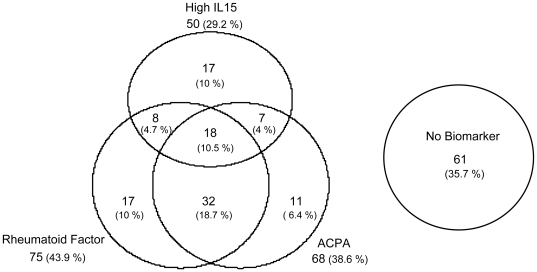
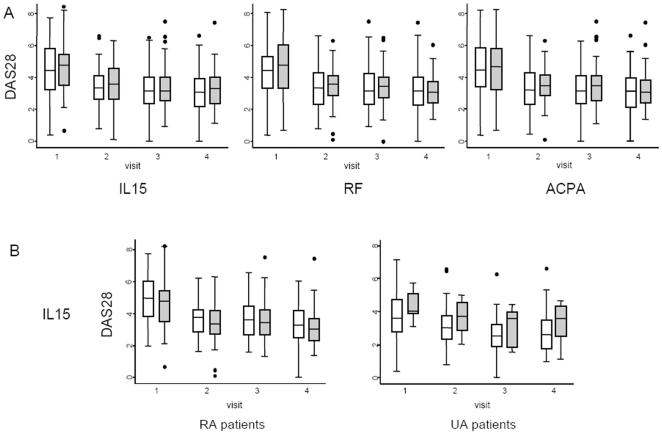
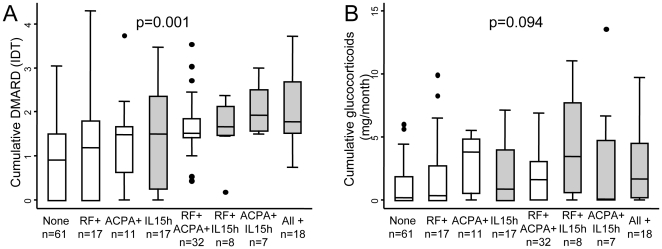
Data from 190 patients in an EA register were analysed (77.2% female; median age 53 years; 6-month median disease duration at entry). Clinical and treatment information was recorded systematically, especially the prescription of disease modifying anti-rheumatic drugs. Two multivariate longitudinal analyses were performed with different dependent variables: 1) DAS28 and 2) a variable reflecting intensive treatment. Both included sIL-15 as predictive variable and other variables associated with disease severity, including rheumatoid factor (RF) and anti-cyclic citrullinated peptide antibodies (ACPA). Of the 171 patients (638 visits analysed) completing the follow-up, 71% suffered rheumatoid arthritis and 29% were considered as undifferentiated arthritis. Elevated sIL-15 was detected in 29% of this population and this biomarker did not overlap extensively with RF or ACPA. High sIL-15 levels (β Coefficient [95% confidence interval]: 0.12 [0.06-0.18]; p<0.001) or ACPA (0.34 [0.01-0.67]; p = 0.044) were significantly and independently associated with a higher DAS28 during follow-up, after adjusting for confounding variables such as gender, age and treatment. In addition, those patients with elevated sIL-15 had a significantly higher risk of receiving intensive treatment (RR 1.78, 95% confidence interval 1.18-2.7; p = 0.007).
Patients with EA displaying high baseline sIL-15 suffered a more severe disease and received more intensive treatment. Thus, sIL-15 may be a biomarker for patients that are candidates for early and more intensive treatment.
白细胞介素-15(IL-15)被认为参与了 RA 的病理生理机制,并且可以在 RA 患者的血清和炎症关节的滑液中检测到,但在骨关节炎或其他炎症性关节疾病患者中则无法检测到。因此,本研究的目的是分析血清白细胞介素-15(sIL-15)水平是否可作为早期关节炎(EA)患者疾病严重程度的生物标志物。
对 EA 登记处的 190 例患者的数据进行了分析(77.2%为女性;中位年龄 53 岁;入组时疾病的中位病程为 6 个月)。系统记录了临床和治疗信息,特别是疾病修饰抗风湿药物的处方。对两个不同的因变量进行了多元纵向分析:1)DAS28 和 2)反映强化治疗的变量。两个分析均将 sIL-15 作为预测变量,并将其他与疾病严重程度相关的变量(包括类风湿因子[RF]和抗环瓜氨酸肽抗体[ACPA])纳入其中。在完成随访的 171 例患者(638 次就诊分析)中,71%患有类风湿关节炎,29%被认为是未分化关节炎。该人群中有 29%检测到 sIL-15 升高,而该生物标志物与 RF 或 ACPA 没有广泛重叠。高 sIL-15 水平(β 系数[95%置信区间]:0.12[0.06-0.18];p<0.001)或 ACPA(0.34[0.01-0.67];p=0.044)与随访期间 DAS28 升高显著相关,并且在调整性别、年龄和治疗等混杂因素后仍然如此。此外,sIL-15 升高的患者接受强化治疗的风险显著增加(RR 1.78,95%置信区间 1.18-2.7;p=0.007)。
基线 sIL-15 较高的 EA 患者疾病更严重,接受了更强化的治疗。因此,sIL-15 可能是适合早期更强化治疗的患者的生物标志物。