Department of Urology, Sylvester Comprehensive Cancer Center, University of Miami Miller School of Medicine, Miami, Florida 33101, USA.
J Urol. 2012 Mar;187(3):827-33. doi: 10.1016/j.juro.2011.10.150. Epub 2012 Jan 15.
Molecular characterization of renal cell carcinoma may help differentiate benign oncocytoma from malignant renal cell carcinoma subtypes and predict metastasis. Chemokines, eg IL-8 and chemokine receptors such as CXCR4 and 7, promote inflammation and metastasis. SDF-1 is a CXCR4 and 7 ligand with 6 known isoforms. We evaluated the expression of these chemokines and chemokine receptors in kidney specimens.
Using quantitative polymerase chain reaction we measured mRNA levels of IL-8, CXCR4 and 7, and SDF1 isoforms α, β and γ in a total of 166 specimens from 86 patients, including 86 tumor samples and 80 matched normal kidney samples. Mean ± SD followup was 18.9 ± 12 months (median 19.5). Renal cell carcinoma specimens included the clear cell, papillary and chromophobe subtype in 65, 10 and 5 cases, respectively, and oncocytoma in 6. A total of 17 cases were positive for metastasis.
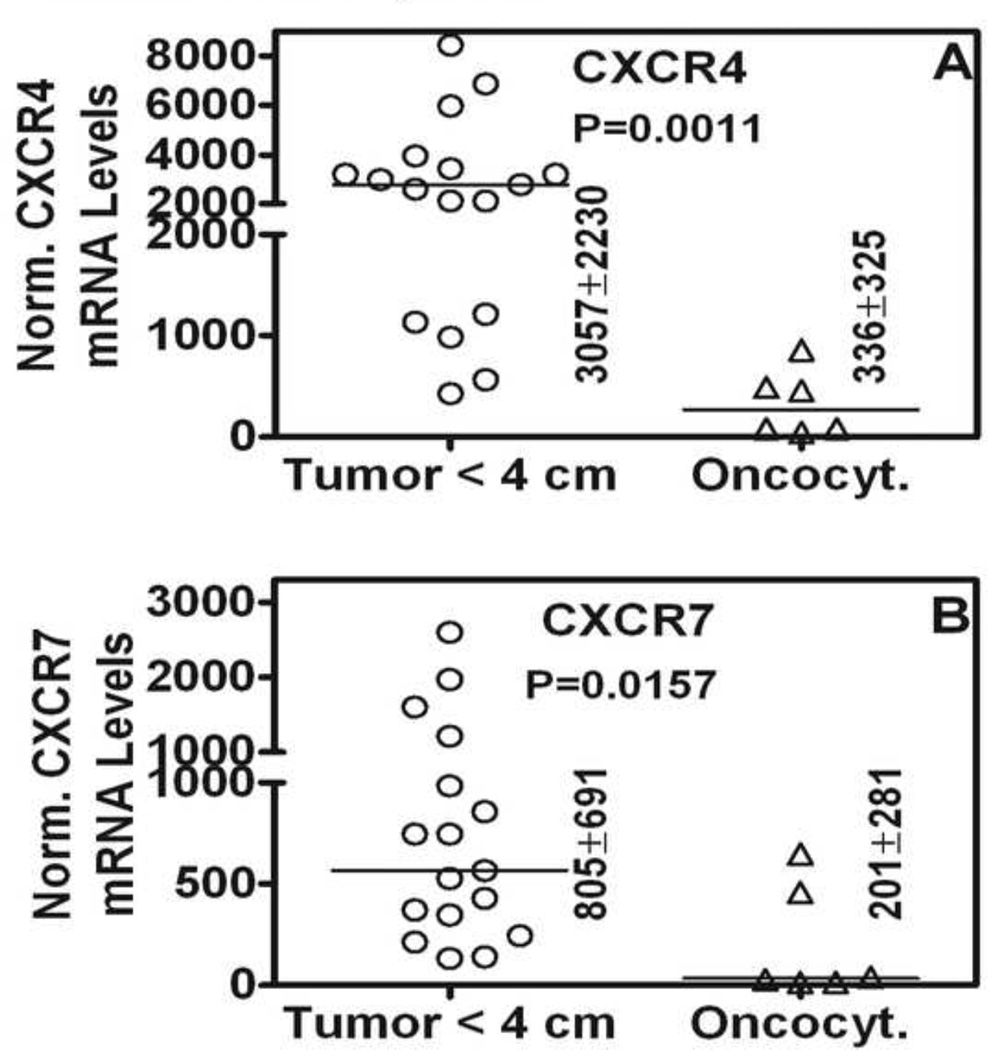
Median CXCR4 and 7, and SFD1-γ levels were increased twofold to tenfold. SDF1-α and β were unchanged or lower in clear cell renal cell carcinoma and papillary tumors than in normal tissue. Median SDF1-γ, IL-8, and CXCR4 and 7 were increased threefold to fortyfold in chromophobe tumors compared to oncocytoma. CXCR4 and 7 were increased in tumors less than 4 cm (mean 3,057 ± 2,230 and 806 ± 691) compared to oncocytoma (336 ± 325 and 201 ± 281, respectively, p ≤0.016). On multivariate analysis CXCR4 (p = 0.01), CXCR7 (p = 0.02) and SDF1-β (p = 0.005) were independently associated with metastasis. Combined CXCR7 plus SDF1-α and CXCR7 plus IL-8 markers showed the highest sensitivity (71% to 81%) and specificity (75% to 80%) of all individual or combined markers.
Chemokines and chemokine receptors differentiate renal cell carcinoma and oncocytoma. Combined SDF1-α plus CXCR7 and IL-8 plus CXCR7 markers have about 80% accuracy for predicting renal cell carcinoma metastasis.
肾细胞癌的分子特征可帮助鉴别良性的嗜酸细胞瘤与恶性肾细胞癌亚型,并预测转移。趋化因子,如 IL-8 和趋化因子受体如 CXCR4 和 7,可促进炎症和转移。SDF-1 是 CXCR4 和 7 的配体,有 6 种已知的同工型。我们评估了这些趋化因子和趋化因子受体在肾脏标本中的表达。
使用定量聚合酶链反应,我们测量了 86 例患者 86 个肿瘤样本和 80 个匹配的正常肾样本中总共 166 个样本中 IL-8、CXCR4 和 7 以及 SDF1 同工型 α、β 和 γ 的 mRNA 水平。平均 ± SD 随访时间为 18.9 ± 12 个月(中位数 19.5)。肾细胞癌标本包括透明细胞、乳头状和嫌色细胞亚型,分别为 65、10 和 5 例,嗜酸细胞瘤为 6 例。共有 17 例发生转移。
CXCR4 和 7 以及 SDF1-γ 的中位数水平增加了两倍至十倍。与正常组织相比,透明细胞肾细胞癌和乳头状肿瘤的 SDF1-α 和 β 不变或降低。与嗜酸细胞瘤相比,嫌色细胞瘤的 SDF1-γ、IL-8 和 CXCR4 和 7 的中位数增加了三倍至四十倍。与嗜酸细胞瘤相比,小于 4cm 的肿瘤(平均 3057 ± 2230 和 806 ± 691)中 CXCR4 和 7 增加(分别为 336 ± 325 和 201 ± 281,p ≤0.016)。多变量分析显示,CXCR4(p = 0.01)、CXCR7(p = 0.02)和 SDF1-β(p = 0.005)与转移独立相关。联合 CXCR7 加 SDF1-α 和 CXCR7 加 IL-8 标志物的敏感性(71%至 81%)和特异性(75%至 80%)均高于所有单个或联合标志物。
趋化因子和趋化因子受体可区分肾细胞癌和嗜酸细胞瘤。联合 SDF1-α 加 CXCR7 和 IL-8 加 CXCR7 标志物对预测肾细胞癌转移的准确率约为 80%。