Janson Jolanda, Kranczioch Cornelia
Adv Cogn Psychol. 2011;7:92-107. doi: 10.2478/v10053-008-0089-x. Epub 2011 Dec 22.
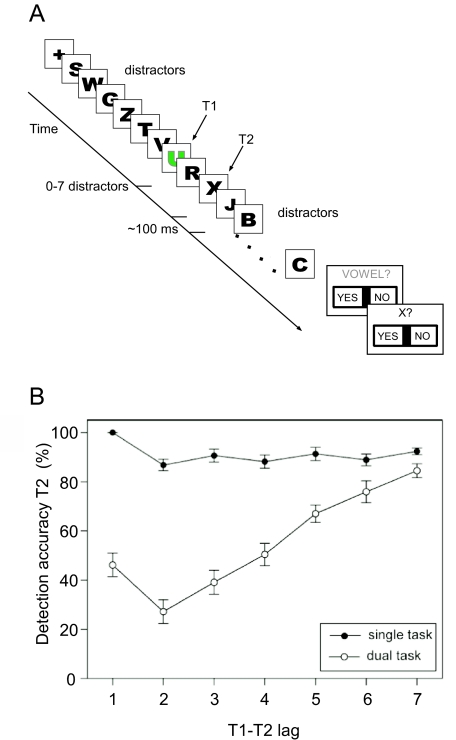
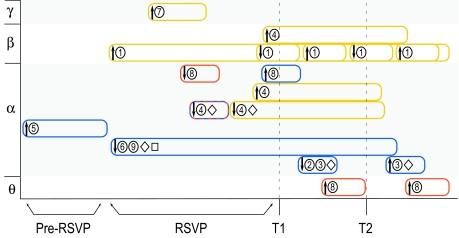
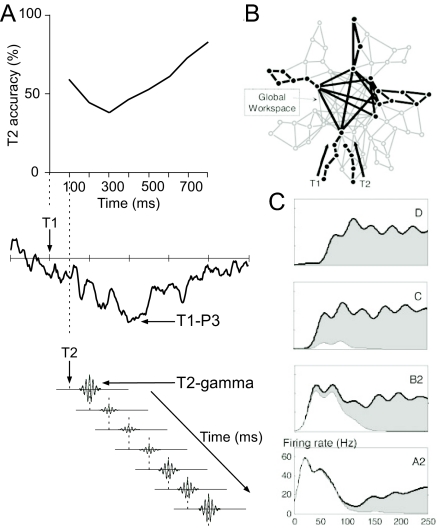
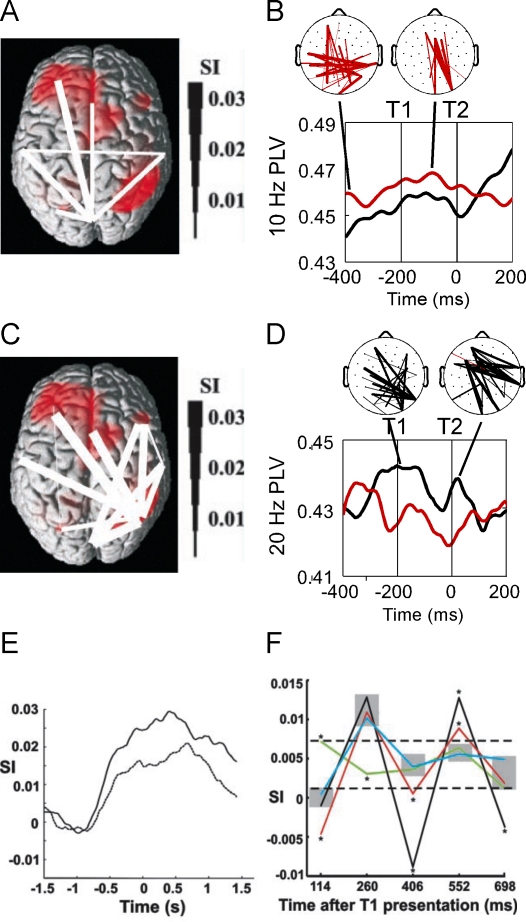
The attentional blink (AB) is a deficit in reporting the second (T2) of two targets (T1, T2) when presented in close temporal succession and within a stream of distractor stimuli. The AB has received a great deal of attention in the past two decades because it allows to study the mechanisms that influence the rate and depth of information processing in various setups and therefore provides an elegant way to study correlates of conscious perception in supra-threshold stimuli. Recently evidence has accumulated suggesting that oscillatory signals play a significant role in temporally coordinating information between brain areas. This review focuses on studies looking into oscillatory brain activity in the AB. The results of these studies indicate that the AB is related to modulations in oscillatory brain activity in the theta, alpha, beta, and gamma frequency bands. These modulations are sometimes restricted to a circumscribed brain area but more frequently include several brain regions. They occur before targets are presented as well as after the presentation of the targets. We will argue that the complexity of the findings supports the idea that the AB is not the result of a processing impairment in one particular process or brain area, but the consequence of a dynamic interplay between several processes and/or parts of a neural network.
注意瞬脱(AB)是指当两个目标(T1、T2)在紧密的时间序列中呈现且处于一串干扰刺激流中时,报告第二个目标(T2)出现困难的现象。在过去二十年里,注意瞬脱受到了广泛关注,因为它有助于研究在各种情境下影响信息处理速度和深度的机制,从而为研究阈上刺激中意识知觉的相关因素提供了一种简洁的方法。最近,越来越多的证据表明,振荡信号在大脑区域之间的时间信息协调中起着重要作用。这篇综述聚焦于研究注意瞬脱中大脑的振荡活动。这些研究结果表明,注意瞬脱与θ、α、β和γ频段的大脑振荡活动调制有关。这些调制有时局限于一个特定的脑区,但更常见的是涉及多个脑区。它们在目标呈现之前以及目标呈现之后都会出现。我们认为,这些研究结果的复杂性支持了这样一种观点,即注意瞬脱并非一个特定过程或脑区处理受损的结果,而是多个过程和/或神经网络部分之间动态相互作用的结果。