Centre for Cellular and Molecular Biology, Hyderabad, India.
PLoS One. 2012;7(1):e29827. doi: 10.1371/journal.pone.0029827. Epub 2012 Jan 11.
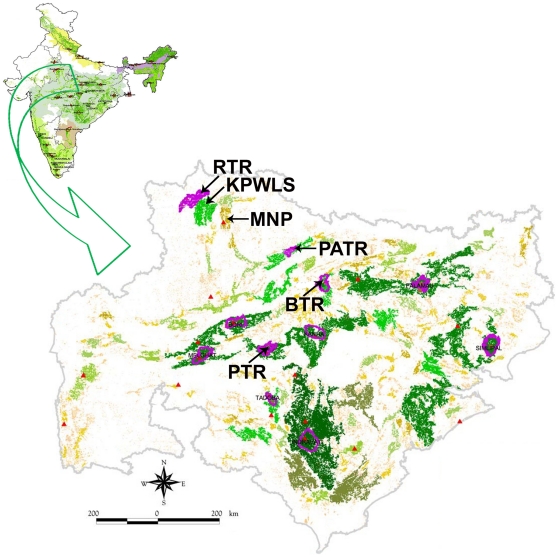
Majority of the tiger habitat in Indian subcontinent lies within high human density landscapes and is highly sensitive to surrounding pressures. These forests are unable to sustain healthy tiger populations within a tiger-hostile matrix, despite considerable conservation efforts. Ranthambore Tiger Reserve (RTR) in Northwest India is one such isolated forest which is rapidly losing its links with other tiger territories in the Central Indian landscape. Non-invasive genetic sampling for individual identification is a potent technique to understand the relationships between threatened tiger populations in degraded habitats. This study is an attempt to establish tiger movement across a fragmented landscape between RTR and its neighboring forests, Kuno-Palpur Wildlife Sanctuary (KPWLS) and Madhav National Park (MNP) based on non-invasively obtained genetic data.
Data from twelve microsatellite loci was used to define population structure and also to identify first generation migrants and admixed individuals in the above forests.
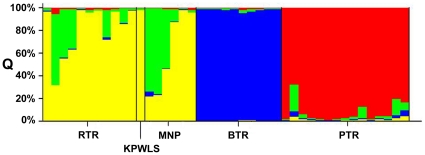
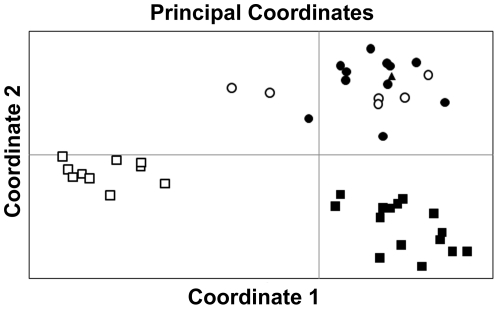
Population structure was consistent with the Central Indian landscape and we could determine significant gene flow between RTR and MNP. We could identify individuals of admixed ancestry in both these forests, as well as first generation migrants from RTR to KPWLS and MNP.
Our results indicate reproductive mixing between animals of RTR and MNP in the recent past and migration of animals even today, despite fragmentation and poaching risk, from RTR towards MNP. Substantial conservation efforts should be made to maintain connectivity between these two subpopulations and also higher protection status should be conferred on Madhav National Park.
印度次大陆大部分老虎栖息地都位于人类密度较高的景观中,并且对周围的压力非常敏感。尽管做出了相当大的保护努力,但这些森林无法在对老虎不利的环境中维持健康的老虎种群。印度西北部的兰塔本老虎保护区(RTR)就是这样一个孤立的森林,它正在迅速失去与印度中部景观中其他老虎领地的联系。个体识别的非侵入性遗传采样是了解退化栖息地中濒危老虎种群之间关系的有效技术。本研究试图基于非侵入性获得的遗传数据,确定 RTR 与其邻近森林(库诺-帕尔普尔野生动物保护区(KPWLS)和马德哈夫国家公园(MNP))之间在破碎景观中的老虎迁移情况。
使用来自十二个微卫星基因座的数据来定义种群结构,并确定上述森林中的第一代移民和混合个体。
种群结构与印度中部景观一致,我们可以确定 RTR 和 MNP 之间存在显著的基因流动。我们可以确定这两个森林中都有混合血统的个体,以及从 RTR 到 KPWLS 和 MNP 的第一代移民。
我们的结果表明,RTR 和 MNP 的动物在最近发生了繁殖混合,尽管存在碎片化和偷猎风险,但仍有动物从 RTR 向 MNP 迁移。应做出大量保护努力,以维持这两个亚种群之间的连通性,并赋予马德哈夫国家公园更高的保护地位。