Department of Urology, Hanyang University College of Medicine, Seoul, Korea.
Int Neurourol J. 2011 Dec;15(4):216-21. doi: 10.5213/inj.2011.15.4.216. Epub 2011 Dec 31.
We analyzed the prescriptions of alpha-blockers and phosphodiesterase 5 inhibitors (PDE5Is) in the urology department as well as in other departments of the general hospital.
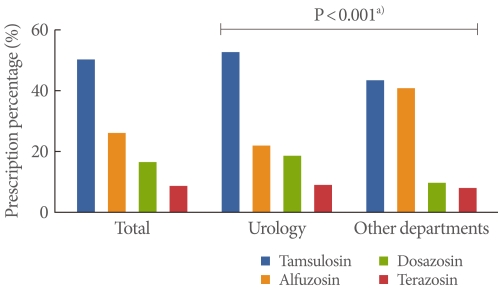
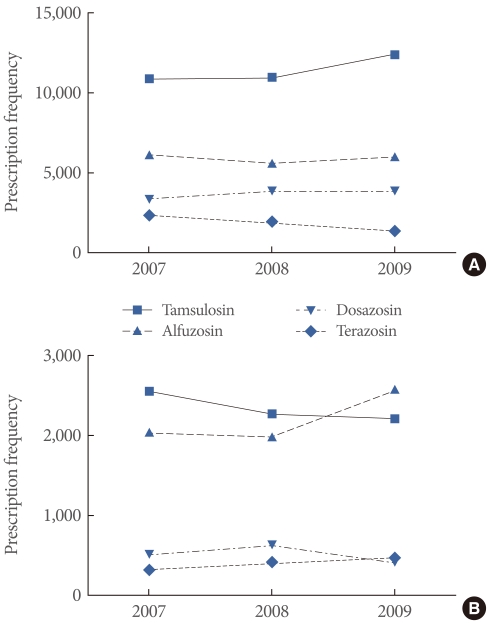
We investigated the frequency of prescription of alpha-blockers and PDE5Is from 3 general hospitals from January 1, 2007 to December 31, 2009. For alpha-blockers, data were collected from patients to whom alpha-blockers were prescribed from among patients recorded as having benign prostatic hyperplasia according to the 5th Korean Standard Classification of Diseases. For PDE5Is, data were collected from patients to whom PDE5Is were prescribed by the urology department and by other departments. Alpha-blockers were classified into tamsulosin, alfuzosin, doxazosin, and terazosin, whereas PDE5Is were classified into sildenafil, tadalafil, vardenafil, udenafil, and mirodenafil.
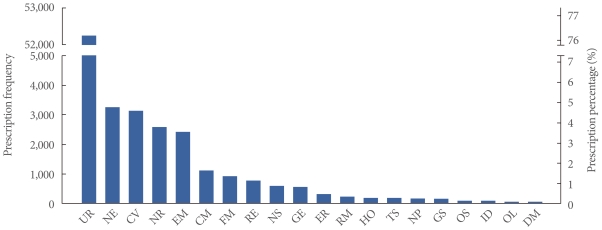
Alpha-blockers were prescribed to 11,436 patients in total over 3 years, and the total frequency of prescriptions was 68,565. Among other departments, the nephrology department had the highest frequency of prescription of 3,225 (4.7%), followed by the cardiology (3,101, 4.5%), neurology (2,576, 3.8%), endocrinology (2,400, 3.5%), pulmonology (1,102, 1.6%), and family medicine (915, 1.3%) departments in order. PDE5Is were prescribed to 2,854 patients in total over 3 years, and the total frequency of prescriptions was 10,558. The prescription frequency from the urology department was 4,900 (46.4%). Among other departments, the endocrinology department showed the highest prescription frequency of 3,488 (33.0%), followed by the neurology (542, 5.1%), cardiology (467, 4.4%), and family medicine (407, 3.9%) departments in order.
A high percentage of prescriptions of alpha-blockers and PDE5Is were from other departments. For more specialized medical care by urologists is required in the treatment of lower urinary tract symptoms and erectile dysfunction.
我们分析了泌尿科及综合医院其他科室开具的α受体阻滞剂和磷酸二酯酶 5 抑制剂(PDE5Is)处方。
我们调查了 2007 年 1 月 1 日至 2009 年 12 月 31 日来自 3 家综合医院的 α受体阻滞剂和 PDE5Is 处方频率。对于 α受体阻滞剂,我们从根据第 5 版韩国疾病分类标准被记录为患有良性前列腺增生的患者中收集了开具 α受体阻滞剂的患者的数据。对于 PDE5Is,我们从泌尿科和其他科室开具 PDE5Is 的患者中收集了数据。α受体阻滞剂分为坦索罗辛、阿夫唑嗪、多沙唑嗪和特拉唑嗪,而 PDE5Is 分为西地那非、他达拉非、伐地那非、乌地那非和米罗那非。
3 年内共为 11436 名患者开具了 α受体阻滞剂,总处方频率为 68565 次。在其他科室中,肾病科的处方频率最高,为 3225 次(4.7%),其次是心内科(3101 次,4.5%)、神经内科(2576 次,3.8%)、内分泌科(2400 次,3.5%)、呼吸内科(1102 次,1.6%)和家庭医学科(915 次,1.3%)。3 年内共为 2854 名患者开具了 PDE5Is,总处方频率为 10558 次。泌尿科的处方频率为 4900 次(46.4%)。在其他科室中,内分泌科的处方频率最高,为 3488 次(33.0%),其次是神经内科(542 次,5.1%)、心内科(467 次,4.4%)和家庭医学科(407 次,3.9%)。
α受体阻滞剂和 PDE5Is 的大部分处方来自其他科室。为了更专业的医疗护理,泌尿科医生需要对下尿路症状和勃起功能障碍进行治疗。