Hunt Tamara D, Ramanathan Shanthi A, Hannaford Natalie A, Hibbert Peter D, Braithwaite Jeffrey, Coiera Enrico, Day Richard O, Westbrook Johanna I, Runciman William B
School of Psychology, Social Work and Social Policy, Division of Education, Arts and Social Sciences, University of South Australia, Adelaide, South Australia, Australia.
BMJ Open. 2012 Jan 18;2(1):e000665. doi: 10.1136/bmjopen-2011-000665. Print 2012.
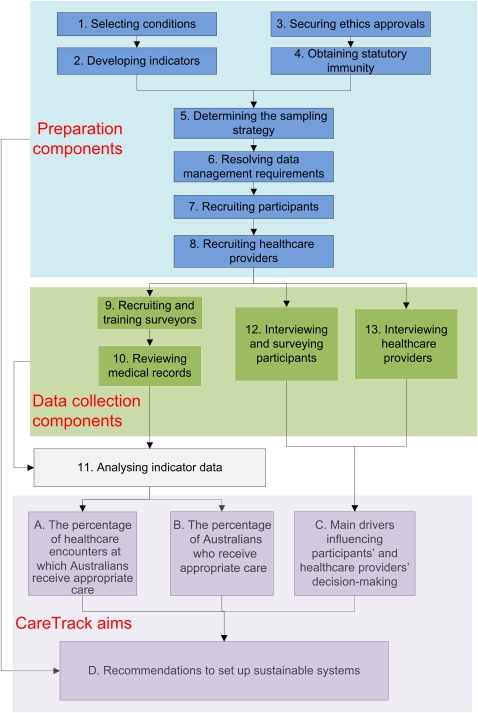
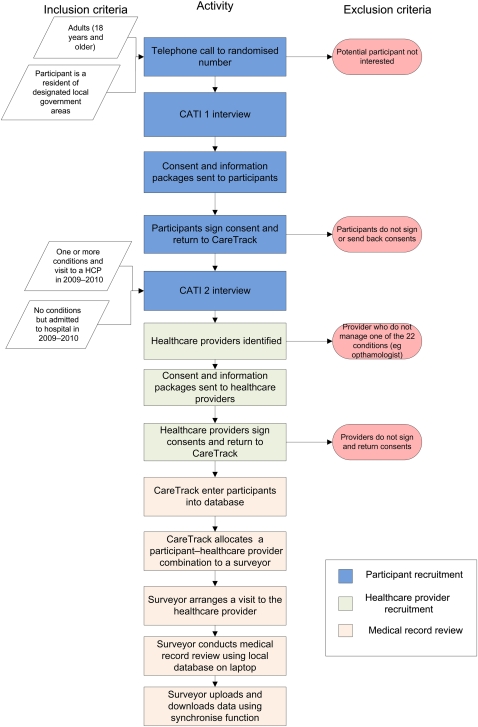
Introduction In recent years in keeping with international best practice, clinical guidelines for common conditions have been developed, endorsed and disseminated by peak national and professional bodies. Yet evidence suggests that there remain considerable gaps between the care that is regarded as appropriate by such guidelines and the care received by patients. With an ageing population and increasing treatment options and expectations, healthcare is likely to become unaffordable unless more appropriate care is provided. This paper describes a study protocol that seeks to determine the percentage of healthcare encounters in which patients receive appropriate care for 22 common clinical conditions and the reasons why variations exist from the perspectives of both patients and providers. Methods/design A random stratified sample of at least 1000 eligible participants will be recruited from a representative cross section of the adult Australian population. Participants' medical records from the years 2009 and 2010 will be audited to assess the appropriateness of the care received for 22 common clinical conditions by determining the percentage of healthcare encounters at which the care provided was concordant with a set of 522 indicators of care, developed for these conditions by a panel of 43 disease experts. The knowledge, attitudes and beliefs of participants and healthcare providers will be examined through interviews and questionnaires to understand the factors influencing variations in care. Ethics and dissemination Primary ethics approvals were sought and obtained from the Hunter New England Local Health Network. The authors will submit the results of the study to a relevant journal as well as undertaking oral presentations to researchers, clinicians and policymakers.
引言 近年来,为与国际最佳实践保持一致,针对常见病症的临床指南已由国家顶级专业机构制定、认可并发布。然而,有证据表明,此类指南所认可的适当护理与患者实际接受的护理之间仍存在相当大的差距。随着人口老龄化以及治疗选择和期望的增加,除非提供更适当的护理,否则医疗保健可能会变得难以承受。本文描述了一项研究方案,旨在确定患者针对22种常见临床病症接受适当护理的医疗接触比例,以及从患者和提供者角度分析存在差异的原因。
方法/设计 将从具有代表性的澳大利亚成年人群体中随机分层抽取至少1000名符合条件的参与者。将审核参与者2009年和2010年的病历,通过确定所提供的护理与由43位疾病专家组成的小组针对这些病症制定的522项护理指标相一致的医疗接触百分比,来评估针对22种常见临床病症所接受护理的适当性。将通过访谈和问卷调查来研究参与者和医疗保健提供者的知识、态度和信念,以了解影响护理差异的因素。
伦理与传播 已寻求并获得了亨特新英格兰地方卫生网络的主要伦理批准。作者将把研究结果提交给相关期刊,并向研究人员、临床医生和政策制定者进行口头报告。