Department of Pathology, Unit of Molecular Pathology, VU University Medical Center, Amsterdam, The Netherlands.
Cell Oncol (Dordr). 2012 Apr;35(2):77-84. doi: 10.1007/s13402-011-0062-4. Epub 2012 Jan 24.
The role of Notch signaling in HPV-mediated transformation has been a long standing debate, as both tumor suppressive and oncogenic properties have been described. We examined whether the dual findings in literature may be explained by gene dosage effects and determined the relation with AP-1, a downstream target of Notch.
SiHa cervical cancer cells were transfected with two doses of intracellular active Notch. Non-tumorigenic HPV16-immortalized keratinocytes (FK16A) were transfected with Fra1 specific siRNAs and non-targeting controls. Transfectants were analysed for Notch, Hes, cJun, cFos and Fra1 mRNA expression, Notch pathway activation using luciferase assays, cell viability using MTT assays, anchorage independent growth, AP-1 activity and/or AP-1 complex composition using EMSA.
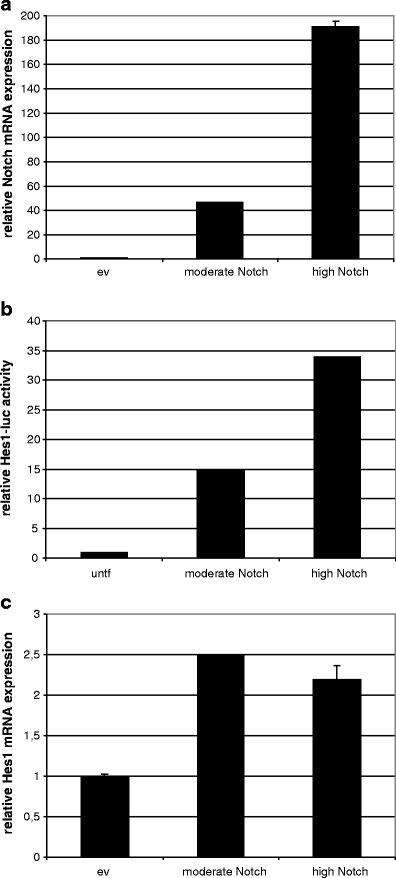
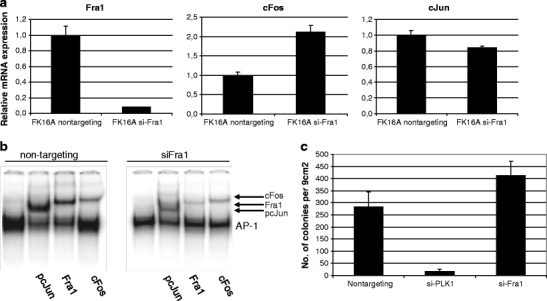
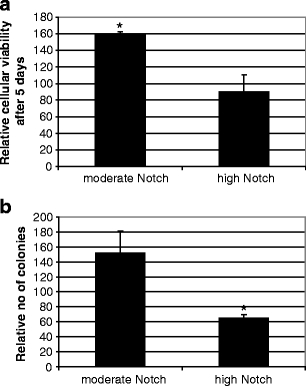
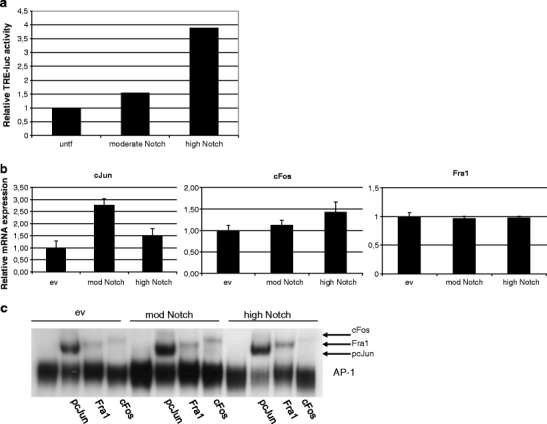
In SiHa cells two activation states of Notch signaling pathway were obtained. Moderate Notch activation contributed to increased viability and anchorage independent growth, whereas high level Notch activation decreased anchorage independent growth. The shift in phenotypical outcome was correlated to altered AP-1 activity and complex composition. Moderate Notch expression led to an increased AP-1 transcriptional activity and DNA binding activity, but did not affect complex composition. High levels of Notch additionally led to a change in AP-1 complex composition, from cJun/cFos to cJun/Fra1 dimers, which is exemplary for non-tumorigenic HPV-immortalized cell lines. Conversely, silencing of Fra1 in non-tumorigenic HPV16-immortalized keratinocytes, leading to an enrichment of cJun/cFos dimers, was accompanied with increased colony formation.
The functional role of Notch in HPV-mediated transformation is dosage dependent and correlated to a change in AP-1.
Notch 信号通路在 HPV 介导的转化中的作用一直是一个长期存在的争论,因为已经描述了其肿瘤抑制和致癌特性。我们研究了文献中的双重发现是否可以用基因剂量效应来解释,并确定了与 Notch 的下游靶标 AP-1 的关系。
用两种剂量的细胞内活性 Notch 转染宫颈癌细胞系 SiHa。用 Fra1 特异性 siRNA 和非靶向对照转染非致瘤性 HPV16 永生化角质形成细胞(FK16A)。用荧光素酶测定法分析 Notch、Hes、cJun、cFos 和 Fra1 mRNA 的表达、Notch 通路的激活,用 MTT 测定法分析细胞活力,用锚定非依赖性生长、AP-1 活性和/或 EMSA 分析 AP-1 复合物组成。
在 SiHa 细胞中获得了两种 Notch 信号通路的激活状态。中等程度的 Notch 激活有助于增加细胞活力和锚定非依赖性生长,而高水平的 Notch 激活则降低了锚定非依赖性生长。表型结果的变化与 AP-1 活性和复合物组成的改变相关。适度的 Notch 表达导致 AP-1 转录活性和 DNA 结合活性增加,但不影响复合物组成。高水平的 Notch 还导致 AP-1 复合物组成的改变,从 cJun/cFos 二聚体到 cJun/Fra1 二聚体,这是典型的非致瘤性 HPV 永生化细胞系的特征。相反,在非致瘤性 HPV16 永生化角质形成细胞中沉默 Fra1,导致 cJun/cFos 二聚体富集,伴随着集落形成增加。
Notch 在 HPV 介导的转化中的功能作用是剂量依赖性的,并与 AP-1 的变化相关。