IPATIMUP-Institute of Molecular Pathology and Immunology of the University of Porto, Porto, Portugal.
PLoS One. 2012;7(1):e29684. doi: 10.1371/journal.pone.0029684. Epub 2012 Jan 17.
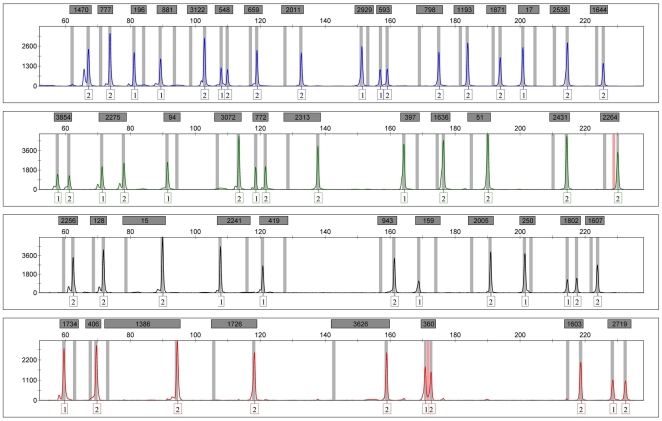
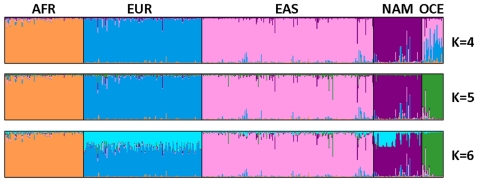
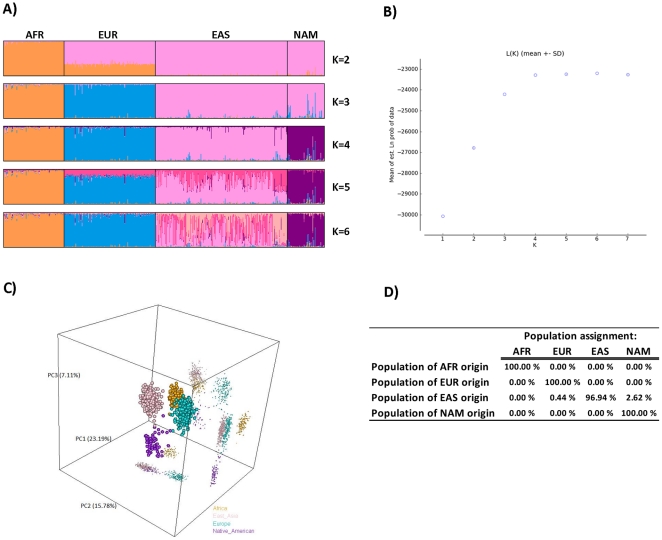
Ancestry-informative markers (AIMs) show high allele frequency divergence between different ancestral or geographically distant populations. These genetic markers are especially useful in inferring the likely ancestral origin of an individual or estimating the apportionment of ancestry components in admixed individuals or populations. The study of AIMs is of great interest in clinical genetics research, particularly to detect and correct for population substructure effects in case-control association studies, but also in population and forensic genetics studies. This work presents a set of 46 ancestry-informative insertion deletion polymorphisms selected to efficiently measure population admixture proportions of four different origins (African, European, East Asian and Native American). All markers are analyzed in short fragments (under 230 basepairs) through a single PCR followed by capillary electrophoresis (CE) allowing a very simple one tube PCR-to-CE approach. HGDP-CEPH diversity panel samples from the four groups, together with Oceanians, were genotyped to evaluate the efficiency of the assay in clustering populations from different continental origins and to establish reference databases. In addition, other populations from diverse geographic origins were tested using the HGDP-CEPH samples as reference data. The results revealed that the AIM-INDEL set developed is highly efficient at inferring the ancestry of individuals and provides good estimates of ancestry proportions at the population level. In conclusion, we have optimized the multiplexed genotyping of 46 AIM-INDELs in a simple and informative assay, enabling a more straightforward alternative to the commonly available AIM-SNP typing methods dependent on complex, multi-step protocols or implementation of large-scale genotyping technologies.
遗传标记(AIMs)显示不同祖先或地理上遥远的人群之间的等位基因频率有很大的差异。这些遗传标记特别有助于推断个体的可能祖先起源,或估计混合个体或群体中祖先成分的分配。AIMs 的研究在临床遗传学研究中非常有趣,特别是在病例对照关联研究中检测和纠正群体亚结构效应,但也在群体和法医遗传学研究中。本工作提出了一套 46 个遗传标记,用于有效地测量四个不同起源(非洲、欧洲、东亚和美洲原住民)的人口混合比例。所有标记都通过单个 PCR 进行短片段(小于 230 个碱基对)分析,然后通过毛细管电泳(CE)进行分析,允许非常简单的单管 PCR-CE 方法。对来自四个群体的 HGDP-CEPH 多样性面板样本以及大洋洲样本进行了基因分型,以评估该检测方法在聚类来自不同大陆起源的人群方面的效率,并建立参考数据库。此外,还使用 HGDP-CEPH 样本作为参考数据测试了来自不同地理起源的其他人群。结果表明,开发的 AIM-INDEL 集在推断个体的祖先方面非常有效,并提供了人群水平上的祖先比例的良好估计。总之,我们已经优化了 46 个 AIM-INDEL 的多重基因分型,使其在一个简单而信息丰富的检测中,提供了一种更直接的替代方法,而不是常见的依赖复杂、多步骤方案或实施大规模基因分型技术的 AIM-SNP 分型方法。