Department of Anesthesiology, Xijing Hospital, Fourth Military Medical University, Xi'an 710032, China.
J Neuroinflammation. 2012 Jan 26;9:24. doi: 10.1186/1742-2094-9-24.
We have previously reported that electroacupuncture (EA) pretreatment induced tolerance against cerebral ischemic injury, but the mechanisms underlying this effect of EA are unknown. In this study, we assessed the effect of EA pretreatment on the expression of α7 nicotinic acetylcholine receptors (α7nAChR), using the ischemia-reperfusion model of focal cerebral ischemia in rats. Further, we investigated the role of high mobility group box 1 (HMGB1) in neuroprotection mediated by the α7nAChR and EA.
Rats were treated with EA at the acupoint "Baihui (GV 20)" 24 h before focal cerebral ischemia which was induced for 120 min by middle cerebral artery occlusion. Neurobehavioral scores, infarction volumes, neuronal apoptosis, and HMGB1 levels were evaluated after reperfusion. The α7nAChR agonist PHA-543613 and the antagonist α-bungarotoxin (α-BGT) were used to investigate the role of the α7nAChR in mediating neuroprotective effects. The roles of the α7nAChR and HMGB1 release in neuroprotection were further tested in neuronal cultures exposed to oxygen and glucose deprivation (OGD).
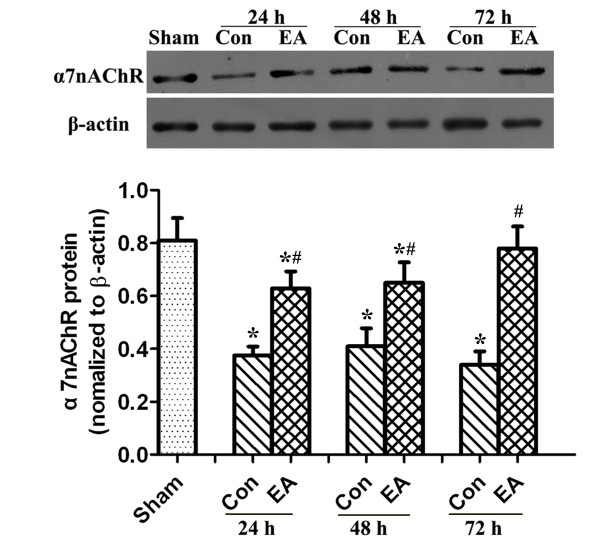
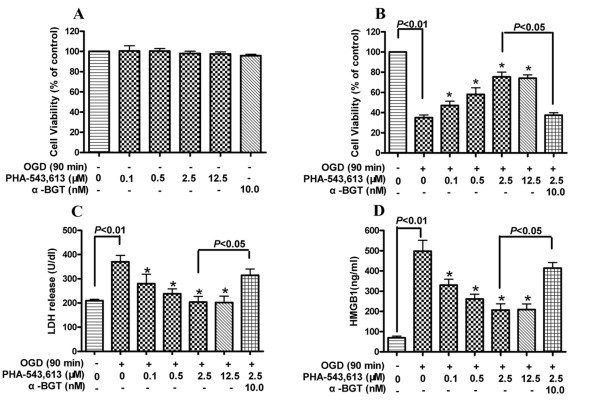
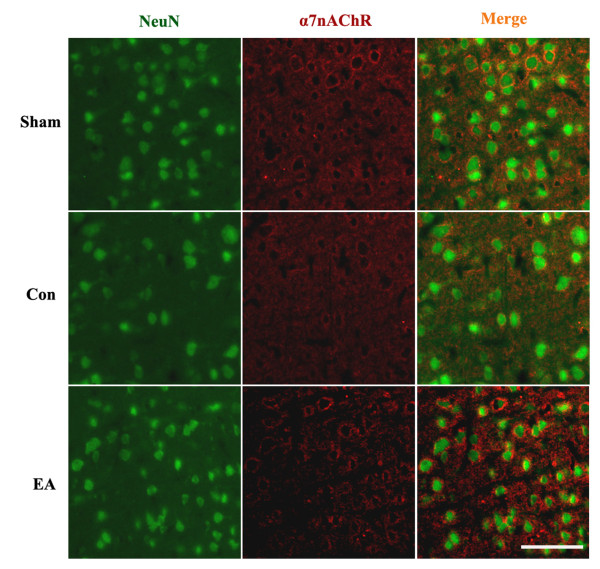
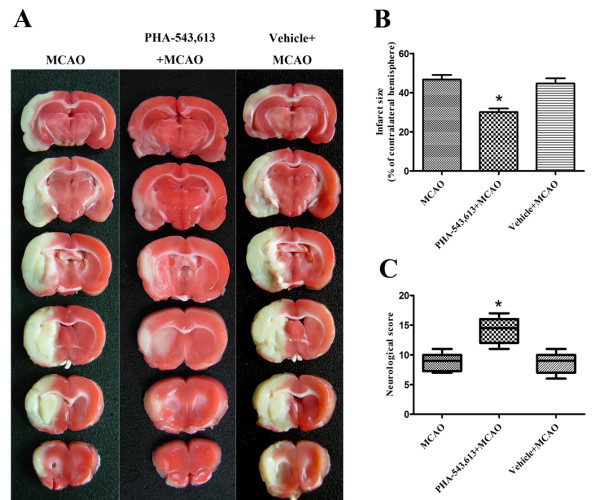
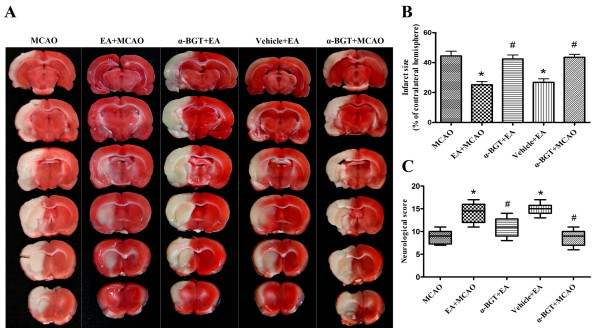
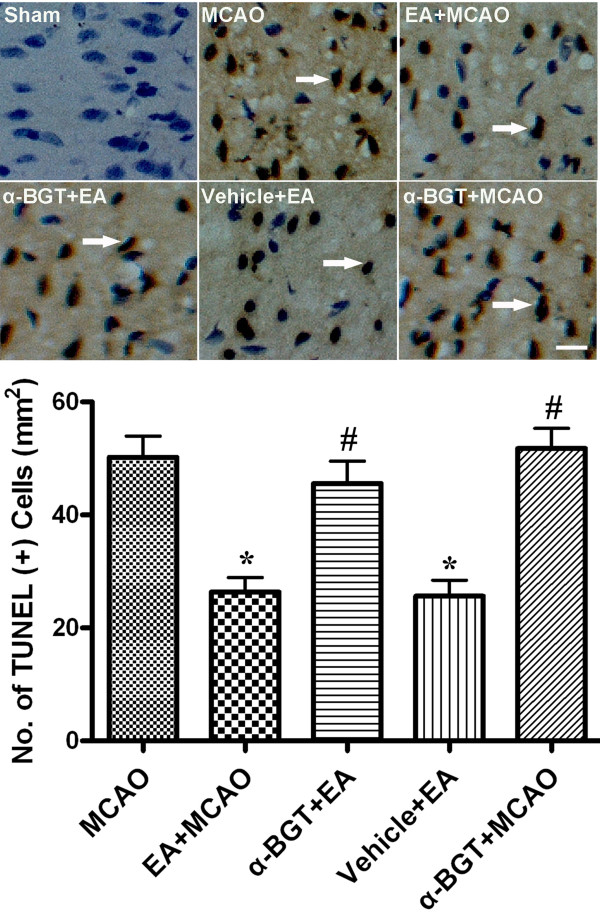
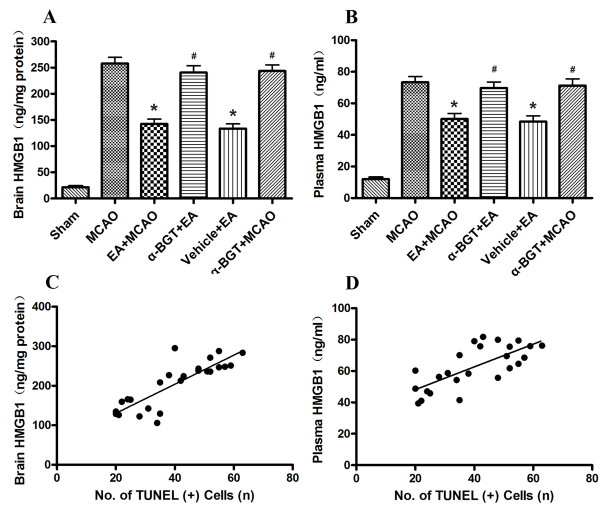
Our results showed that the expression of α7nAChR was significantly decreased after reperfusion. EA pretreatment prevented the reduction in neuronal expression of α7nAChR after reperfusion in the ischemic penumbra. Pretreatment with PHA-543613 afforded neuroprotective effects against ischemic damage. Moreover, EA pretreatment reduced infarct volume, improved neurological outcome, inhibited neuronal apoptosis and HMGB1 release following reperfusion, and the beneficial effects were attenuated by α-BGT. The HMGB1 levels in plasma and the penumbral brain tissue were correlated with the number of apoptotic neurons in the ischemic penumbra. Furthermore, OGD in cultured neurons triggered HMGB1 release into the culture medium, and this effect was efficiently suppressed by PHA-543,613. Pretreatment with α-BGT reversed the inhibitory effect of PHA-543,613 on HMGB1 release.
These data demonstrate that EA pretreatment strongly protects the brain against transient cerebral ischemic injury, and inhibits HMGB1 release through α7nAChR activation in rats. These findings suggest the novel potential for stroke interventions harnessing the anti-inflammatory effects of α7nAChR activation, through acupuncture or pharmacological strategies.
我们之前曾报道过电针(EA)预处理可诱导对脑缺血损伤的耐受,但 EA 产生这种作用的机制尚不清楚。在这项研究中,我们使用大鼠局灶性脑缺血再灌注模型评估了 EA 预处理对α7 烟碱型乙酰胆碱受体(α7nAChR)表达的影响。此外,我们还研究了高迁移率族蛋白 1(HMGB1)在 α7nAChR 和 EA 介导的神经保护中的作用。
在通过大脑中动脉闭塞诱导 120 分钟的局灶性脑缺血前 24 小时,对大鼠进行“百会(GV 20)”穴位的 EA 治疗。再灌注后评估神经行为评分、梗死体积、神经元凋亡和 HMGB1 水平。使用 α7nAChR 激动剂 PHA-543613 和拮抗剂 α-银环蛇毒素(α-BGT)来研究 α7nAChR 在介导神经保护作用中的作用。在暴露于氧葡萄糖剥夺(OGD)的神经元培养物中进一步测试了 α7nAChR 和 HMGB1 释放在神经保护中的作用。
我们的结果表明,再灌注后 α7nAChR 的表达明显减少。EA 预处理可防止缺血半影区神经元再灌注后 α7nAChR 的表达减少。PHA-543613 预处理可对抗缺血性损伤提供神经保护作用。此外,EA 预处理可减少梗死体积、改善神经功能结局、抑制再灌注后神经元凋亡和 HMGB1 释放,而 α-BGT 则减弱了这些有益作用。缺血半影区脑组织和血浆中的 HMGB1 水平与缺血半影区凋亡神经元的数量相关。此外,在培养的神经元中进行 OGD 会触发 HMGB1 释放到培养基中,而 PHA-543613 可有效地抑制这种作用。用 α-BGT 预处理可逆转 PHA-543613 对 HMGB1 释放的抑制作用。
这些数据表明,EA 预处理可强烈保护大脑免受短暂性脑缺血损伤,并通过激活大鼠的α7nAChR 抑制 HMGB1 释放。这些发现表明,通过针刺或药物策略利用α7nAChR 激活的抗炎作用进行中风干预具有新的潜力。