Department of Immunobiology, Yale University School of Medicine, New Haven, CT 06520, USA.
Sci Transl Med. 2012 Jan 25;4(118):118ra12. doi: 10.1126/scitranslmed.3003401.
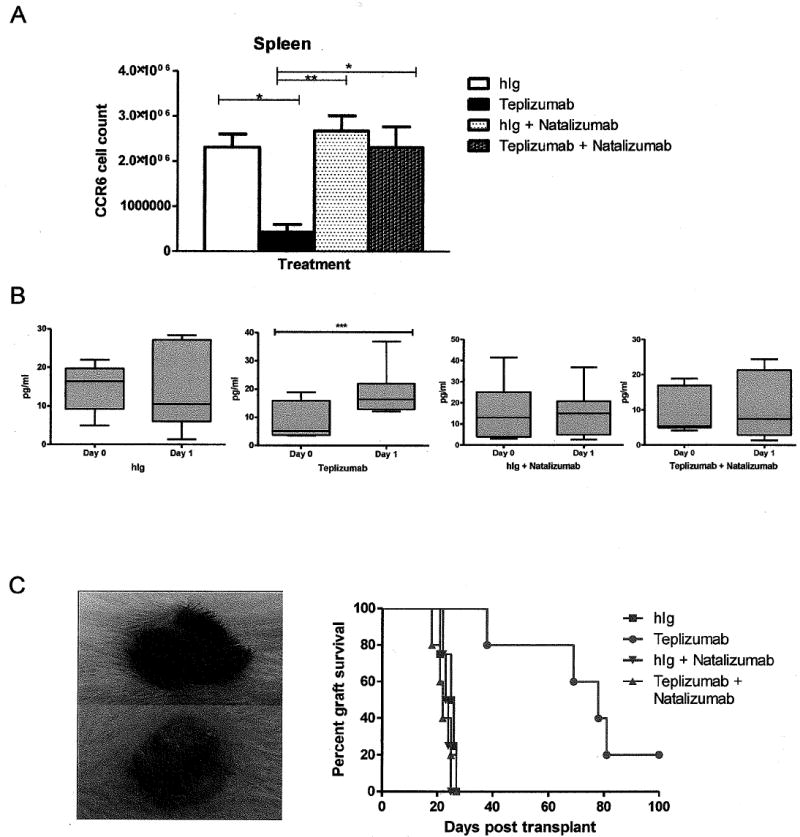
The development and optimization of immune therapies in patients has been hampered by the lack of preclinical models in which their effects on human immune cells can be studied. As a result, observations that have been made in preclinical studies have suggested mechanisms of drug action in murine models that have not been confirmed in clinical studies. Here, we used a humanized mouse reconstituted with human hematopoietic stem cells to study the mechanism of action of teplizumab, an Fc receptor nonbinding humanized monoclonal antibody to CD3 being tested in clinical trials for the treatment of patients with type 1 diabetes mellitus. In this model, human gut-tropic CCR6(+) T cells exited the circulation and secondary lymph organs and migrated to the small intestine. These cells then produced interleukin-10 (IL-10), a regulatory cytokine, in quantities that could be detected in the peripheral circulation. Blocking T cell migration to the small intestine with natalizumab, which prevents cellular adhesion by inhibiting α(4) integrin binding, abolished the treatment effects of teplizumab. Moreover, IL-10 expression by CD4(+)CD25(high)CCR6(+)FoxP3 cells returning to the peripheral circulation was increased in patients with type 1 diabetes treated with teplizumab. These findings demonstrate that humanized mice may be used to identify novel immunologic mechanisms that occur in patients treated with immunomodulators.
免疫疗法在患者中的发展和优化受到缺乏可研究其对人类免疫细胞影响的临床前模型的阻碍。因此,在临床前研究中观察到的药物作用机制在临床研究中尚未得到证实,这些观察结果在鼠模型中得到证实。在这里,我们使用用人造血干细胞重建的人源化小鼠来研究 teplizumab 的作用机制,teplizumab 是一种正在临床试验中用于治疗 1 型糖尿病患者的 Fc 受体非结合性人源化单克隆抗体。在这种模型中,人肠道趋向性 CCR6(+)T 细胞从循环和次级淋巴器官中移出,并迁移到小肠。然后,这些细胞产生白细胞介素 10(IL-10),一种调节细胞因子,其数量可以在外周循环中检测到。用那他珠单抗(natalizumab)阻断 T 细胞向小肠的迁移,通过抑制 α(4)整合素结合来阻止细胞黏附,从而消除了 teplizumab 的治疗效果。此外,用 teplizumab 治疗的 1 型糖尿病患者外周循环中 CD4(+)CD25(high)CCR6(+)FoxP3 细胞返回时的 IL-10 表达增加。这些发现表明,人源化小鼠可用于鉴定接受免疫调节剂治疗的患者中发生的新型免疫机制。