Department of Psychology and the Gonda Brain Sciences Center, Bar-Ilan University, Ramat-Gan, Israel.
Psychoneuroendocrinology. 2012 Aug;37(8):1277-85. doi: 10.1016/j.psyneuen.2011.12.021. Epub 2012 Jan 26.
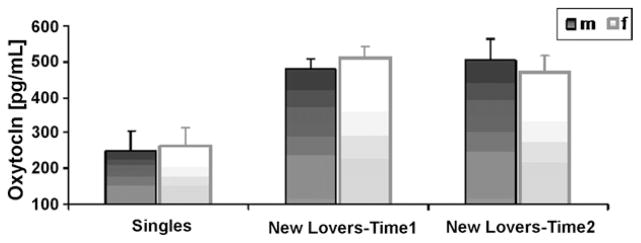
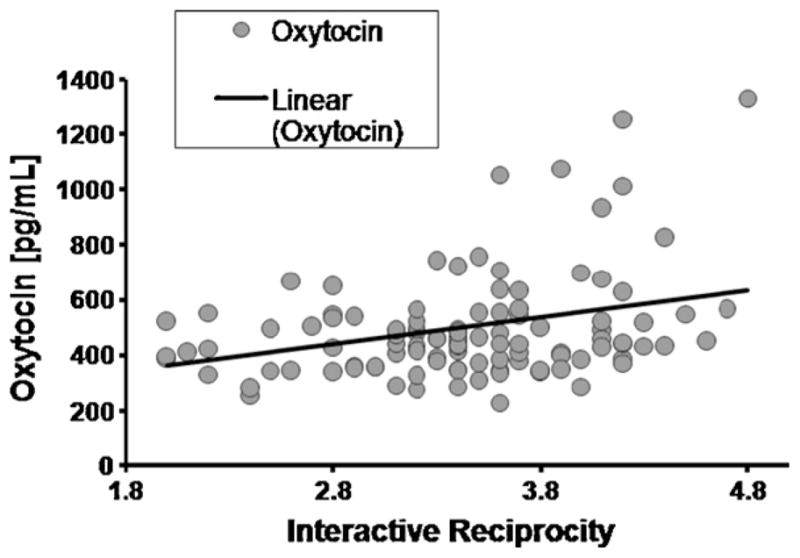
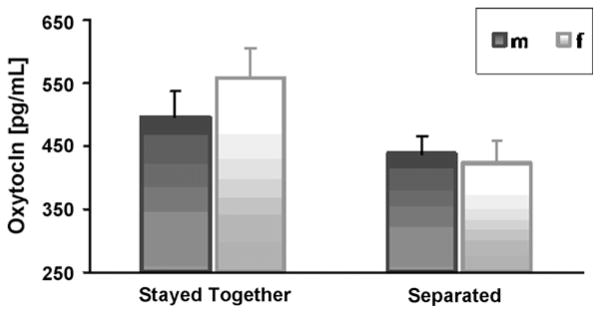
Romantic relationships can have a profound effect on adults' health and well-being whereas the inability to maintain intimate bonds has been associated with physical and emotional distress. Studies in monogamous mammalian species underscore the central role of oxytocin (OT) in pair-bonding and human imaging studies implicate OT-rich brain areas in early romantic love. To assess the role of OT in romantic attachment, we examined plasma OT in 163 young adults: 120 new lovers (60 couples) three months after the initiation of their romantic relationship and 43 non-attached singles. Twenty-five of the 36 couples who stayed together were seen again six months later. Couples were observed in dyadic interactions and were each interviewed regarding relationship-related thoughts and behaviors. OT was significantly higher in new lovers compared to singles, F(1,152)=109.33, p<.001, which may suggest increased activity of the oxytocinergic system during the early stages of romantic attachment. These high levels of OT among new lovers did not decrease six months later and showed high individual stability. OT correlated with the couples' interactive reciprocity, including social focus, positive affect, affectionate touch, and synchronized dyadic states, and with anxieties and worries regarding the partner and the relationship, findings which parallel those described for parent-infant bonding. OT levels at the first assessment differentiated couples who stayed together six months later from those who separated during this period. Regression analysis showed that OT predicted interactive reciprocity independent of sex, relationship duration, and the partner's OT. Findings suggest that OT may play an important role at the first stages of romantic attachment and lend support to evolutionary models suggesting that parental and romantic attachment share underlying bio-behavioral mechanisms.
浪漫关系对成年人的健康和幸福有深远的影响,而无法维持亲密关系则与身体和情感上的痛苦有关。在一夫一妻制的哺乳动物物种中的研究强调了催产素(OT)在伴侣关系中的核心作用,而人类成像研究则表明 OT 丰富的大脑区域参与了早期浪漫爱情。为了评估 OT 在浪漫依恋中的作用,我们检查了 163 名年轻成年人的血浆 OT:120 名新恋人(60 对情侣)在他们浪漫关系开始三个月后,以及 43 名非依恋单身人士。25 对继续在一起的情侣在六个月后再次被观察。情侣们在二元互动中被观察,并分别就与关系相关的想法和行为接受采访。与单身者相比,新恋人的 OT 明显更高,F(1,152)=109.33,p<.001,这可能表明在浪漫依恋的早期阶段,催产素能系统的活动增加。新恋人的 OT 水平在六个月后并没有降低,而且具有很高的个体稳定性。OT 与情侣的互动互惠性相关,包括社交焦点、积极情绪、亲昵触摸和同步二元状态,以及对伴侣和关系的焦虑和担忧,这些发现与描述母婴依恋的发现相似。第一次评估时的 OT 水平区分了六个月后仍在一起的情侣和在此期间分手的情侣。回归分析表明,OT 预测了互动互惠性,独立于性别、关系持续时间和伴侣的 OT。研究结果表明,OT 可能在浪漫依恋的早期阶段发挥重要作用,并支持了进化模型,即父母依恋和浪漫依恋共享潜在的生物行为机制。