Department of Chemistry, Franklin & Marshall College, Lancaster, Pennsylvania 17604-3003, USA.
J Am Chem Soc. 2012 Feb 15;134(6):2898-901. doi: 10.1021/ja2109745. Epub 2012 Feb 1.
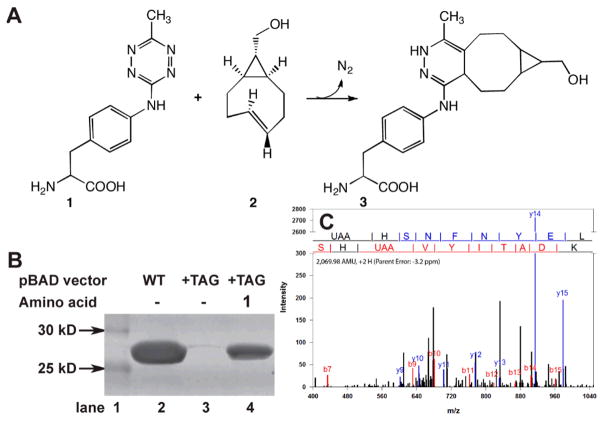
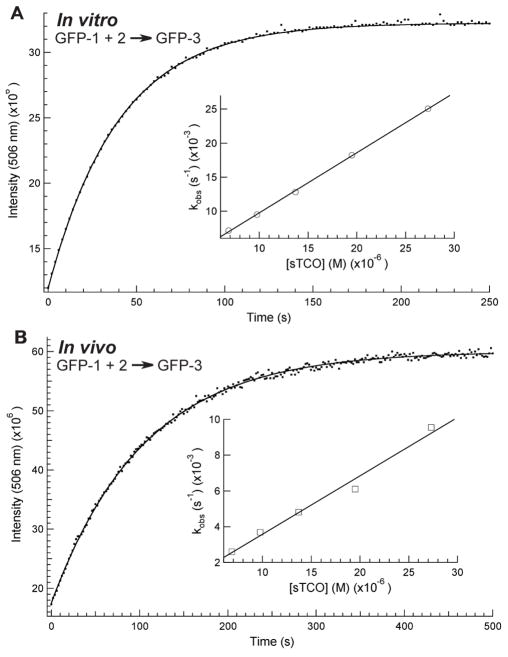
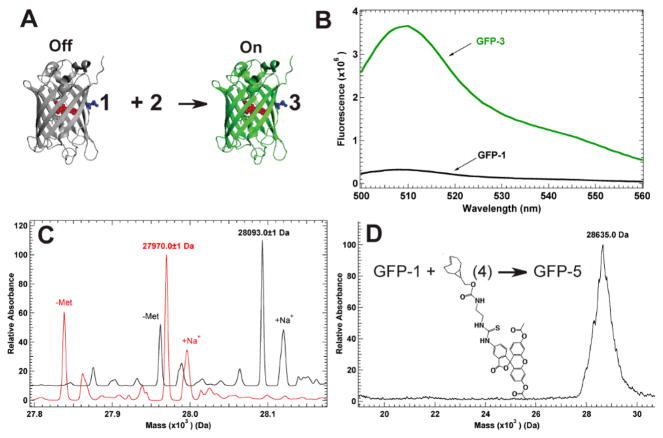
Bioorthogonal ligation methods with improved reaction rates and less obtrusive components are needed for site-specifically labeling proteins without catalysts. Currently no general method exists for in vivo site-specific labeling of proteins that combines fast reaction rate with stable, nontoxic, and chemoselective reagents. To overcome these limitations, we have developed a tetrazine-containing amino acid, 1, that is stable inside living cells. We have site-specifically genetically encoded this unique amino acid in response to an amber codon allowing a single 1 to be placed at any location in a protein. We have demonstrated that protein containing 1 can be ligated to a conformationally strained trans-cyclooctene in vitro and in vivo with reaction rates significantly faster than most commonly used labeling methods.
需要具有改进的反应速率和更少干扰性成分的生物正交连接方法,以便在没有催化剂的情况下对蛋白质进行特异性标记。目前,尚无通用方法可用于在体内对蛋白质进行特异性标记,该方法将快速反应速率与稳定、无毒和化学选择性试剂结合在一起。为了克服这些限制,我们开发了一种含有四嗪的氨基酸 1,该氨基酸在活细胞内稳定。我们通过基因特异性地将这种独特的氨基酸编码在对琥珀终止密码子的响应中,从而可以在蛋白质的任何位置放置一个 1。我们已经证明,含有 1 的蛋白质可以在体外和体内与构象受约束的反式环辛烯进行连接,其反应速率明显快于大多数常用的标记方法。