Medical Research Council Laboratory of Molecular Biology, Hills Road, Cambridge CB2 0QH, United Kingdom.
J Am Chem Soc. 2012 Jun 27;134(25):10317-20. doi: 10.1021/ja302832g. Epub 2012 Jun 13.
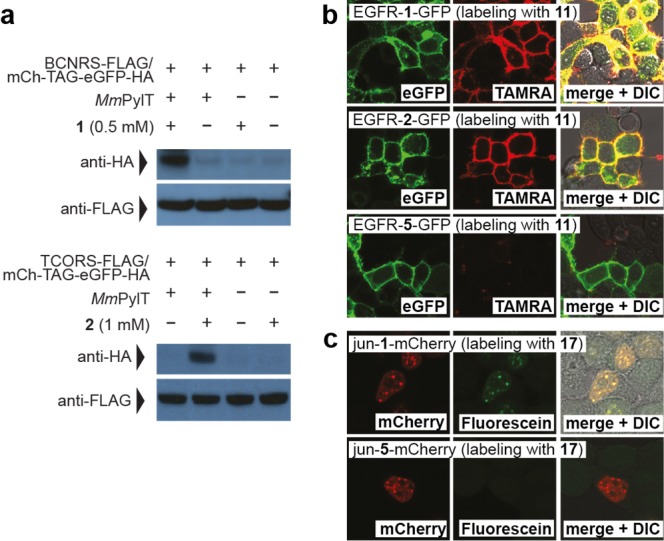
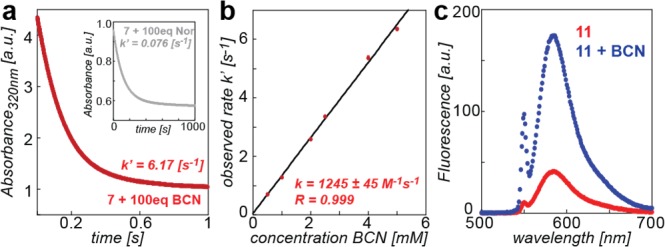
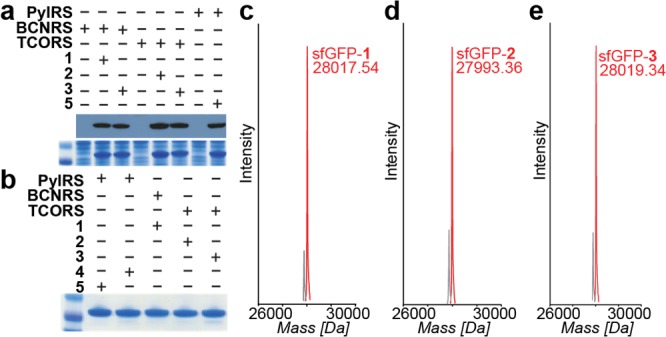
Rapid, site-specific labeling of proteins with diverse probes remains an outstanding challenge for chemical biologists. Enzyme-mediated labeling approaches may be rapid but use protein or peptide fusions that introduce perturbations into the protein under study and may limit the sites that can be labeled, while many "bioorthogonal" reactions for which a component can be genetically encoded are too slow to effect quantitative site-specific labeling of proteins on a time scale that is useful for studying many biological processes. We report a fluorogenic reaction between bicyclo[6.1.0]non-4-yn-9-ylmethanol (BCN) and tetrazines that is 3-7 orders of magnitude faster than many bioorthogonal reactions. Unlike the reactions of strained alkenes, including trans-cyclooctenes and norbornenes, with tetrazines, the BCN-tetrazine reaction gives a single product of defined stereochemistry. We have discovered aminoacyl-tRNA synthetase/tRNA pairs for the efficient site-specific incorporation of a BCN-containing amino acid, 1, and a trans-cyclooctene-containing amino acid 2 (which also reacts extremely rapidly with tetrazines) into proteins expressed in Escherichia coli and mammalian cells. We demonstrate the rapid fluorogenic labeling of proteins containing 1 and 2 in vitro, in E. coli , and in live mammalian cells. These approaches may be extended to site-specific protein labeling in animals, and we anticipate that they will have a broad impact on labeling and imaging studies.
快速、特异性地标记具有不同探针的蛋白质仍然是化学生物学家面临的一项重大挑战。酶介导的标记方法可能很快,但需要使用蛋白质或肽融合,这会对研究中的蛋白质造成干扰,并且可能限制可以标记的位点,而许多可以遗传编码的“生物正交”反应速度太慢,无法在对许多生物过程进行研究有用的时间尺度内实现蛋白质的定量特异性标记。我们报告了双环[6.1.0]壬-4-炔-9-基甲醇(BCN)和四嗪之间的荧光反应,其速度比许多生物正交反应快 3-7 个数量级。与包括反式环辛烯和降冰片烯在内的应变烯烃与四嗪的反应不同,BCN-四嗪反应得到具有明确定立体化学的单一产物。我们已经发现了用于有效特异性掺入含有 BCN 的氨基酸 1 和含有反式环辛烯的氨基酸 2(其也与四嗪反应非常迅速)的氨酰-tRNA 合成酶/tRNA 对,将其掺入大肠杆菌和哺乳动物细胞中表达的蛋白质中。我们证明了在体外、大肠杆菌和活的哺乳动物细胞中含有 1 和 2 的蛋白质的快速荧光标记。这些方法可以扩展到动物的蛋白质特异性标记,我们预计它们将对标记和成像研究产生广泛的影响。