Forest Ecology and Forest Management Group, Wageningen University, PO Box 47, 6700 AA Wageningen, The Netherlands.
Oecologia. 2012 Aug;169(4):895-904. doi: 10.1007/s00442-012-2258-3.
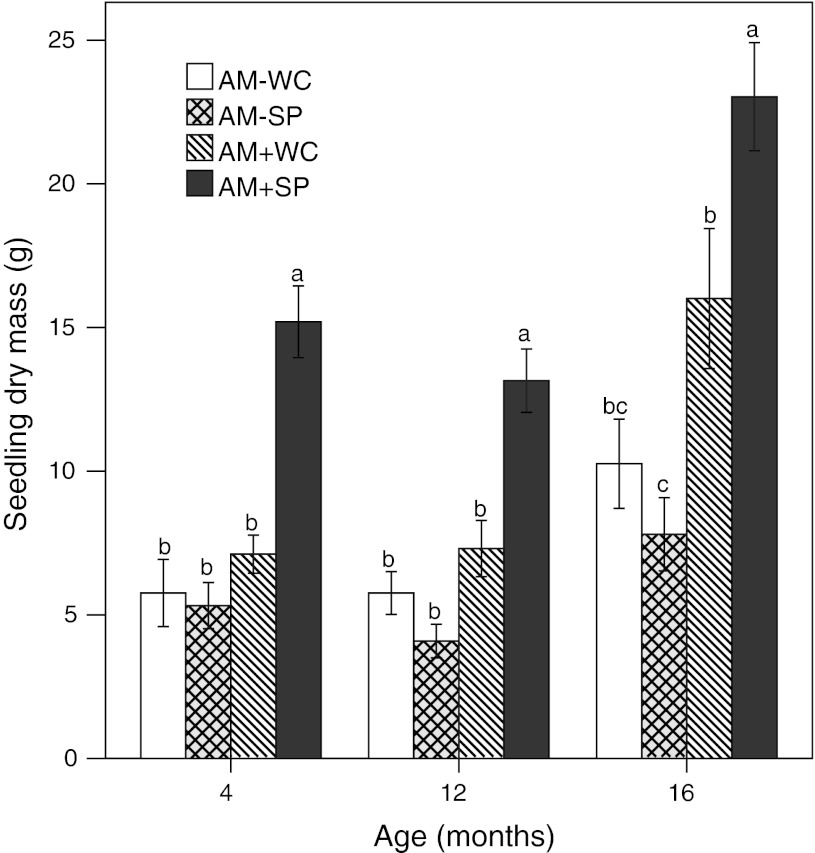
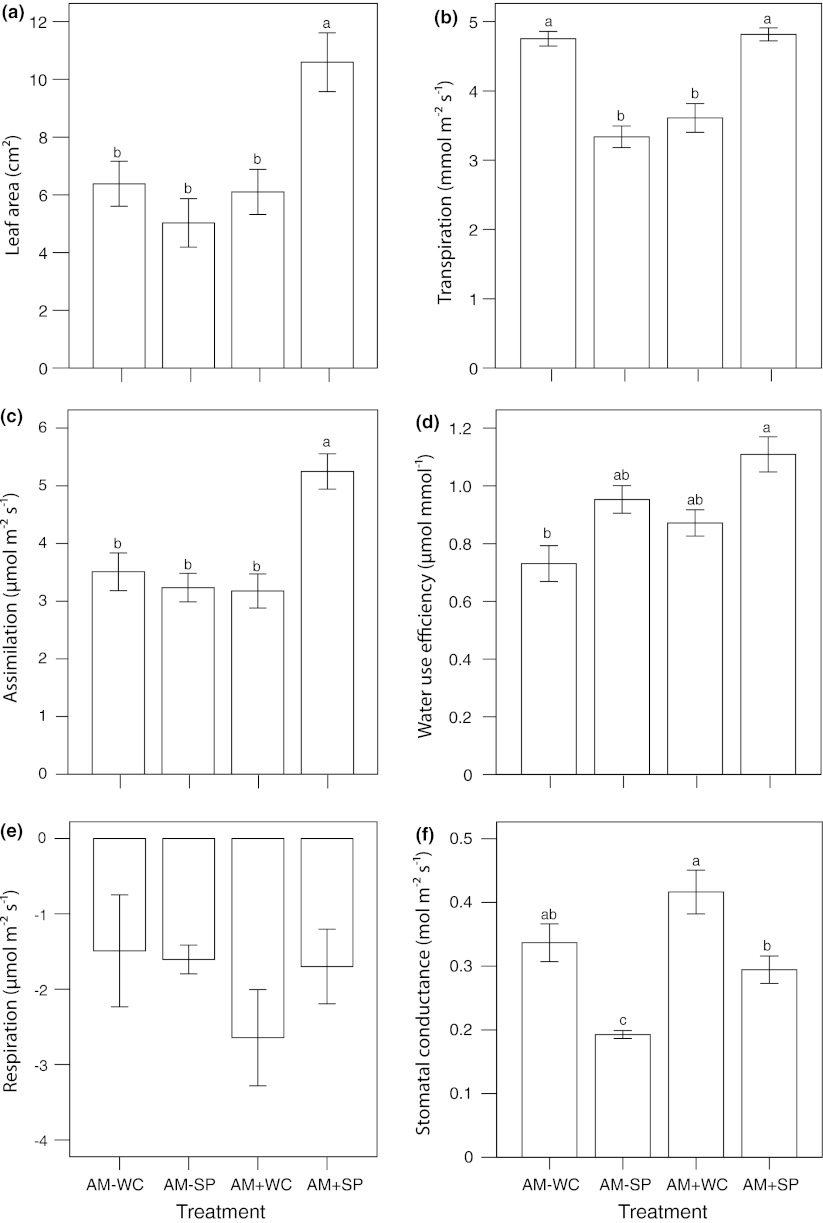
Under drought conditions, arbuscular mycorrhizal (AM) fungi alter water relationships of plants and improve their resistance to drought. In a factorial greenhouse experiment, we tested the effects of the AM symbiosis and precipitation regime on the performance (growth, gas exchange, nutrient status and mycorrhizal responsiveness) of Boswellia papyrifera seedlings. A continuous precipitation regime was imitated by continuous watering of plants to field capacity every other day during 4 months, and irregular precipitation by pulsed watering of plants where watering was switched every 15 days during these 4 months, with 15 days of watering followed by 15 days without watering. There were significantly higher levels of AM colonization under irregular precipitation regime than under continuous precipitation. Mycorrhizal seedlings had higher biomass than control seedlings. Stomatal conductance and phosphorus mass fraction in shoot and root were also significantly higher for mycorrhizal seedlings. Mycorrhizal seedlings under irregular watering had the highest biomass. Both a larger leaf area and higher assimilation rates contributed to higher biomass. Under irregular watering, the water use efficiency increased in non-mycorrhizal seedlings through a reduction in transpiration, while in mycorrhizal seedlings irregular watering increased transpiration. Because assimilation rates increased even more, mycorrhizal seedlings achieved an even higher water use efficiency. Boswellia seedlings allocated almost all carbon to the storage root. Boswellia seedlings had higher mass fractions of N, P, and K in roots than in shoots. Irregular precipitation conditions apparently benefit Boswellia seedlings when they are mycorrhizal. Electronic supplementary material The online version of this article (doi:10.1007/s00442-012-2258-3) contains supplementary material, which is available to authorized users.
在干旱条件下,丛枝菌根(AM)真菌改变植物的水分关系,提高其抗旱性。在一个因子温室实验中,我们测试了 AM 共生体和降水制度对 Boswellia papyrifera 幼苗性能(生长、气体交换、营养状况和菌根响应)的影响。通过每隔一天将植物浇至田间持水量的连续浇水来模拟连续降水制度,在这 4 个月中每隔 15 天进行脉冲浇水,其中 15 天浇水,然后 15 天不浇水。在不规则降水制度下,AM 定殖的水平明显更高。菌根幼苗的生物量比对照幼苗高。菌根幼苗的气孔导度和地上部和根部的磷质量分数也显著更高。在不规则浇水条件下,菌根幼苗的生物量最高。较大的叶面积和较高的同化率都有助于更高的生物量。在不规则浇水下,非菌根幼苗通过减少蒸腾来提高水分利用效率,而在菌根幼苗中,不规则浇水增加了蒸腾。由于同化率增加更多,菌根幼苗实现了更高的水分利用效率。Boswellia 幼苗将几乎所有的碳分配到贮藏根中。Boswellia 幼苗的根中的氮、磷和钾质量分数高于地上部。当 Boswellia 幼苗菌根化时,不规则降水条件显然对它们有益。