Department of Human Genetics, University of Chicago, Chicago, IL 60637, USA.
Hum Mol Genet. 2012 May 1;21(9):2111-23. doi: 10.1093/hmg/dds021. Epub 2012 Jan 27.
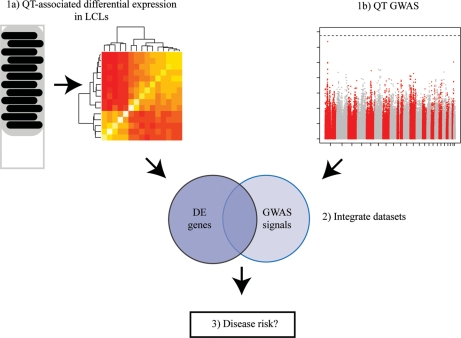
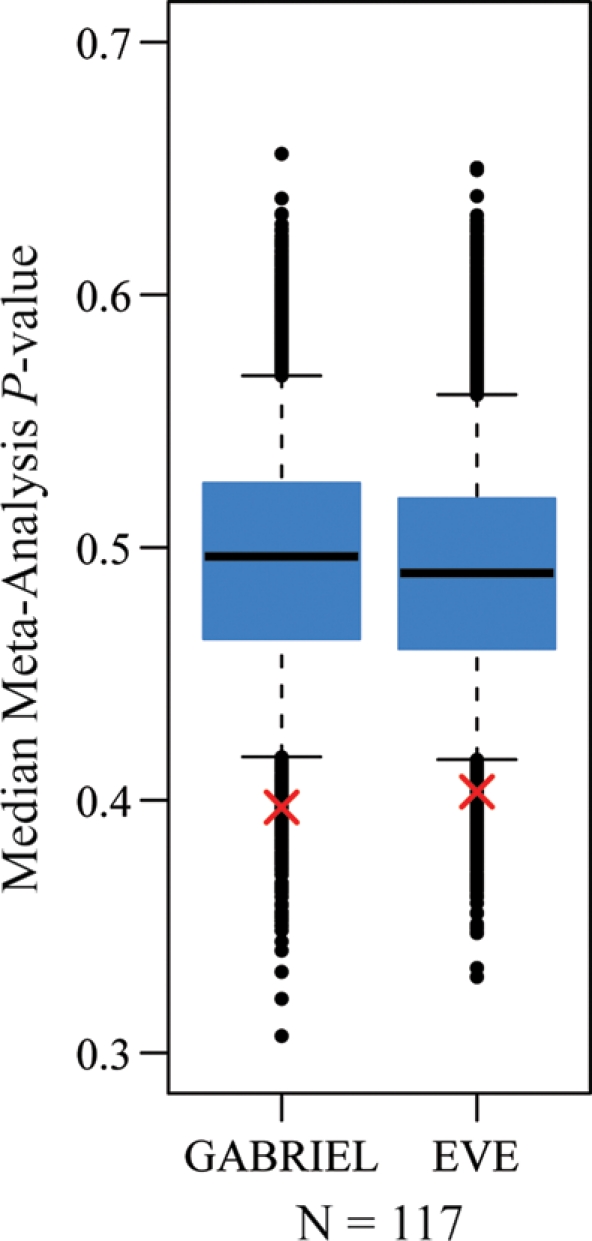
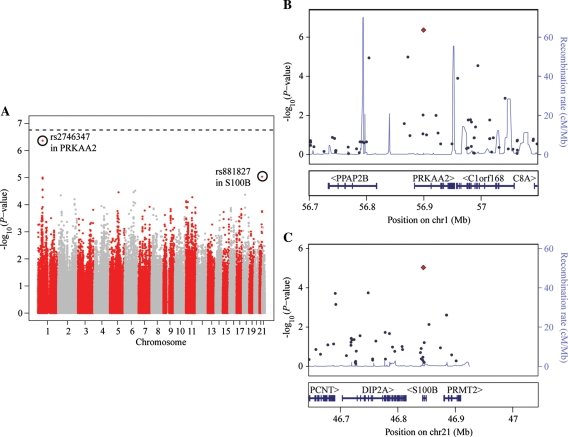
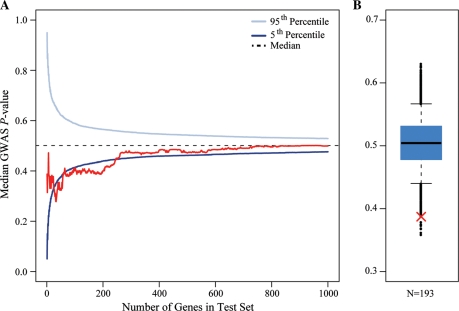
Recent genome-wide association studies (GWAS) have identified a number of novel genetic associations with complex human diseases. In spite of these successes, results from GWAS generally explain only a small proportion of disease heritability, an observation termed the 'missing heritability problem'. Several sources for the missing heritability have been proposed, including the contribution of many common variants with small individual effect sizes, which cannot be reliably found using the standard GWAS approach. The goal of our study was to explore a complimentary approach, which combines GWAS results with functional data in order to identify novel genetic associations with small effect sizes. To do so, we conducted a GWAS for lymphocyte count, a physiologic quantitative trait associated with asthma, in 462 Hutterites. In parallel, we performed a genome-wide gene expression study in lymphoblastoid cell lines from 96 Hutterites. We found significant support for genetic associations using the GWAS data when we considered variants near the 193 genes whose expression levels across individuals were most correlated with lymphocyte counts. Interestingly, these variants are also enriched with signatures of an association with asthma susceptibility, an observation we were able to replicate. The associated loci include genes previously implicated in asthma susceptibility as well as novel candidate genes enriched for functions related to T cell receptor signaling and adenosine triphosphate synthesis. Our results, therefore, establish a new set of asthma susceptibility candidate genes. More generally, our observations support the notion that many loci of small effects influence variation in lymphocyte count and asthma susceptibility.
最近的全基因组关联研究(GWAS)已经确定了许多与复杂人类疾病相关的新遗传关联。尽管取得了这些成功,但 GWAS 的结果通常只能解释疾病遗传率的一小部分,这种现象被称为“遗传缺失问题”。对于遗传缺失的原因有几种推测,包括许多具有小个体效应大小的常见变体的贡献,而使用标准的 GWAS 方法无法可靠地发现这些变体。我们的研究目的是探索一种补充方法,将 GWAS 结果与功能数据相结合,以确定具有小效应大小的新遗传关联。为此,我们对淋巴细胞计数进行了 GWAS,这是一个与哮喘相关的生理定量特征,涉及 462 名哈特派教徒。平行地,我们对来自 96 名哈特派教徒的淋巴母细胞系进行了全基因组基因表达研究。当我们考虑个体间与淋巴细胞计数最相关的 193 个基因附近的变体时,我们使用 GWAS 数据发现了遗传关联的显著支持。有趣的是,这些变体也富集了与哮喘易感性相关的关联的特征,我们能够复制这一观察结果。相关的基因座包括先前被认为与哮喘易感性相关的基因,以及与 T 细胞受体信号和三磷酸腺苷合成相关的功能相关的新型候选基因。因此,我们的研究结果确定了一组新的哮喘易感性候选基因。更普遍地,我们的观察结果支持了这样一种观点,即许多具有小效应的基因座影响淋巴细胞计数和哮喘易感性的变异。