MHS, Duke Clinical Research Institute, Duke University School of Medicine, Durham, NC 27715, USA.
Circulation. 2012 Mar 6;125(9):1094-101. doi: 10.1161/CIRCULATIONAHA.111.066605. Epub 2012 Jan 27.
Prior studies have demonstrated low use of implantable cardioverter defibrillators (ICDs) as primary prevention, particularly among women and blacks. The degree to which the overall use of ICD therapy and disparities in use have changed is unclear.
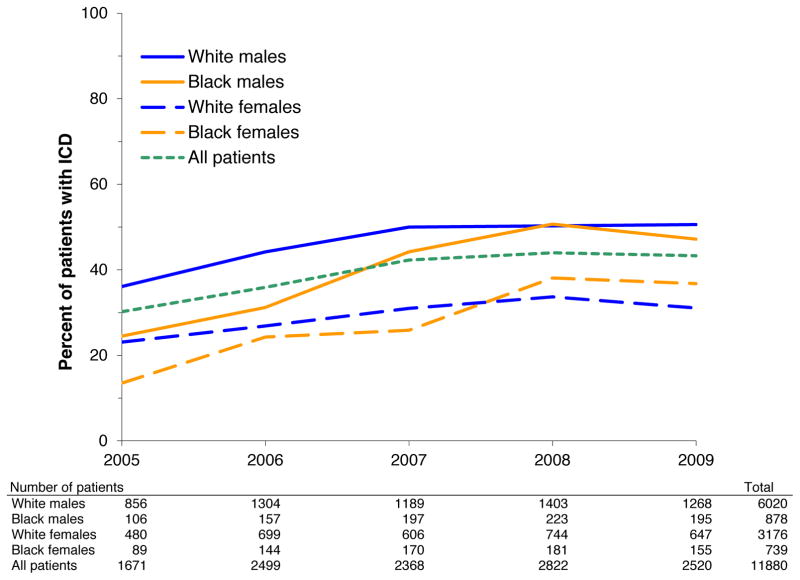
We examined 11 880 unique patients with a history of heart failure and left ventricular ejection fraction ≤35% who were ≥65 years old and enrolled in the Get With the Guidelines-Heart Failure (GWTG-HF) program from January 2005 through December 2009. We determined the rate of ICD use by year for the overall population and for sex and race groups. From 2005 to 2007, overall ICD use increased from 30.2% to 42.4% and then remained unchanged in 2008 to 2009. After adjustment for potential confounders, ICD use increased significantly in the overall study population during 2005 to 2007 (odds ratio, 1.28; 95% confidence interval, 1.11-1.48 per year; P=0.0008) and in black women (odds ratio, 1.82; 95% confidence interval, 1.28-2.58 per year; P=0.0008), white women (odds ratio, 1.30; 95% confidence interval, 1.06-1.59 per year; P=0.010), black men (odds ratio, 1.54; 95% confidence interval, 1.19-1.99 per year; P=0.0009), and white men (odds ratio, 1.25; 95% confidence interval, 1.06-1.48 per year; P=0.0072). The increase in ICD use was greatest among blacks.
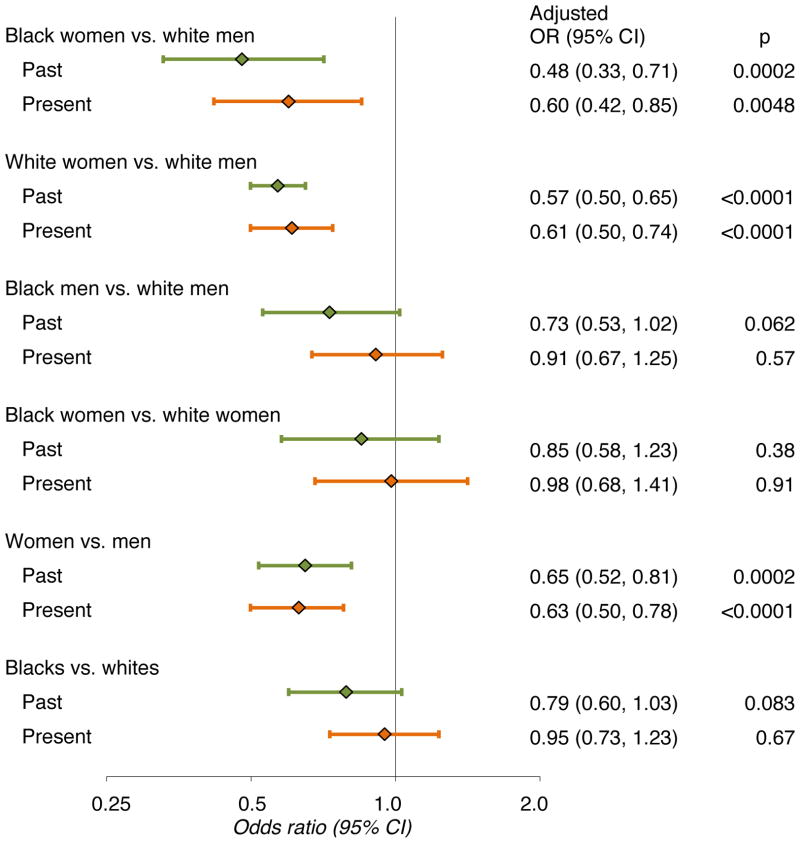
In the GWTG-HF quality improvement program, a significant increase in ICD therapy use was observed over time in all sex and race groups. The previously described racial disparities in ICD use were no longer present by the end of the study period; however, sex differences persisted.
先前的研究表明,植入式心脏复律除颤器(ICD)的使用率较低,主要用于预防,尤其是在女性和黑人中。整体 ICD 治疗的使用程度和使用的差异程度尚不清楚。
我们检查了 11880 名年龄≥65 岁且有心力衰竭和左心室射血分数≤35%病史的独特患者,这些患者参加了 2005 年 1 月至 2009 年 12 月期间的 Get With the Guidelines-Heart Failure(GWTG-HF)计划。我们按年度确定了总体人群以及性别和种族群体中 ICD 的使用率。从 2005 年到 2007 年,ICD 的总体使用率从 30.2%增加到 42.4%,然后在 2008 年到 2009 年保持不变。在调整了潜在混杂因素后,2005 年至 2007 年期间,总体研究人群中 ICD 的使用率显著增加(比值比,1.28;95%置信区间,1.11-1.48/年;P=0.0008),黑人和女性(比值比,1.82;95%置信区间,1.28-2.58/年;P=0.0008),白人女性(比值比,1.30;95%置信区间,1.06-1.59/年;P=0.010),黑人男性(比值比,1.54;95%置信区间,1.19-1.99/年;P=0.0009)和白人男性(比值比,1.25;95%置信区间,1.06-1.48/年;P=0.0072)。ICD 使用率的增加在黑人中最为显著。
在 GWTG-HF 质量改进计划中,所有性别和种族群体的 ICD 治疗使用率随着时间的推移都有显著增加。在研究结束时,先前描述的 ICD 使用种族差异不再存在;然而,性别差异仍然存在。