Kesieme Emeka, Kesieme Chinenye, Jebbin Nze, Irekpita Eshiobo, Dongo Andrew
Department of Surgery, Irrua Specialist Teaching Hospital, Irrua, Nigeria;
J Blood Med. 2011;2:59-69. doi: 10.2147/JBM.S19009. Epub 2011 Apr 29.
Deep vein thrombosis (DVT) is the formation of blood clots (thrombi) in the deep veins. It commonly affects the deep leg veins (such as the calf veins, femoral vein, or popliteal vein) or the deep veins of the pelvis. It is a potentially dangerous condition that can lead to preventable morbidity and mortality.
To present an update on the causes and management of DVT.
A review of publications obtained from Medline search, medical libraries, and Google.
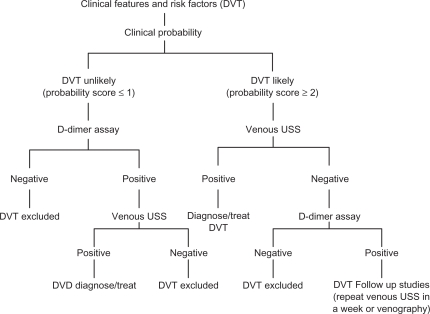
DVT affects 0.1% of persons per year. It is predominantly a disease of the elderly and has a slight male preponderance. The approach to making a diagnosis currently involves an algorithm combining pretest probability, D-dimer testing, and compression ultrasonography. This will guide further investigations if necessary. Prophylaxis is both mechanical and pharmacological. The goals of treatment are to prevent extension of thrombi, pulmonary embolism, recurrence of thrombi, and the development of complications such as pulmonary hypertension and post-thrombotic syndrome.
DVT is a potentially dangerous condition with a myriad of risk factors. Prophylaxis is very important and can be mechanical and pharmacological. The mainstay of treatment is anticoagulant therapy. Low-molecular-weight heparin, unfractionated heparin, and vitamin K antagonists have been the treatment of choice. Currently anticoagulants specifically targeting components of the common pathway have been recommended for prophylaxis. These include fondaparinux, a selective indirect factor Xa inhibitor and the new oral selective direct thrombin inhibitors (dabigatran) and selective factor Xa inhibitors (rivaroxaban and apixaban). Others are currently undergoing trials. Thrombolytics and vena caval filters are very rarely indicated in special circumstances.
深静脉血栓形成(DVT)是指在深静脉内形成血凝块(血栓)。它通常影响下肢深静脉(如小腿静脉、股静脉或腘静脉)或盆腔深静脉。这是一种潜在危险的病症,可导致可预防的发病和死亡。
介绍深静脉血栓形成的病因及管理的最新情况。
对通过医学文献数据库检索、医学图书馆及谷歌获取的出版物进行综述。
深静脉血栓形成每年影响0.1%的人群。它主要是一种老年疾病,男性略占优势。目前的诊断方法包括一种结合预检概率、D-二聚体检测和加压超声检查的算法。如有必要,这将指导进一步的检查。预防措施包括机械预防和药物预防。治疗的目标是防止血栓扩展、肺栓塞、血栓复发以及诸如肺动脉高压和血栓后综合征等并发症的发生。
深静脉血栓形成是一种具有众多危险因素的潜在危险病症。预防非常重要,可采用机械和药物方法。治疗的主要手段是抗凝治疗。低分子量肝素、普通肝素和维生素K拮抗剂一直是首选治疗药物。目前已推荐针对共同途径成分的抗凝剂用于预防。这些药物包括磺达肝癸钠,一种选择性间接Xa因子抑制剂,以及新型口服选择性直接凝血酶抑制剂(达比加群)和选择性Xa因子抑制剂(利伐沙班和阿哌沙班)。其他药物目前正在进行试验。在特殊情况下,溶栓剂和腔静脉滤器很少使用。