McDonald Paul C, Winum Jean-Yves, Supuran Claudiu T, Dedhar Shoukat
Department of Integrative Oncology, British Columbia Cancer Research Centre and Cancer Agency, Vancouver, BC, Canada.
Oncotarget. 2012 Jan;3(1):84-97. doi: 10.18632/oncotarget.422.
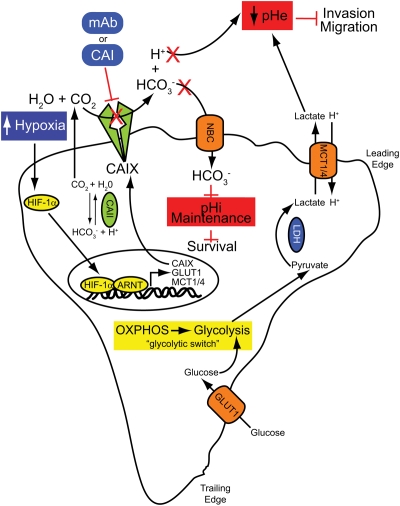
Carbonic anhydrase IX (CAIX) is a hypoxia-inducible enzyme that is overexpressed by cancer cells from many tumor types, and is a component of the pH regulatory system invoked by these cells to combat the deleterious effects of a high rate of glycolytic metabolism. CAIX functions to help produce and maintain an intracellular pH (pHi) favorable for tumor cell growth and survival, while at the same time participating in the generation of an increasingly acidic extracellular space, facilitating tumor cell invasiveness. Pharmacologic interference of CAIX catalytic activity using monoclonal antibodies or CAIX-specific small molecule inhibitors, consequently disrupting pH regulation by cancer cells, has been shown recently to impair primary tumor growth and metastasis. Many of these agents are in preclinical or clinical development and constitute a novel, targeted strategy of cancer therapy.
碳酸酐酶IX(CAIX)是一种缺氧诱导酶,在多种肿瘤类型的癌细胞中过表达,是这些细胞为对抗高糖酵解代谢的有害影响而激活的pH调节系统的一个组成部分。CAIX的作用是帮助产生并维持有利于肿瘤细胞生长和存活的细胞内pH值(pHi),同时参与细胞外空间酸性增强的过程,促进肿瘤细胞的侵袭。最近研究表明,使用单克隆抗体或CAIX特异性小分子抑制剂对CAIX催化活性进行药理学干扰,从而破坏癌细胞的pH调节,会损害原发性肿瘤的生长和转移。其中许多药物正处于临床前或临床开发阶段,构成了一种新型的癌症靶向治疗策略。