Biometris, Plant Sciences Group, Wageningen University and Research Center, Wageningen, The Netherlands.
PLoS One. 2012;7(1):e28762. doi: 10.1371/journal.pone.0028762. Epub 2012 Jan 23.
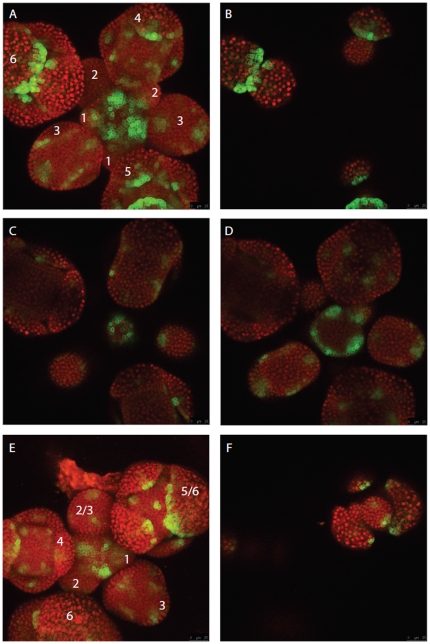
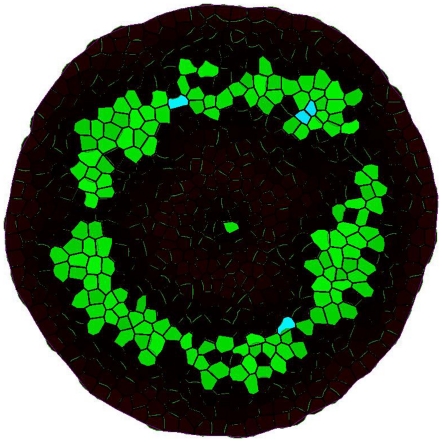
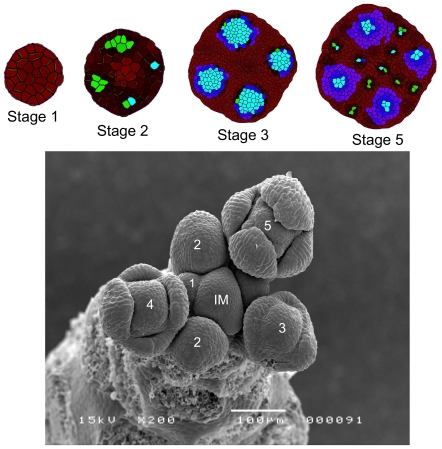
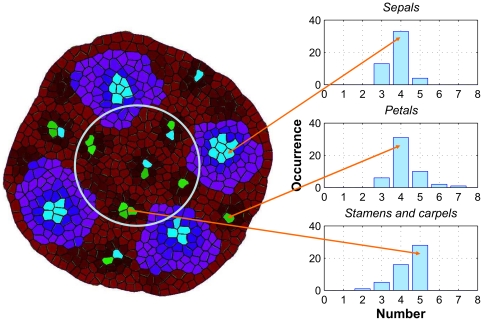
An intriguing phenomenon in plant development is the timing and positioning of lateral organ initiation, which is a fundamental aspect of plant architecture. Although important progress has been made in elucidating the role of auxin transport in the vegetative shoot to explain the phyllotaxis of leaf formation in a spiral fashion, a model study of the role of auxin transport in whorled organ patterning in the expanding floral meristem is not available yet. We present an initial simulation approach to study the mechanisms that are expected to play an important role. Starting point is a confocal imaging study of Arabidopsis floral meristems at consecutive time points during flower development. These images reveal auxin accumulation patterns at the positions of the organs, which strongly suggests that the role of auxin in the floral meristem is similar to the role it plays in the shoot apical meristem. This is the basis for a simulation study of auxin transport through a growing floral meristem, which may answer the question whether auxin transport can in itself be responsible for the typical whorled floral pattern. We combined a cellular growth model for the meristem with a polar auxin transport model. The model predicts that sepals are initiated by auxin maxima arising early during meristem outgrowth. These form a pre-pattern relative to which a series of smaller auxin maxima are positioned, which partially overlap with the anlagen of petals, stamens, and carpels. We adjusted the model parameters corresponding to properties of floral mutants and found that the model predictions agree with the observed mutant patterns. The predicted timing of the primordia outgrowth and the timing and positioning of the sepal primordia show remarkable similarities with a developing flower in nature.
植物发育中的一个有趣现象是侧生器官起始的时间和位置,这是植物结构的一个基本方面。尽管在阐明生长素运输在营养芽中的作用以解释叶片形成的螺旋式叶序方面已经取得了重要进展,但生长素运输在扩展的花分生组织中轮生器官模式形成中的作用的模型研究尚不可用。我们提出了一种初步的模拟方法来研究预计将发挥重要作用的机制。出发点是对拟南芥花分生组织在花发育过程中的连续时间点进行共聚焦成像研究。这些图像揭示了器官位置处生长素积累模式,这强烈表明生长素在花分生组织中的作用类似于它在茎尖分生组织中所起的作用。这是通过生长中的花分生组织进行生长素运输模拟研究的基础,这可能有助于回答生长素运输本身是否可以负责典型的轮生花模式的问题。我们将分生组织的细胞生长模型与极性生长素运输模型相结合。该模型预测,花分生组织早期的生长素最大值启动了萼片的形成。这些形成了一个相对于预图案的位置,其中较小的生长素最大值被定位,这些最大值与花瓣、雄蕊和心皮的原基部分重叠。我们根据花突变体的特性调整了模型参数,并发现模型预测与观察到的突变体模式一致。原基的生长时间以及萼片原基的时间和位置与自然发育中的花显示出显著的相似性。