Center for Conservation and Evolutionary Genetics, Smithsonian Institution, Washington DC, United States of America.
PLoS One. 2012;7(1):e30222. doi: 10.1371/journal.pone.0030222. Epub 2012 Jan 23.
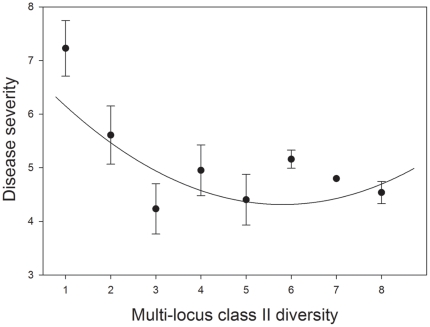
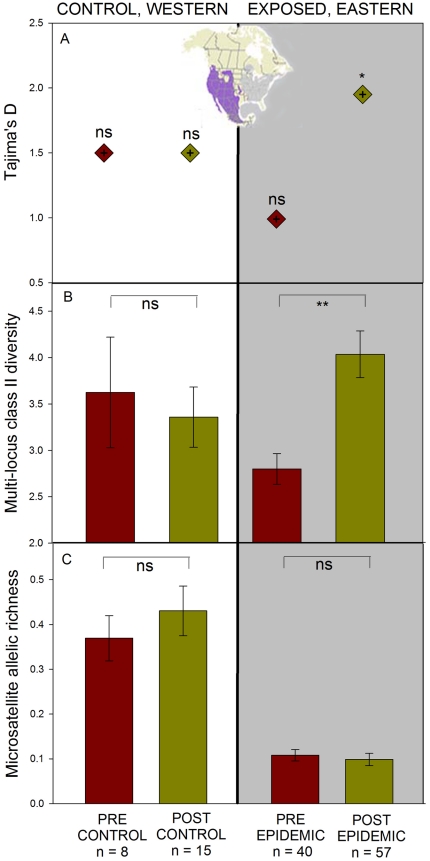
The extent to which pathogens maintain the extraordinary polymorphism at vertebrate Major Histocompatibility Complex (MHC) genes via balancing selection has intrigued evolutionary biologists for over half a century, but direct tests remain challenging. Here we examine whether a well-characterized epidemic of Mycoplasmal conjunctivitis resulted in balancing selection on class II MHC in a wild songbird host, the house finch (Carpodacus mexicanus). First, we confirmed the potential for pathogen-mediated balancing selection by experimentally demonstrating that house finches with intermediate to high multi-locus MHC diversity are more resistant to challenge with Mycoplasma gallisepticum. Second, we documented sequence and diversity-based signatures of pathogen-mediated balancing selection at class II MHC in exposed host populations that were absent in unexposed, control populations across an equivalent time period. Multi-locus MHC diversity significantly increased in exposed host populations following the epidemic despite initial compromised diversity levels from a recent introduction bottleneck in the exposed host range. We did not observe equivalent changes in allelic diversity or heterozygosity across eight neutral microsatellite loci, suggesting that the observations reflect selection rather than neutral demographic processes. Our results indicate that a virulent pathogen can exert sufficient balancing selection on class II MHC to rescue compromised levels of genetic variation for host resistance in a recently bottlenecked population. These results provide evidence for Haldane's long-standing hypothesis that pathogens directly contribute to the maintenance of the tremendous levels of genetic variation detected in natural populations of vertebrates.
病原体通过平衡选择在脊椎动物主要组织相容性复合体(MHC)基因中维持非凡多态性的程度引起了进化生物学家半个多世纪的兴趣,但直接测试仍然具有挑战性。在这里,我们研究了一种经过充分研究的支原体结膜炎流行是否导致野生鸣禽宿主,即家雀(Carpodacus mexicanus)中的 II 类 MHC 发生平衡选择。首先,我们通过实验证实了病原体介导的平衡选择的可能性,即具有中等至高多基因座 MHC 多样性的家雀对鸡败血支原体的挑战更具抵抗力。其次,我们在暴露宿主种群中记录了基于序列和多样性的病原体介导的平衡选择的特征,而在同等时间内未暴露的对照种群中则不存在这些特征。尽管在暴露宿主范围内最近发生了引入瓶颈,导致初始多样性水平降低,但在流行后,多基因座 MHC 多样性在暴露宿主种群中显著增加。我们没有观察到八个中性微卫星基因座的等位基因多样性或杂合度发生等效变化,这表明这些观察结果反映了选择而不是中性的人口过程。我们的研究结果表明,一种毒力病原体可以对 II 类 MHC 施加足够的平衡选择,以挽救最近瓶颈种群中宿主抗性遗传变异水平的降低。这些结果为 Haldane 的长期假设提供了证据,即病原体直接有助于维持在脊椎动物自然种群中检测到的巨大遗传变异水平。