Department of Radiology, University Medical Center Regensburg, Regensburg, Germany.
Med Sci Monit. 2012 Feb;18(2):CR88-92. doi: 10.12659/msm.882463.
Thermal ablation procedures, including radiofrequency ablation (RFA) or laser-induced interstitial thermotherapy (LITT), are now well established in the treatment of malignant unresectable hepatic tumors. But the impact of partial ablation (PA) on long-term survival following computed tomography (CT)-guided radiofrequency ablation and laser- induced interstitial thermotherapy of unresectable malignant liver lesions and the associated risk factors of PA remain partially unknown.
MATERIAL/METHODS: This study included 254 liver tumors in 91 consecutive patients (66 men and 25 women; age 60.9 ± 10.4 years; mean tumor size 25 ± 14 mm [range 5-70 mm]) who underwent thermal ablation (RFA or LITT) between January 2000 and December 2007. Mean follow-up period was 21.1 month (range 1-69 months). Survival rate and local progression-free survival (PFS) were calculated for patients with complete ablation (CA) vs. patients with partial ablation (PA) to assess the impact on long-term survival.
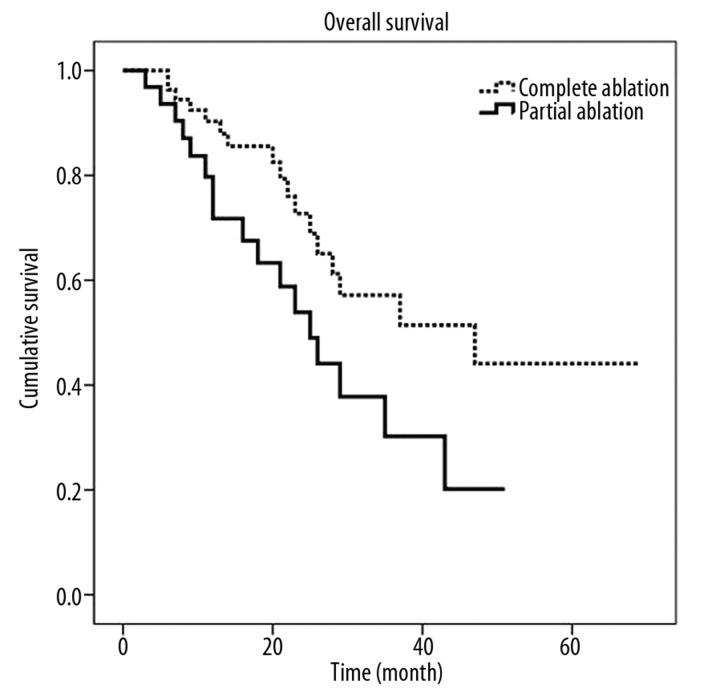
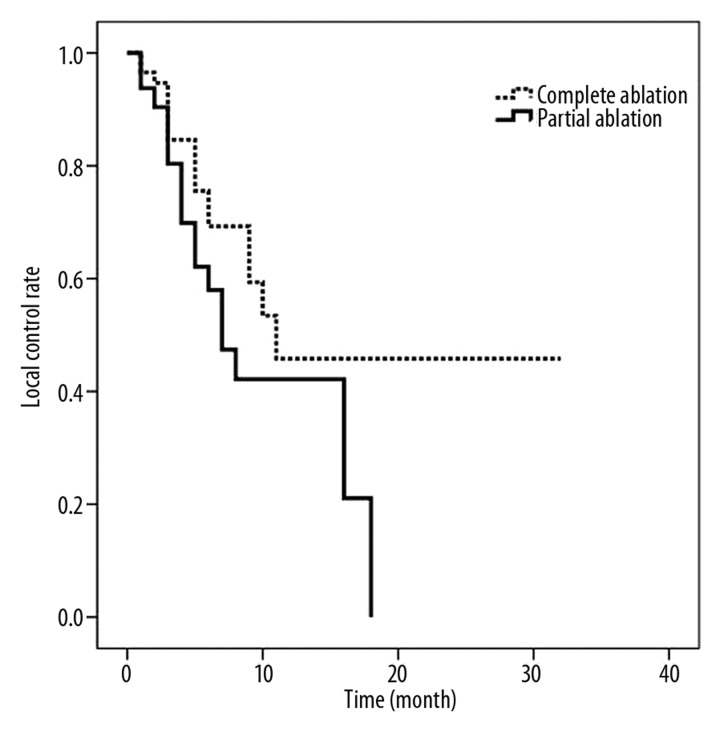
Median survival after CA was 47 months compared to 25 months after PA (P=0.04). The corresponding 5-year survival rates were 44% vs. 20%. Median PFS for CA was 11 months compared to 7 months for PA (P=0.118). The sole statistically significant risk factor for PA was tumor size (>30 mm; P=0.0003). Sustained complete ablation was achieved in 71% of lesions ≤ 30 mm vs. 47% of lesions >30 mm.
We conclude that achievement of complete ablation is a highly important predictor of long-term survival and that tumor size is by far the most important predictor of the likelihood of achieving complete ablation.
热消融治疗,包括射频消融(RFA)或激光诱导间质热疗(LITT),在恶性不可切除肝肿瘤的治疗中已得到广泛应用。但是,在 CT 引导下射频消融和激光诱导间质热疗治疗不可切除的恶性肝病变后,部分消融(PA)对长期生存的影响以及 PA 的相关危险因素部分仍不清楚。
材料/方法:本研究纳入了 2000 年 1 月至 2007 年 12 月期间接受热消融(RFA 或 LITT)的 91 例连续患者(66 名男性和 25 名女性;年龄 60.9±10.4 岁;平均肿瘤大小 25±14mm[范围 5-70mm])的 254 个肝脏肿瘤。中位随访时间为 21.1 个月(范围 1-69 个月)。计算完全消融(CA)患者与部分消融(PA)患者的生存率和局部无进展生存期(PFS),以评估其对长期生存的影响。
CA 后的中位生存期为 47 个月,而 PA 后为 25 个月(P=0.04)。相应的 5 年生存率分别为 44%和 20%。CA 的中位 PFS 为 11 个月,而 PA 为 7 个月(P=0.118)。PA 的唯一具有统计学意义的危险因素是肿瘤大小(>30mm;P=0.0003)。≤30mm 的病变中,持续完全消融的比例为 71%,而>30mm 的病变中为 47%。
我们得出结论,完全消融的实现是长期生存的一个重要预测因素,而肿瘤大小是目前实现完全消融的最主要预测因素。