The Roslin Institute and Royal (Dick) School of Veterinary Sciences, University of Edinburgh, Edinburgh, UK.
Mucosal Immunol. 2012 Mar;5(2):216-25. doi: 10.1038/mi.2011.68. Epub 2012 Feb 1.
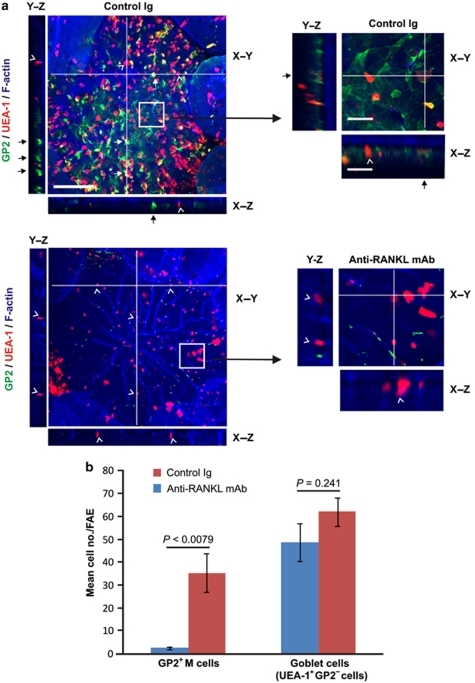
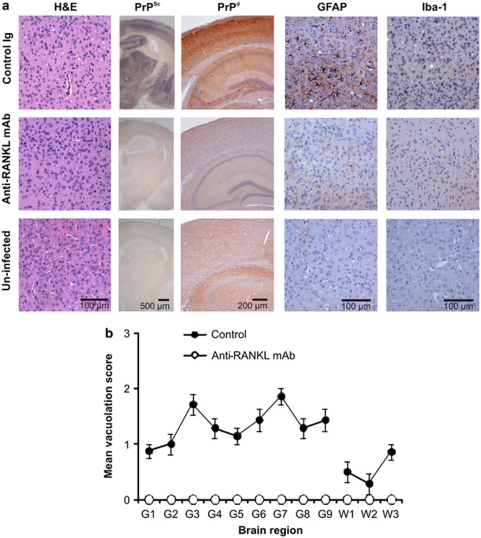
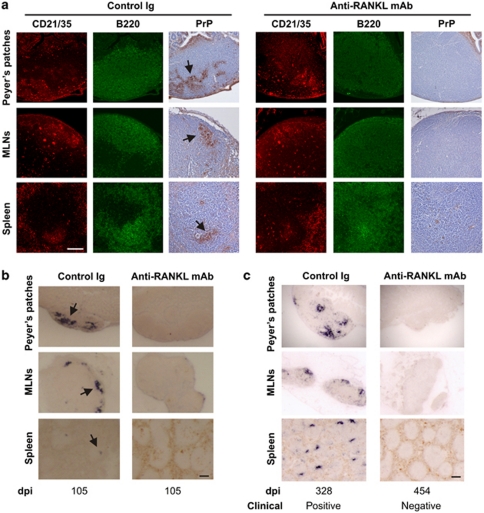
Many prion diseases are orally acquired. Our data show that after oral exposure, early prion replication upon follicular dendritic cells (FDC) in Peyer's patches is obligatory for the efficient spread of disease to the brain (termed neuroinvasion). For prions to replicate on FDC within Peyer's patches after ingestion of a contaminated meal, they must first cross the gut epithelium. However, the mechanism through which prions are conveyed into Peyer's patches is uncertain. Within the follicle-associated epithelium overlying Peyer's patches are microfold cells (M cells), unique epithelial cells specialized for the transcytosis of particles. We show that following M cell-depletion, early prion accumulation upon FDC in Peyer's patches is blocked. Furthermore, in the absence of M cells at the time of oral exposure, neuroinvasion and disease development are likewise blocked. These data suggest M cells are important sites of prion uptake from the gut lumen into Peyer's patches.
许多朊病毒疾病是经口获得的。我们的数据表明,在口服暴露后,滤泡树突状细胞(FDC)在派尔集合淋巴结中的早期朊病毒复制对于疾病向大脑的有效传播(称为神经入侵)是必需的。为了使摄入污染食物后的 FDC 在派尔集合淋巴结中复制朊病毒,它们必须首先穿过肠道上皮。然而,朊病毒被递送到派尔集合淋巴结的机制尚不确定。在派尔集合淋巴结上的滤泡相关上皮内是微褶皱细胞(M 细胞),是专门用于颗粒胞吞作用的独特上皮细胞。我们发现,在 M 细胞耗竭后,派尔集合淋巴结中 FDC 上的早期朊病毒积累被阻断。此外,在口服暴露时不存在 M 细胞的情况下,神经入侵和疾病发展也同样被阻断。这些数据表明 M 细胞是从肠道腔摄取朊病毒进入派尔集合淋巴结的重要部位。