Division of the National Toxicology Program, National Institute of Environmental Health Sciences, National Institutes of Health, Department of Health and Human Services, Research Triangle Park, North Carolina, USA.
Environ Health Perspect. 2012 Jun;120(6):779-89. doi: 10.1289/ehp.1104597. Epub 2012 Feb 1.
There has been increasing interest in the concept that exposures to environmental chemicals may be contributing factors to the epidemics of diabetes and obesity. On 11-13 January 2011, the National Institute of Environmental Health Sciences (NIEHS) Division of the National Toxicology Program (NTP) organized a workshop to evaluate the current state of the science on these topics of increasing public health concern.
The main objective of the workshop was to develop recommendations for a research agenda after completing a critical analysis of the literature for humans and experimental animals exposed to certain environmental chemicals. The environmental exposures considered at the workshop were arsenic, persistent organic pollutants, maternal smoking/nicotine, organotins, phthalates, bisphenol A, and pesticides. High-throughput screening data from Toxicology in the 21st Century (Tox21) were also considered as a way to evaluate potential cellular pathways and generate -hypotheses for testing which and how certain chemicals might perturb biological processes related to diabetes and obesity.
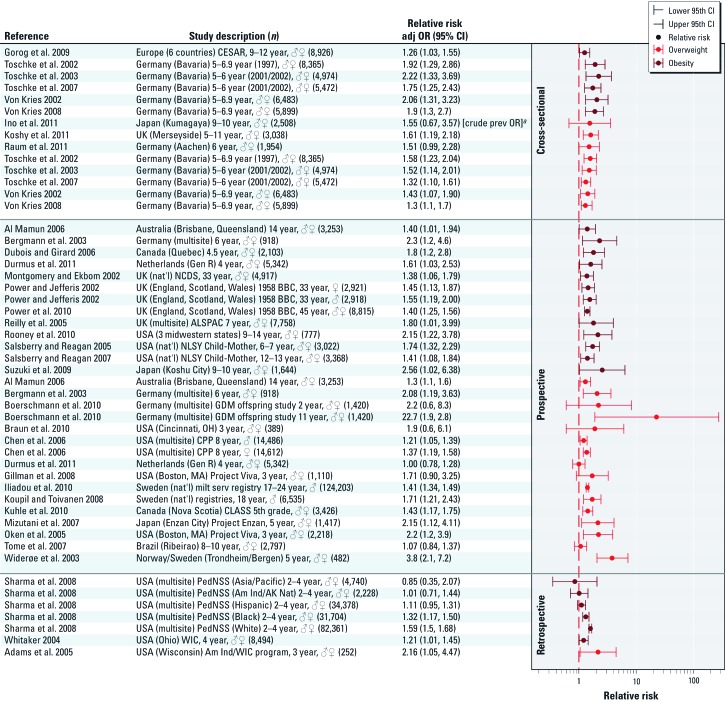
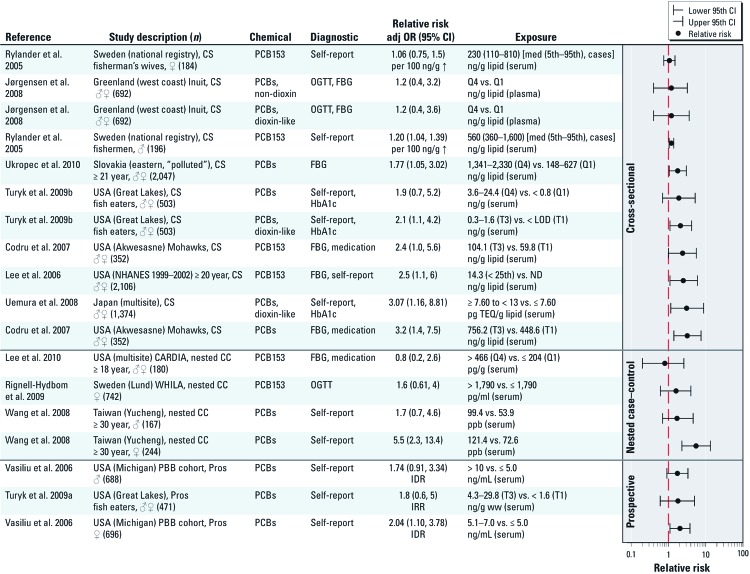
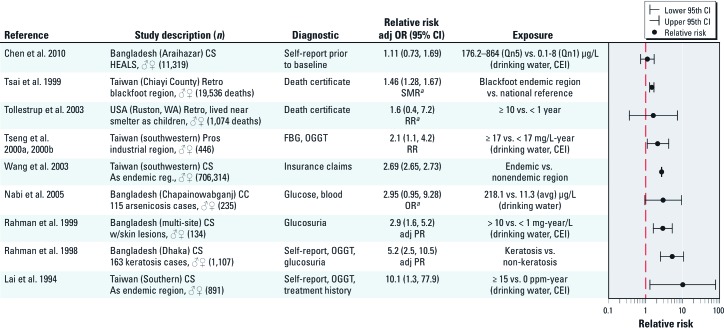
Overall, the review of the existing literature identified linkages between several of the environmental exposures and type 2 diabetes. There was also support for the "developmental obesogen" hypothesis, which suggests that chemical exposures may increase the risk of obesity by altering the differentiation of adipocytes or the development of neural circuits that regulate feeding behavior. The effects may be most apparent when the developmental exposure is combined with consumption of a high-calorie, high-carbohydrate, or high-fat diet later in life. Research on environmental chemical exposures and type 1 diabetes was very limited. This lack of research was considered a critical data gap. In this workshop review, we outline the major themes that emerged from the workshop and discuss activities that NIEHS/NTP is undertaking to address research recommendations. This review also serves as an introduction to an upcoming series of articles that review the literature regarding specific exposures and outcomes in more detail.
人们越来越关注环境化学物质暴露可能是糖尿病和肥胖症流行的促成因素。2011 年 1 月 11 日至 13 日,美国国家环境卫生科学研究所(NIEHS)国家毒理学计划(NTP)分部组织了一次研讨会,以评估当前有关这些日益引起公众关注的健康问题的科学状况。
研讨会的主要目标是在对人类和实验动物暴露于某些环境化学物质的文献进行批判性分析后,为研究议程提出建议。研讨会考虑的环境暴露包括砷、持久性有机污染物、母体吸烟/尼古丁、有机锡、邻苯二甲酸酯、双酚 A 和农药。还考虑了 21 世纪毒理学中的高通量筛选数据(Tox21),作为评估潜在细胞途径的一种方法,并提出假设,以测试某些化学物质如何干扰与糖尿病和肥胖相关的生物过程。
总的来说,对现有文献的审查确定了几种环境暴露与 2 型糖尿病之间的联系。“发育性肥胖物”假说也得到了支持,该假说表明,化学物质暴露可能通过改变脂肪细胞的分化或调节进食行为的神经回路来增加肥胖的风险。当发育性暴露与生命后期摄入高热量、高碳水化合物或高脂肪饮食相结合时,这些影响可能最为明显。关于环境化学物质暴露与 1 型糖尿病的研究非常有限。研究的缺乏被认为是一个关键的数据差距。在本次研讨会的审查中,我们概述了研讨会提出的主要主题,并讨论了 NIEHS/NTP 正在开展的活动,以解决研究建议。这篇综述还介绍了即将发表的一系列文章,这些文章将更详细地回顾特定暴露和结果的文献。