Japan Agency for Marine-Earth Science and Technology, Yokosuka, Kanagawa, 237-0061, Japan.
Biol Direct. 2012 Feb 1;7:5. doi: 10.1186/1745-6150-7-5.
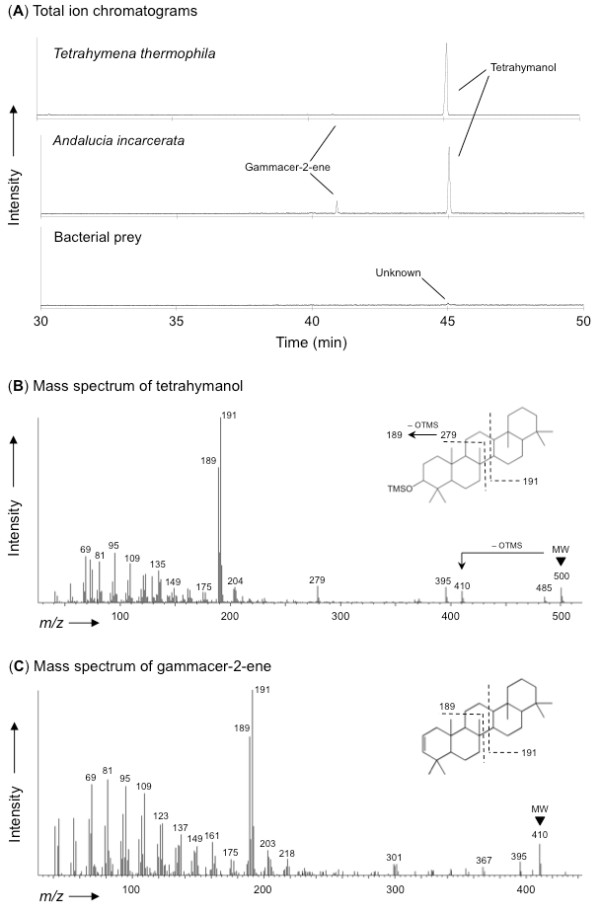
Sterols are key components of eukaryotic cellular membranes that are synthesized by multi-enzyme pathways that require molecular oxygen. Because prokaryotes fundamentally lack sterols, it is unclear how the vast diversity of bacterivorous eukaryotes that inhabit hypoxic environments obtain, or synthesize, sterols. Here we show that tetrahymanol, a triterpenoid that does not require molecular oxygen for its biosynthesis, likely functions as a surrogate of sterol in eukaryotes inhabiting oxygen-poor environments. Genes encoding the tetrahymanol synthesizing enzyme squalene-tetrahymanol cyclase were found from several phylogenetically diverged eukaryotes that live in oxygen-poor environments and appear to have been laterally transferred among such eukaryotes.
甾醇是真核细胞膜的关键组成部分,它们通过需要分子氧的多酶途径合成。由于原核生物从根本上缺乏甾醇,因此尚不清楚生活在缺氧环境中的大量细菌食性真核生物如何获得或合成甾醇。在这里,我们表明,四氢甲醇,一种萜烯,其生物合成不需要分子氧,可能在生活在缺氧环境中的真核生物中作为甾醇的替代物发挥作用。我们从生活在缺氧环境中的几种系统发育上不同的真核生物中发现了编码 squalene-tetrahymanol cyclase 的四氢甲醇合成酶基因,这些基因似乎在这些真核生物之间发生了横向转移。