Institute of Neurobiology, Slovak Academy of Sciences, Košice, Slovak Republic.
Eur J Histochem. 2011 Oct 19;55(4):e33. doi: 10.4081/ejh.2011.e33.
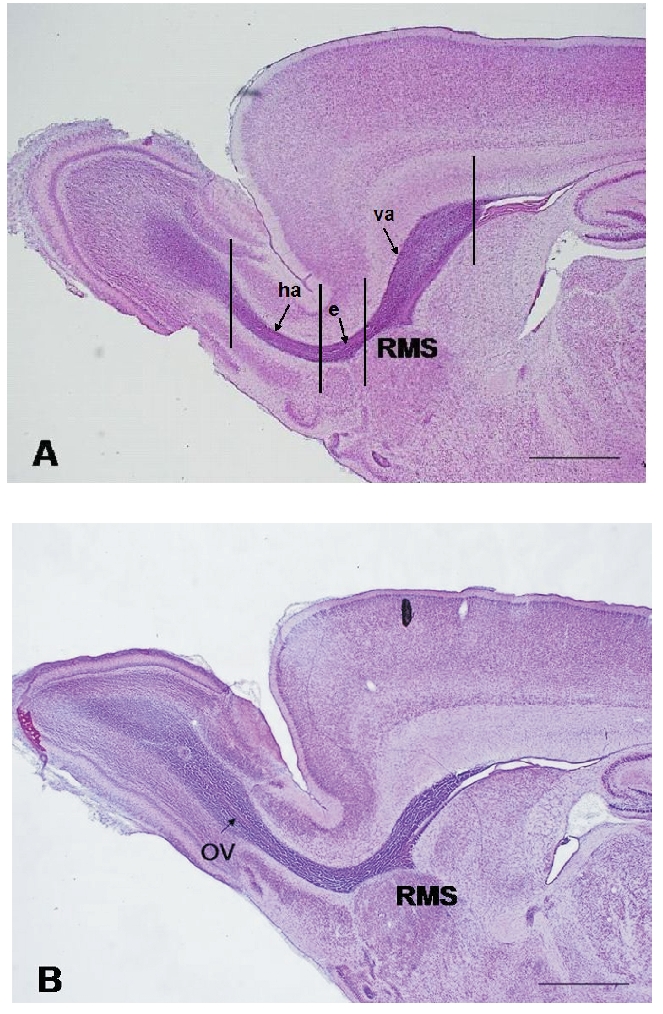
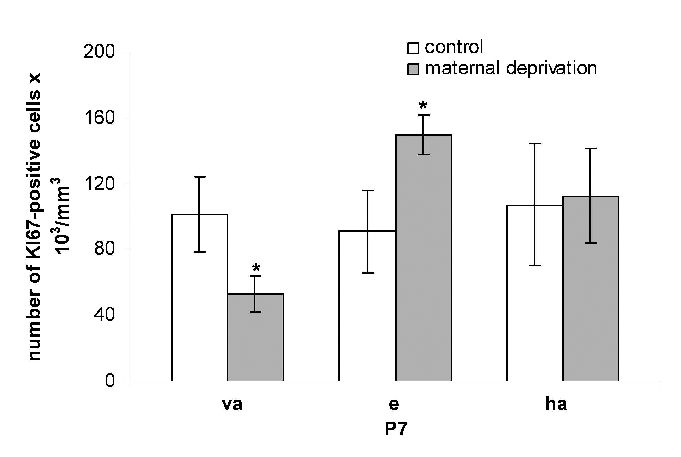
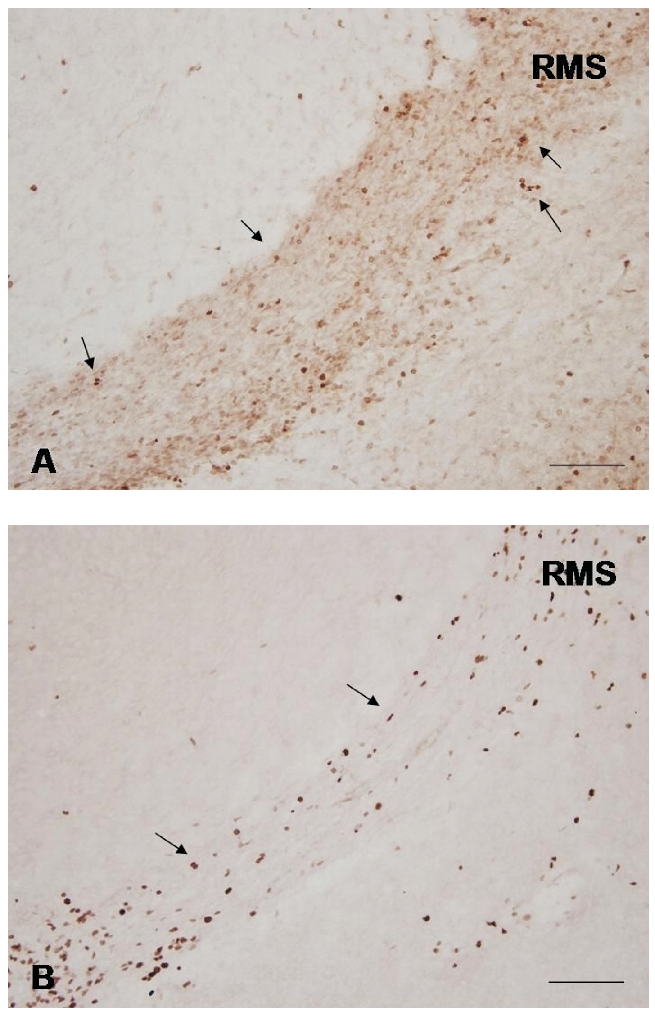
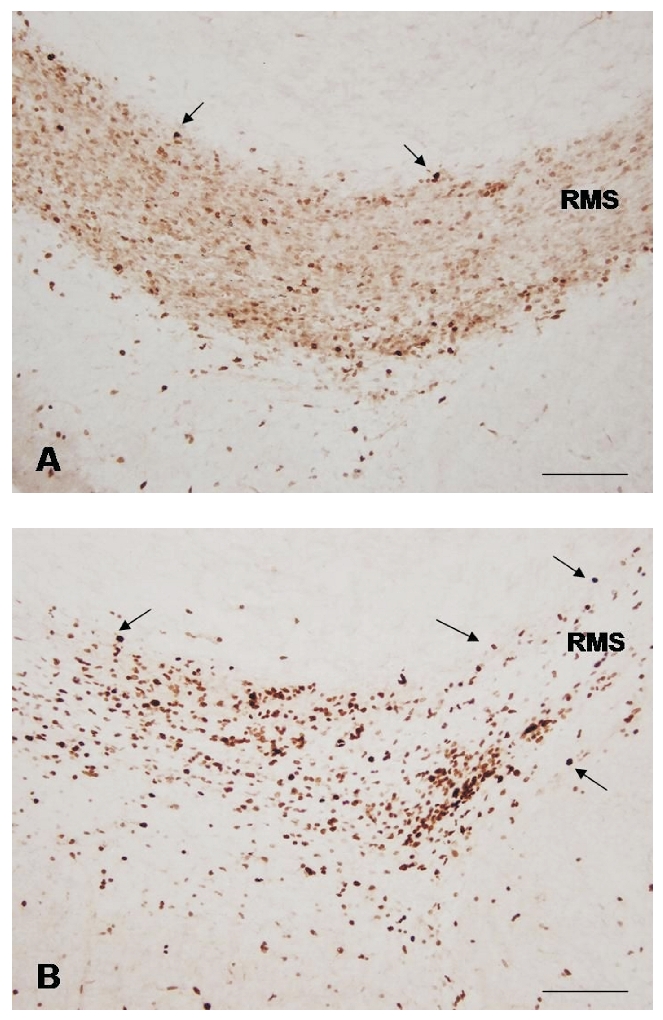
The objective of this study was to investigate whether stressful experience during early postnatal period may influence morphological characteristics of the rat neurogenic pathway--the rostral migratory stream (RMS) and proliferation of neuronal precursors in three successive areas of the RMS: in the vertical arm, the elbow and the horizontal arm. To induce stress, the pups were subjected to repeated maternal deprivation during the first postnatal week after birth. Brains were analyzed at the seventh postnatal day. The controls matched the age of maternally deprived animals. Observation of hematoxylin-eosin stained sections showed that maternal deprivation did not affect the general morphological appearance of the RMS. The shape of the RMS of maternally deprived rats resembles the RMS of control animals. Maternal deprivation caused slight, not significant increase in the RMS thickness in comparison with control rats. Significant difference between the control and maternally deprived rats concerns the olfactory ventricle. While in seven days old control rats the olfactory ventricle is completely closed, in maternally deprived rats of the same age the olfactory ventricle was regularly visible as a narrow lumen at the axis of the RMS horizontal arm. This finding indicates delayed maturation of the migratory pathway as a consequence of stress. Proliferation activity has been assessed by immunoreactivity of the endogenous cell cycle protein Ki-67. The results of Ki-67 immunohistochemistry showed that seven days' maternal separation for 3 h daily induces significant quantitative changes in the number of proliferating cells within the RMS. The response of Ki-67-positive cells to stress differed in individual part of the RMS, with a marked decrease in the vertical arm and a significant increase in the elbow, suggesting heterogeneity of neural stem cells along the RMS; while in the RMS vertical arm the number of dividing cells significantly decreased, there was a marked increase of Ki-67-positive cells in the RMS elbow. This suggests heterogeneity of neural stem cells along the RMS.
本研究旨在探讨产后早期的应激体验是否会影响大鼠神经发生途径——头侧迁移流(RMS)的形态特征以及 RMS 三个连续区域中神经元前体的增殖:垂直臂、肘和水平臂。为了诱导应激,新生后第一周内反复剥夺幼鼠的母源。在出生后第 7 天分析大脑。对照组与母源剥夺动物的年龄相匹配。苏木精-伊红染色切片观察显示,母源剥夺对 RMS 的一般形态外观没有影响。母源剥夺大鼠的 RMS 形状与对照动物的 RMS 相似。与对照大鼠相比,母源剥夺大鼠的 RMS 厚度略有但无显著增加。对照组和母源剥夺组之间的显著差异与嗅球有关。在 7 天大的对照大鼠中,嗅球完全闭合,而在同龄的母源剥夺大鼠中,嗅球作为 RMS 水平臂轴上的狭窄管腔定期可见。这一发现表明,由于应激,迁移途径的成熟延迟。增殖活性通过内源性细胞周期蛋白 Ki-67 的免疫反应性来评估。Ki-67 免疫组织化学的结果表明,每天 3 小时的 7 天母体分离会导致 RMS 内增殖细胞数量的显著变化。Ki-67 阳性细胞对应激的反应在 RMS 的各个部位不同,垂直臂明显减少,肘明显增加,表明 RMS 上神经干细胞的异质性;而在 RMS 垂直臂中,分裂细胞的数量显著减少,RMS 肘中 Ki-67 阳性细胞的数量显著增加。这表明 RMS 上神经干细胞的异质性。