Imumorin Ikhide G, Kim Eun-Hee, Lee Yun-Mi, De Koning Dirk-Jan, van Arendonk Johan A, De Donato Marcos, Taylor Jeremy F, Kim Jong-Joo
Department of Animal Science, Cornell University Ithaca, NY, USA.
Front Genet. 2011 Jul 12;2:44. doi: 10.3389/fgene.2011.00044. eCollection 2011.
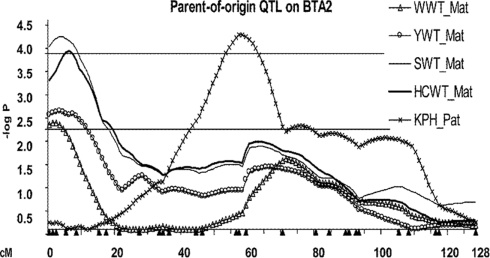
Parent-of-origin effects (POE) such as genomic imprinting influence growth and body composition in livestock, rodents, and humans. Here, we report the results of a genome scan to detect quantitative trait loci (QTL) with POE on growth and carcass traits in Angus × Brahman cattle crossbreds. We identified 24 POE-QTL on 15 Bos taurus autosomes (BTAs) of which six were significant at 5% genome-wide (GW) level and 18 at the 5% chromosome-wide (CW) significance level. Six QTL were paternally expressed while 15 were maternally expressed. Three QTL influencing post-weaning growth map to the proximal end of BTA2 (linkage region of 0-9 cM; genomic region of 5.0-10.8 Mb), for which only one imprinted ortholog is known so far in the human and mouse genomes, and therefore may potentially represent a novel imprinted region. The detected QTL individually explained 1.4 ∼ 5.1% of each trait's phenotypic variance. Comparative in silico analysis of bovine genomic locations show that 32 out of 1,442 known mammalian imprinted genes from human and mouse homologs map to the identified QTL regions. Although several of the 32 genes have been associated with quantitative traits in cattle, only two (GNAS and PEG3) have experimental proof of being imprinted in cattle. These results lend additional support to recent reports that POE on quantitative traits in mammals may be more common than previously thought, and strengthen the need to identify and experimentally validate cattle orthologs of imprinted genes so as to investigate their effects on quantitative traits.
诸如基因组印记之类的亲本来源效应(POE)会影响家畜、啮齿动物和人类的生长及身体组成。在此,我们报告了一项基因组扫描的结果,以检测安格斯×婆罗门牛杂交后代中具有亲本来源效应的生长和胴体性状的数量性状基因座(QTL)。我们在15条牛常染色体(BTA)上鉴定出24个亲本来源效应QTL,其中6个在全基因组5%(GW)水平上显著,18个在染色体5%(CW)显著水平上显著。6个QTL为父本表达,15个为母本表达。三个影响断奶后生长的QTL定位于BTA2近端(连锁区域为0 - 9 cM;基因组区域为5.0 - 10.8 Mb),迄今为止,在人类和小鼠基因组中仅知道一个该区域的印记直系同源基因,因此该区域可能代表一个新的印记区域。检测到的QTL分别解释了每个性状表型变异的1.4%至5.1%。对牛基因组位置的计算机模拟比较分析表明,来自人类和小鼠同源物的1442个已知哺乳动物印记基因中有32个映射到鉴定出的QTL区域。虽然这32个基因中的几个与牛的数量性状相关,但只有两个(GNAS和PEG3)有在牛中印记的实验证据。这些结果为最近的报道提供了更多支持,即哺乳动物数量性状的亲本来源效应可能比以前认为的更普遍,并强化了鉴定和通过实验验证印记基因的牛直系同源物以研究其对数量性状影响的必要性。