Department of Public Health, Università Cattolica del Sacro Cuore, Largo Francesco Vito 1, 00168 Rome, Italy.
BMC Public Health. 2012 Feb 3;12:99. doi: 10.1186/1471-2458-12-99.
Breast and cervical cancer screening are widely recognized as effective preventive procedures in reducing cancer mortality. The aim of this study was to evaluate the impact of socioeconomic disparities in the uptake of female screening in Italy, with a specific focus on different types of screening programs.
A cross-sectional study was conducted using data from the 2004-2005 national health interview survey. A sample of 15, 486 women aged 50-69 years for mammography and one of 35, 349 women aged 25-64 years for Pap smear were analysed. Logistic regression models were used to estimate the association between socioeconomic factors and female screening utilization.
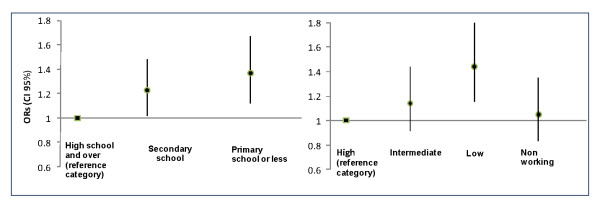
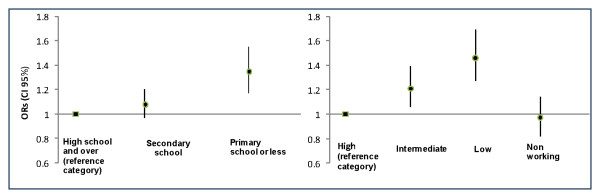
Education and occupation were positively associated with attendance to both screening. Women with higher levels of education were more likely to have a mammogram than those with a lower level (OR = 1.28; 95% CI = 1.10-1.49). Women of intermediate and high occupational classes were more likely to use breast cancer screening (OR = 1.77; 95% CI = 1.55-2.03, OR = 1.63; 95% CI = 1.40-1.91) compared to unemployed women. Women in the highest occupational class had a higher likelihood of cervical cancer screening compared to those in the lowest class (OR = 1.81; 95% CI = 1.63-2.01). Among women who attended screening, those with lower levels of education and lower occupational classes were more likely than more advantaged women to attend organized screening programs rather than being screened on the basis of their own initiative.
Inequalities in the uptake of female screening widely exist in Italy. Organized screening programs may have an important role in increasing screening attendance and tackling inequalities.
乳腺癌和宫颈癌筛查被广泛认为是降低癌症死亡率的有效预防措施。本研究旨在评估意大利女性筛查参与率的社会经济差异的影响,特别关注不同类型的筛查计划。
本研究使用了 2004-2005 年全国健康访谈调查的数据进行了一项横断面研究。对 15486 名年龄在 50-69 岁的女性进行了乳房 X 光检查,对 35349 名年龄在 25-64 岁的女性进行了巴氏涂片检查。使用逻辑回归模型来估计社会经济因素与女性筛查利用之间的关联。
教育程度和职业与两种筛查都呈正相关。受教育程度较高的女性比受教育程度较低的女性更有可能进行乳房 X 光检查(OR=1.28;95%CI=1.10-1.49)。中高职业类别的女性更有可能使用乳腺癌筛查(OR=1.77;95%CI=1.55-2.03,OR=1.63;95%CI=1.40-1.91),而失业女性则不然。与职业等级最低的女性相比,职业等级最高的女性进行宫颈癌筛查的可能性更高(OR=1.81;95%CI=1.63-2.01)。在参加筛查的女性中,与受教育程度较低和职业等级较低的女性相比,受教育程度较高和职业等级较高的女性更有可能参加有组织的筛查计划,而不是根据自己的意愿进行筛查。
意大利女性筛查参与率存在广泛的不平等现象。有组织的筛查计划可能在提高筛查参与率和解决不平等问题方面发挥重要作用。