Beconi Maria G, Howland David, Park Larry, Lyons Kathryn, Giuliano Joseph, Dominguez Celia, Munoz-Sanjuan Ignacio, Pacifici Robert
Director, DMPK, CHDI Management/CHDI Foundation, Princeton, NJ; Director of In Vivo Biology, CHDI Foundation Inc; Director, PreClinical Research, CHDI Foundation, Inc; Pharmacokinetic consultant for the CHDI Foundation, Holland NY; CHDI Foundation, Inc.; VP, Chemistry CHDI Foundation/ CHDI Management Inc. Los Angeles CA; VP Translational Biology, CHDI Management/CHDI Foundation Inc., Los Angeles (USA) and CSO - Drug Discovery & Development, CHDI Foundation / CHDI Management.
PLoS Curr. 2011 Dec 15;3:RRN1291. doi: 10.1371/currents.RRN1291.
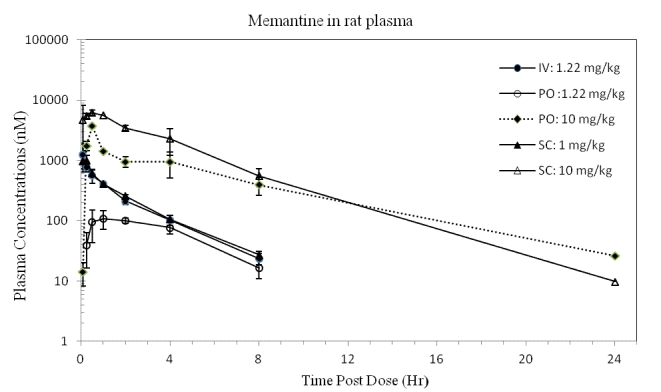
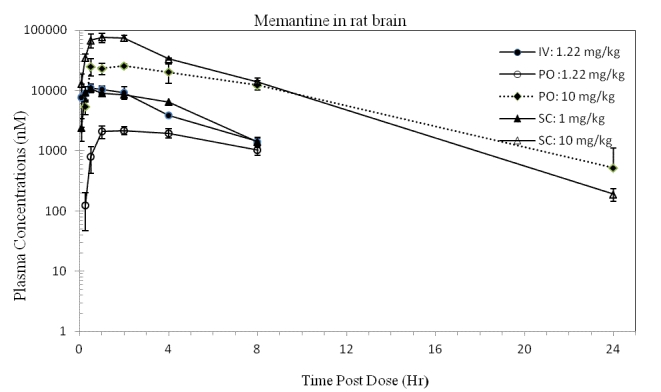
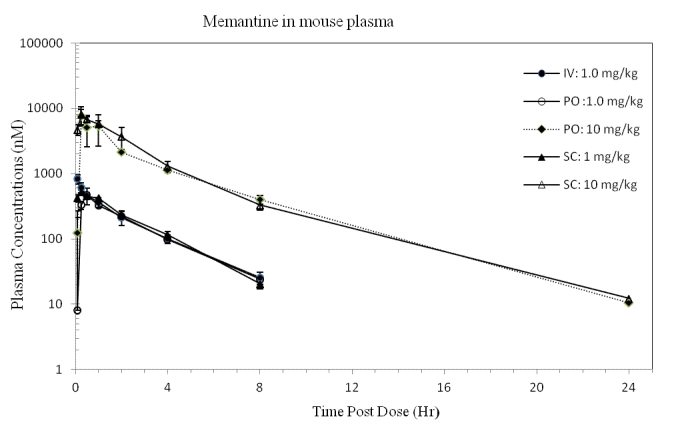
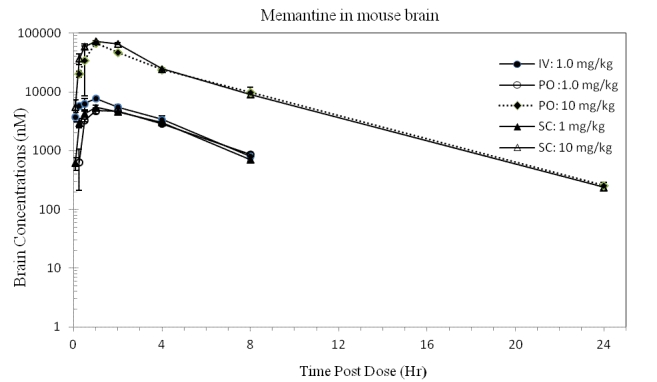
To evaluate the potential of memantine as a therapeutic agent for Huntington's disease (HD) we have undertaken a series of in vitro, ex vivo and whole animal studies to characterize its pharmacokinetics (PK) and pharmacodynamics (PD) in rats and mice. Results from these studies will enable determination of memantine exposures needed to engage the related functional PD marker and help predict the dose regimen for clinical trials to test its proposed mechanism of action; the selective blockade of extrasynaptic, but not synaptic, NMDA receptors. The studies reported here describe the PK of memantine in rats and mice at low (1 mg/kg) and high (10 mg/kg) doses. Our studies indicate that the clearance mechanisms of memantine in rats and mice are different from those in human, and that clearance needs to be taken into account when extrapolating to the human. In rats only, there is a significant metabolic contribution to memantine clearance at lower dose levels. While memantine is primarily cleared renally in all three species, the proportion of total systemic clearance above the glomerular filtration rate (GFR) is much higher in rats and mice (~13, 4.5, and 1.4 times higher than GFR in rats, mice, and humans, respectively), suggesting that the contribution of active transport to memantine elimination in rats and mice is more significant than in the human. In rats and mice, memantine had a short half-life (<4 h) and steep Cmax/Cmin ratios (>100). In the human, the half-life of memantine was reported to be very long (60-80 h) with a Cmax/Cmin ratio at steady state concentrations of ~1.5. A small change in the clearance of memantine - for example due to renal impairment or competition for the elimination pathway with a co-administered drug - will likely affect exposure and, therefore, the selectivity of memantine on NMDA receptors . The PK differences observed between these species demonstrate that the PK in mice and rats cannot be directly extrapolated to the human. Further, the relationship between the plasma concentration (and therefore dose) needed to elicit a mechanism-related in vivo functional effect (PD readout) while maintaining the selectivity of the extrasynaptic blockade of the NMDA receptors needs to be established before clinical trials can be appropriately planned.
为了评估美金刚作为亨廷顿舞蹈病(HD)治疗药物的潜力,我们开展了一系列体外、离体和整体动物研究,以表征其在大鼠和小鼠体内的药代动力学(PK)和药效动力学(PD)。这些研究结果将有助于确定与相关功能性PD标志物结合所需的美金刚暴露量,并有助于预测临床试验的给药方案,以测试其提出的作用机制;即选择性阻断突触外而非突触的NMDA受体。本文报道的研究描述了低剂量(1mg/kg)和高剂量(10mg/kg)美金刚在大鼠和小鼠体内的PK。我们的研究表明,美金刚在大鼠和小鼠体内的清除机制与人不同,在外推至人体时需要考虑清除率。仅在大鼠中,较低剂量水平下代谢对美金刚清除有显著贡献。虽然美金刚在所有三个物种中主要通过肾脏清除,但大鼠和小鼠中高于肾小球滤过率(GFR)的全身清除率比例要高得多(分别比大鼠、小鼠和人类的GFR高约13、4.5和1.4倍),这表明主动转运对大鼠和小鼠中美金刚消除的贡献比人类更显著。在大鼠和小鼠中,美金刚的半衰期较短(<4小时),Cmax/Cmin比值陡峭(>100)。在人体中,据报道美金刚的半衰期很长(60 - 80小时),稳态浓度下的Cmax/Cmin比值约为1.5。美金刚清除率的微小变化——例如由于肾功能损害或与同时给药药物竞争消除途径——可能会影响暴露量,进而影响美金刚对NMDA受体的选择性。这些物种之间观察到的PK差异表明,小鼠和大鼠的PK不能直接外推至人体。此外,在能够适当规划临床试验之前,需要建立在维持NMDA受体突触外阻断选择性的同时引发与机制相关的体内功能效应(PD读数)所需的血浆浓度(以及因此的剂量)之间的关系。