Fuchise Tomoyoshi, Sekizaki Haruo, Kishimura Hideki, Klomklao Sappasith, Nalinanon Sitthipong, Benjakul Soottawat, Chun Byung-Soo
Faculty of Pharmaceutical Sciences, Health Sciences University of Hokkaido, Ishikari-Tobetsu, Hokkaido 061-0293, Japan.
J Amino Acids. 2011;2011:912382. doi: 10.4061/2011/912382. Epub 2011 Sep 19.
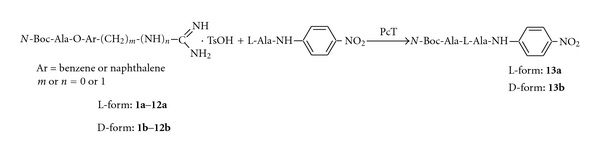
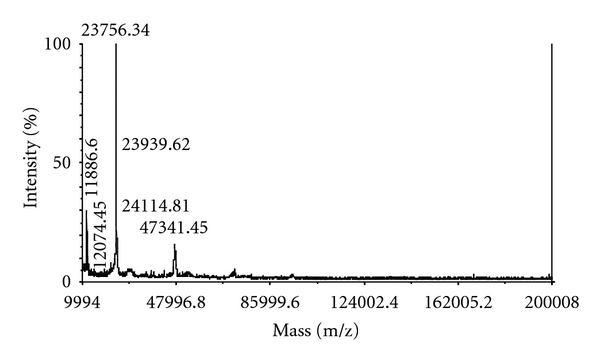
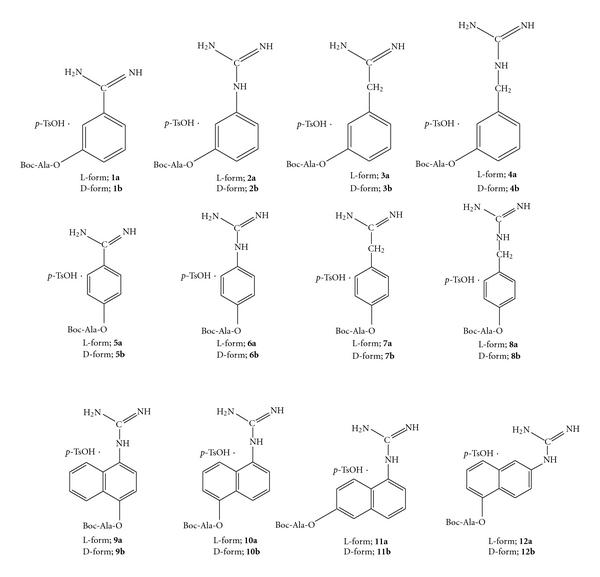
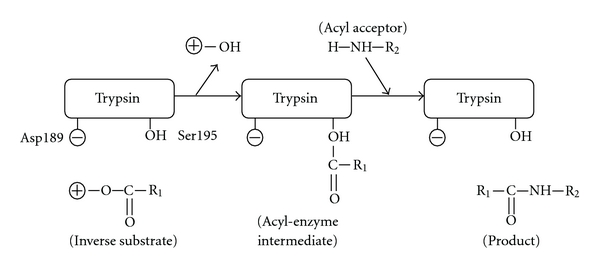
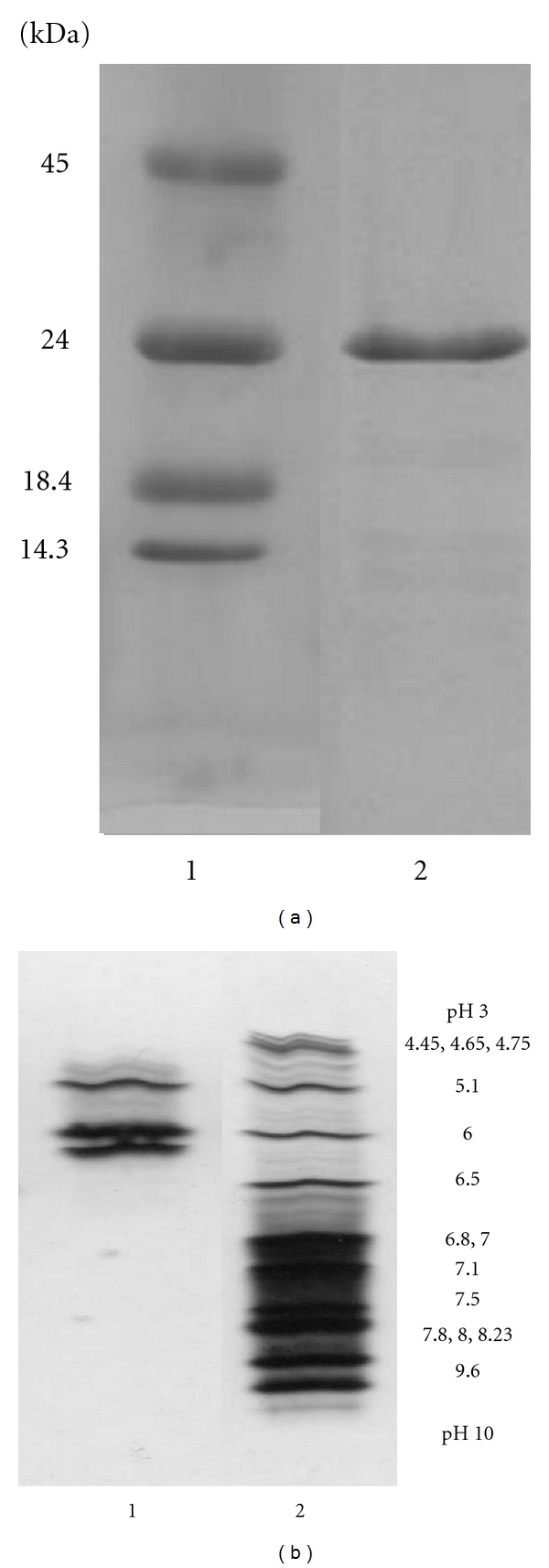
Trypsin from the pyloric caeca of Pacific cod (Gadus macrocephalus) was easily prepared by affinity chromatography on Benzamidine Sepharose 6B and gel filtration on Superdex 75. Pacific cod trypsin was composed of three isozymes, and their molecular masses were estimated 23,756.34 Da, 23,939.62 Da, and 24,114.81 Da by desorption/ionization time-of-flight mass spectroscopy (MALDI/TOF-MS) and their isoelectric points (pIs) were approximately 5.1, 6.0, and 6.2, respectively. The isolated Pacific cod trypsin showed high similarity to other frigid-zone fish trypsins. The kinetic behavior of tryptic hydrolysis toward N-p-tosyl-L-arginine methyl ester hydrochloride (TAME), N-benzoyl-L-arginine p-nitroanilide hydrochloride (BAPA), and p-amidinophenyl ester were also analyzed. In addition, the cod trypsin-catalyzed dipeptide synthesis was investigated using twelve series of "inverse subdtrates" that is p- and m-isomer of amidinophenyl, guanidinophenyl, (amidinomethyl)phenyl, (guanidinomethyl)phenyl, and four position isomers of guanidinonaphtyl esters derived from N-(tert-butoxycarbonyl)amino acid as acyl donor components. They were found to couple with an acyl acceptor such as L-alanine p-nitroanilide to produce dipeptide in the presence of the trypsin. All inverse substrates tested in this study undergo less enantioselective coupling reaction. The p-guanidinophenyl ester was most practical substrate in twelve series tested. The enzymatic hydrolysis of the resulting products was negligible.
通过在苯甲脒琼脂糖凝胶6B上进行亲和层析以及在Superdex 75上进行凝胶过滤,可轻松从太平洋真鳕(Gadus macrocephalus)幽门盲囊中制备胰蛋白酶。太平洋真鳕胰蛋白酶由三种同工酶组成,通过解吸/电离飞行时间质谱(MALDI/TOF-MS)估计它们的分子量分别为23,756.34 Da、23,939.62 Da和24,114.81 Da,其等电点(pI)分别约为5.1、6.0和6.2。分离出的太平洋真鳕胰蛋白酶与其他寒带鱼类胰蛋白酶具有高度相似性。还分析了胰蛋白酶对N-对甲苯磺酰-L-精氨酸甲酯盐酸盐(TAME)、N-苯甲酰-L-精氨酸对硝基苯胺盐酸盐(BAPA)和对脒基苯酯的水解动力学行为。此外,使用十二系列“反向底物”研究了鳕鱼胰蛋白酶催化的二肽合成,这些“反向底物”是作为酰基供体成分的脒基苯基、胍基苯基、(脒基甲基)苯基、(胍基甲基)苯基的对映异构体以及间位异构体,以及源自N-(叔丁氧羰基)氨基酸的胍基萘酯的四种位置异构体。发现它们在胰蛋白酶存在下能与酰基受体如L-丙氨酸对硝基苯胺偶联生成二肽。本研究中测试的所有反向底物的对映选择性偶联反应都较少。在所测试的十二系列中,对胍基苯酯是最实用的底物。所得产物的酶促水解可忽略不计。