Department of Orthodontics, Faculty of Medicine and Dentistry, University of Valencia, Valencia, Spain.
Med Oral Patol Oral Cir Bucal. 2012 Jul 1;17(4):e678-88. doi: 10.4317/medoral.17721.
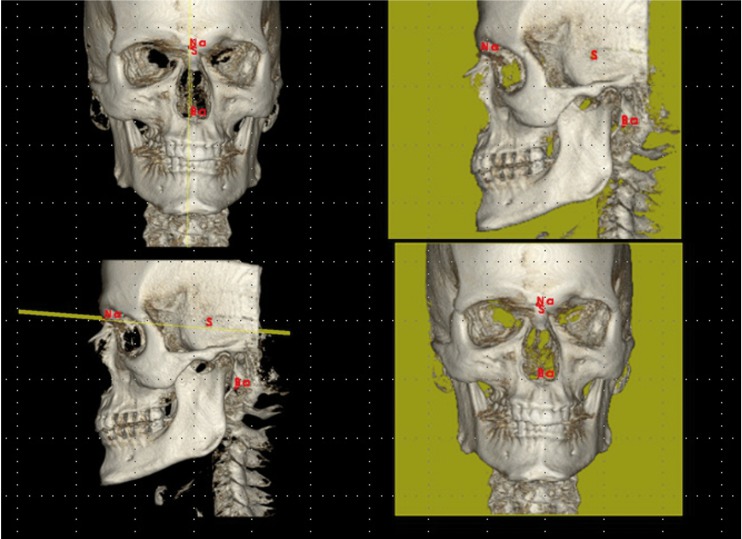
Cone Beam Computerized Tomography (CBCT) allows the possibility of modifying some of the diagnostic tools used in orthodontics, such as cephalometry. The first step must be to study the characteristics of these devices in terms of accuracy and reliability of the most commonly used landmarks. The aims were 1- To assess intra and inter-observer reliability in the location of anatomical landmarks belonging to hard tissues of the skull in images taken with a CBCT device, 2- To determine which of those landmarks are more vs. less reliable and 3- To introduce planes of reference so as to create cephalometric analyses appropriated to the 3D reality.
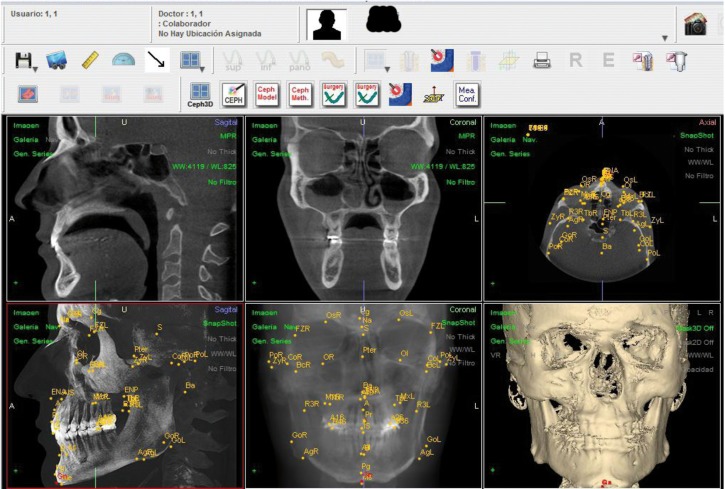
Fifteen patients who had a CBCT (i-CAT) as a diagnostic register were selected. To assess the reproducibility on landmark location and the differences in the measurements of two observers at different times, 41 landmarks were defined on the three spatial axes (X,Y,Z) and located. 3.690 measurements were taken and, as each determination has 3 coordinates, 11.070 data were processed with SPSS statistical package. To discover the reproducibility of the method on landmark location, an ANOVA was undertaken using two variation factors: time (t1, t2 and t3) and observer (Ob1 and Ob2) for each axis (X, Y and Z) and landmark. The order of the CBCT scans submitted to the observers (Ob1, Ob2) at t1, t2, and t3, were different and randomly allocated. Multiple comparisons were undertaken using the Bonferroni test. The intra- and inter-examiner ICC's were calculated.
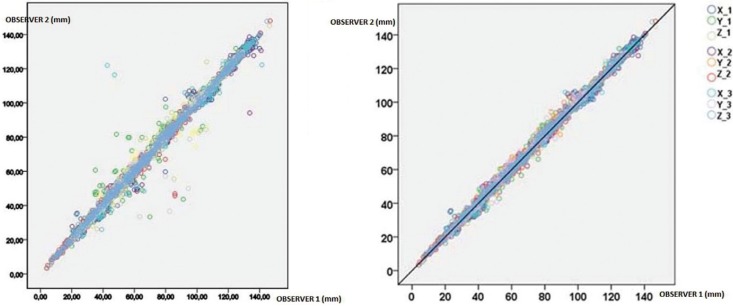
Intra- and interexaminer reliability was high, both being ICC ≥ 0.99, with the best frequency on axis Z.
The most reliable landmarks were: Nasion, Sella, Basion, left Porion, point A, anterior nasal spine, Pogonion, Gnathion, Menton, frontozygomatic sutures, first lower molars and upper and lower incisors. Those with less reliability were the supraorbitals, right zygion and posterior nasal spine.
锥形束计算机断层扫描(CBCT)使得修改一些在正畸学中使用的诊断工具成为可能,如头影测量。第一步必须研究这些设备在最常用的解剖标志的准确性和可靠性方面的特征。目的是:1. 评估在使用 CBCT 设备拍摄的图像中,属于颅骨硬组织的解剖标志的定位的观察者内和观察者间的可靠性,2. 确定哪些标志更可靠,哪些标志不太可靠,3. 引入参考平面,以便创建适用于 3D 现实的头影测量分析。
选择了 15 名患者,他们使用 CBCT(i-CAT)作为诊断记录。为了评估在定位地标位置方面的可重复性和两位观察者在不同时间的测量值之间的差异,在三个空间轴(X、Y、Z)上定义了 41 个地标并进行了定位。共进行了 3.690 次测量,由于每次测定有 3 个坐标,共处理了 11.070 个数据,使用 SPSS 统计软件包进行处理。为了发现地标定位方法的可重复性,采用方差分析方法,使用两个变化因素:时间(t1、t2 和 t3)和观察者(Ob1 和 Ob2),用于每个轴(X、Y 和 Z)和地标。观察者(Ob1、Ob2)在 t1、t2 和 t3 时提交给观察者的 CBCT 扫描的顺序不同,并且是随机分配的。使用 Bonferroni 检验进行多重比较。计算了观察者内和观察者间的 ICC。
观察者内和观察者间的可靠性都很高,ICC 均≥0.99,Z 轴上的频率最高。
最可靠的地标是:Nasion、Sella、Basion、左侧 Porion、点 A、前鼻棘、Pogonion、Gnathion、Menton、额颧缝、第一下磨牙以及上下切牙。可靠性较低的地标是眶上嵴、右侧颧突和后鼻棘。