School of Psychology, University of Birmingham, Edgbaston, Birmingham, UK.
Nat Neurosci. 2012 Feb 12;15(4):636-43. doi: 10.1038/nn.3046.
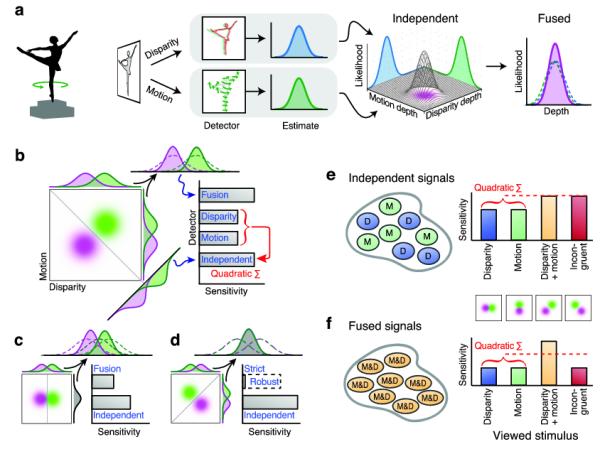
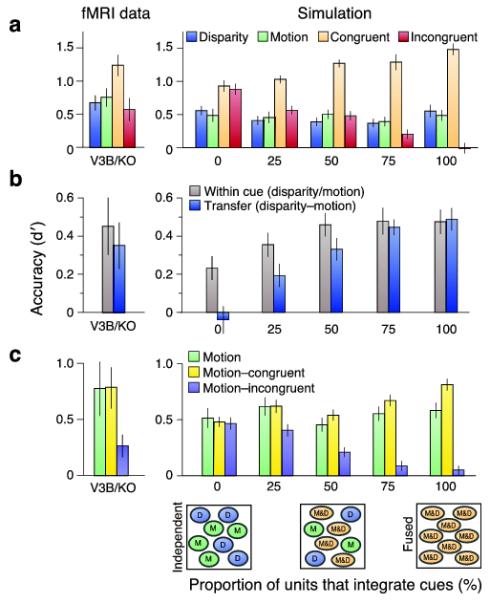
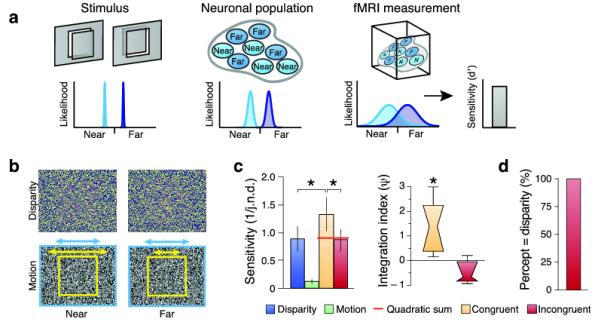
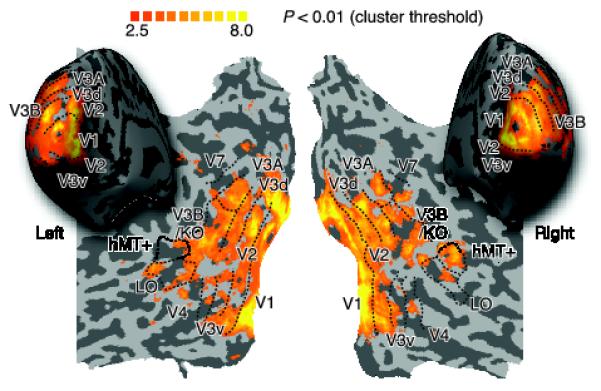
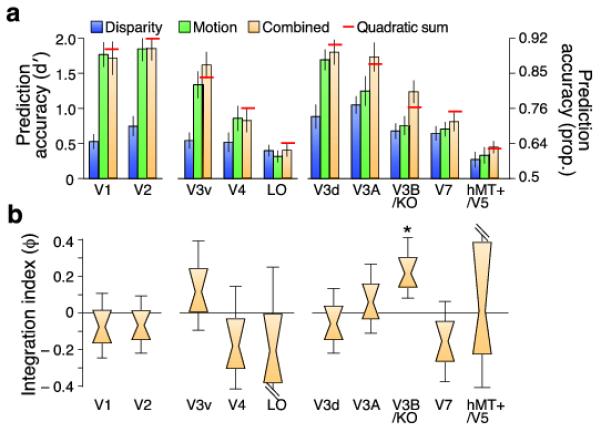
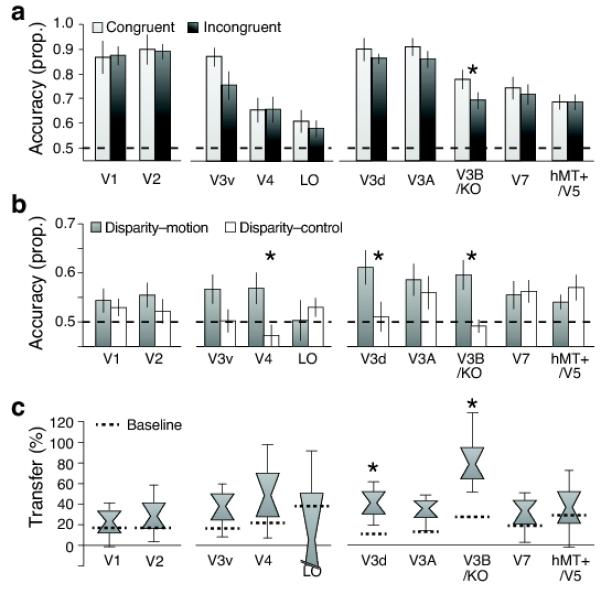
Humans exploit a range of visual depth cues to estimate three-dimensional structure. For example, the slant of a nearby tabletop can be judged by combining information from binocular disparity, texture and perspective. Behavioral tests show humans combine cues near-optimally, a feat that could depend on discriminating the outputs from cue-specific mechanisms or on fusing signals into a common representation. Although fusion is computationally attractive, it poses a substantial challenge, requiring the integration of quantitatively different signals. We used functional magnetic resonance imaging (fMRI) to provide evidence that dorsal visual area V3B/KO meets this challenge. Specifically, we found that fMRI responses are more discriminable when two cues (binocular disparity and relative motion) concurrently signal depth, and that information provided by one cue is diagnostic of depth indicated by the other. This suggests a cortical node important when perceiving depth, and highlights computations based on fusion in the dorsal stream.
人类利用一系列视觉深度线索来估计三维结构。例如,通过结合来自双目视差、纹理和透视的信息,可以判断附近桌面的倾斜度。行为测试表明,人类近乎最优地组合了线索,这一壮举可能取决于区分来自特定线索的机制的输出,或者将信号融合到一个共同的表示中。虽然融合在计算上很有吸引力,但它带来了巨大的挑战,需要定量不同的信号的整合。我们使用功能磁共振成像 (fMRI) 提供了证据,表明背侧视觉区域 V3B/KO 满足了这一挑战。具体来说,我们发现当两个线索(双目视差和相对运动)同时信号深度时,fMRI 反应更具可分辨性,并且一个线索提供的信息可以诊断另一个线索指示的深度。这表明在感知深度时存在一个重要的皮质节点,并强调了基于融合的计算在背侧流中的作用。