Department of Orthopaedic Surgery and Traumatology, Onze Lieve Vrouwe Gasthuis, Amsterdam, The Netherlands.
Clin Orthop Relat Res. 2012 Aug;470(8):2185-92. doi: 10.1007/s11999-012-2277-8. Epub 2012 Feb 11.
It has been suggested that limited active ROM of reverse shoulder prostheses relates to lack of strength. However, the postoperative strength has not been quantified.
QUESTIONS/PURPOSES: We therefore measured joint torques in patients with reverse shoulder prostheses and correlated torques with functional scores.
We recruited 33 patients (age, 72 ± 8 years) with a reverse prosthesis (37 shoulders, 21 primary and 16 revisions). We obtained Constant-Murley, DASH, and Simple Shoulder Test ([D]SST) scores, and performed two isokinetic protocols (abduction/adduction and external/internal rotation) at 60° per second. Minimum followup was 4 months (average, 23 months; range, 4-63 months).
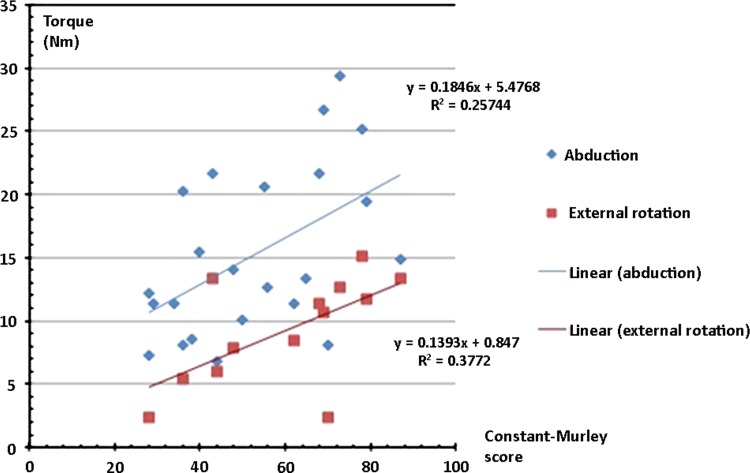
Twenty-three patients (24 shoulders; 13 primaries, 11 revisions) were able to perform at least one of the defined tasks. Mean abduction and adduction torques were 15 Nm ± 7 Nm and 16 Nm ± 10 Nm (19%-78% of normal shoulders). External and internal rotation tasks could be performed by only 13 patients (14 shoulders; nine primary, five revisions) generating 9 Nm ± 4 Nm and 8 Nm ± 3 Nm, respectively (13%-71% of normal shoulders). We found moderate correlations between Constant-Murley, DASH and (D)SST (D = Dutch translation) scores and abduction and external rotation.
Patients with a reverse prosthesis had reduced strength when compared with normal values reported in the literature (only 65% of patients could perform the protocol). This effect was greatest for external rotation and might explain clinical outcomes with which a moderately strong relationship was observed. Our observations suggest limited strength is a major factor in reduced ROM.
有研究表明,反式肩关节假体的活动度有限与力量不足有关。但是,术后的力量尚未量化。
问题/目的:因此,我们测量了反式肩关节假体患者的关节扭矩,并将扭矩与功能评分相关联。
我们招募了 33 名(年龄 72±8 岁)使用反式假体的患者(37 肩,21 例初次置换,16 例翻修)。我们获得了 Constant-Murley、DASH 和 Simple Shoulder Test([D]SST)评分,并进行了两个等速协议(外展/内收和外旋/内旋),速度为 60°/秒。最低随访时间为 4 个月(平均 23 个月;范围 4-63 个月)。
23 名患者(24 肩;13 例初次置换,11 例翻修)能够完成至少一项定义的任务。平均外展和内收扭矩为 15 Nm±7 Nm 和 16 Nm±10 Nm(正常肩的 19%-78%)。只有 13 名患者(14 肩;9 例初次置换,5 例翻修)能够完成外旋和内旋任务,产生 9 Nm±4 Nm 和 8 Nm±3 Nm,分别为正常肩的 13%-71%。我们发现 Constant-Murley、DASH 和(D)SST 评分与外展和外旋之间存在中度相关性。
与文献中报道的正常值相比,使用反式假体的患者力量较弱(只有 65%的患者能够完成方案)。外旋的影响最大,这可能解释了与临床结果观察到的中度强相关关系。我们的观察结果表明,力量有限是活动度减小的主要因素。